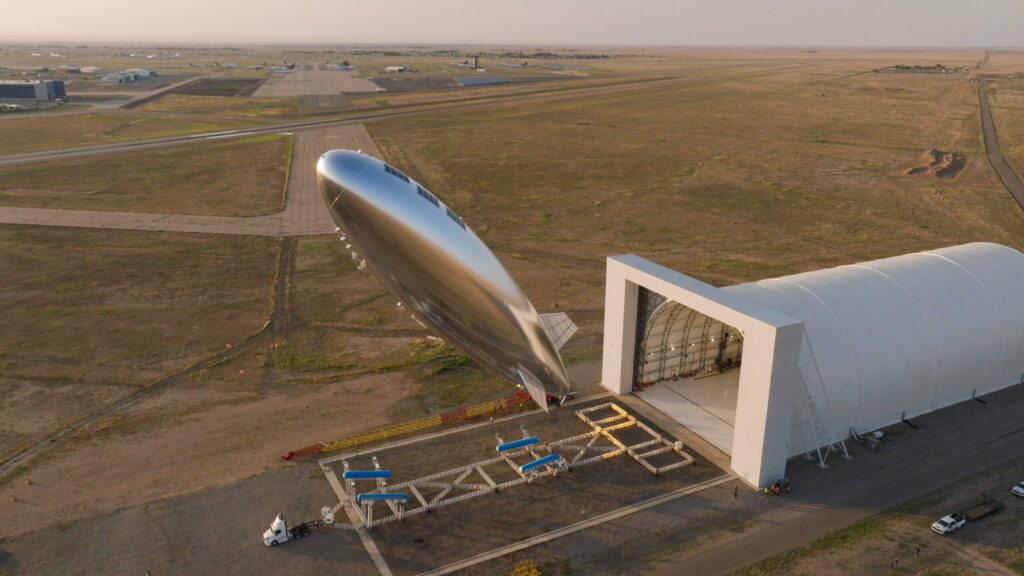
The capacity was first used during a previous 12-day flight from New Mexico to Brazil. But the month-long mission to Japan and back, called Service Test 1 (ST1), was the longest test and deployment flight yet for the Sceye platform.
“There were times when our actual plan trajectory and our flight path were interrupted by a change in weather,” Truong told Ars. “So what I would actually do is park somewhere safe and calm in the weather and just hold position for a while until I moved on.”
Sceye’s team monitors the performance of a high-altitude platform system (HAPS) during its round-trip flight from New Mexico to Japan.
Credit: Sceye
Sceye’s team monitors the performance of a high-altitude platform system (HAPS) during its round-trip flight from New Mexico to Japan.
Credit: Sceye
cell tower in the sky
Arriving at Shikoku, the smallest of Japan’s four main islands, allowed Sceye’s unmanned aircraft to show how it could provide mobile broadband service from an operating altitude of about 54,000 feet (16.5 kilometers) to smartphones, laptops and even drones. That demonstration was done in partnership with Japanese telecommunications company SoftBank Corp, which also invested directly in Sceye.
Sceye’s platform carried the equivalent of a 4G LTE base station for the demonstration, which simulated providing backup coverage in the event of an earthquake or similar large-scale disaster.
“It’s not the first time we’ve flown a telecommunications payload, but it’s the first time we’ve flown to an area where we provide a live service,” Truong said. “What SoftBank did was turn off the cellular coverage area, and then we went in and basically replenished it.”
The SoftBank team conducted tests that included voice calls, text messages, and Internet web browsing, as well as streaming YouTube videos and making video calls. They also verified that Sceye’s platform could support emergency alert messaging systems for earthquakes and tsunamis, as well as supporting calls to a maritime emergency number.
The Japanese company even equipped the drones with LTE cards to control them remotely using Sceye-compatible connectivity, in addition to receiving video feeds from the drones. SoftBank also conducted data performance tests in various environments, including an open beach, a tree-covered forest area, and an indoor test inside a building.