Ukraine’s unprecedented rescue of a wounded battlefield soldier with drones has demonstrated once again how battlefield necessity can spur innovation. The operation was revealed just days after separate Ukrainian drones designed for casualty evacuation were deployed for front-line testing, taking a step beyond the US military’s decades of experimentation with similar concepts.
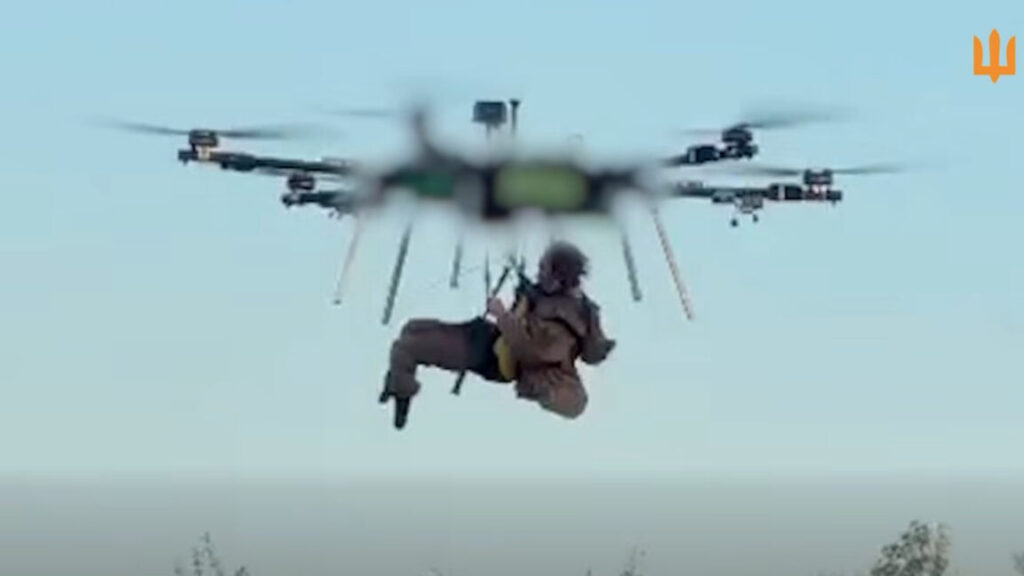
The drone evacuation of the wounded soldier took place at an undisclosed time and location on the front lines, where the presence of Russian drones and landmines made it impractical to send a wheeled ground robot, according to The Kyiv Independent. On October 19, the Ukrainian military shared video of the drone evacuation, showing the wounded soldier securing himself in a harness suspended beneath a heavy hexacopter drone with six rotors before being taken to safety.
“This is a historic event, the next stage of the evacuation of the wounded, which we will all reach,” Napalm, a programmer for the unmanned ground systems company of the 92nd independent assault brigade, said in a statement, using its callsign according to Ukrainian military practice. “Now serious and systematic work begins so that these types of missions are constantly carried out.”
Taking out the wounded
To carry out the improvised air evacuation, the 92nd brigade prepared and tested a heavy hexacopter drone, the Heavy Shot AYUDAG 6 model, provided free of charge by the Ukrainian manufacturer Gurzuf Defence. Special carabiners were first given to the wounded soldier so he could attach to the drone which was equipped with a winch, according to a Gurzuf Defense blog post.
The wounded soldier, who serves in Ukraine’s 30th Separate Mechanized Brigade, had already spent nearly 500 days in a frontline position under threat of Russian fire, according to Gurzuf Defense. Like many soldiers in front-line positions, he had relied on deliveries of ammunition and other supplies by friendly drones.
The drone evacuation flight lasted 1 hour and 14 minutes from start to finish and covered a distance of nearly 39 miles (62 kilometers). This particular hexacopter can reportedly carry up to 200 pounds (90 kilograms).