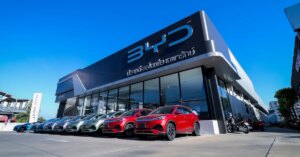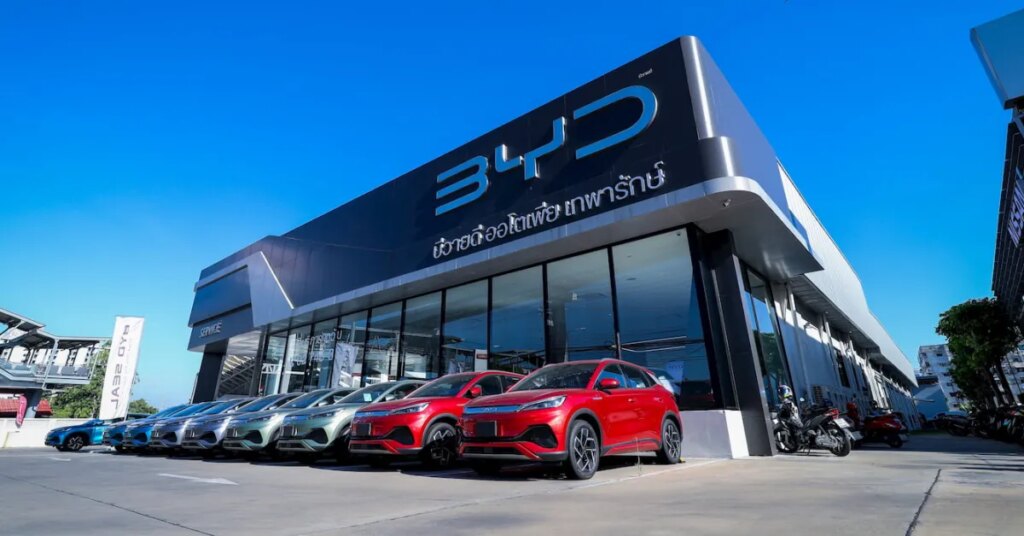
BYD dealership in Thailand (Source: BYD)
BYD now has more than 1.02 million employees, according to Chairman Wang Chuanfu. That’s more people than Toyota, GM, Ford and Tesla employ combined.
And it’s a big jump from the beginning of the year. BYD reported about 869,600 employees by the end of 2025, meaning the Chinese automaker has added about 150,000 people in 10 months as its vehicle sales decline.
About 960,000 BYD employees work in China and about 60,000 work abroad. As many as 120,000 of them are R&D engineers, according to Wang, who shared the figures on stage Wednesday at the 33rd annual conference of the Chinese Society of Automotive Engineers (CSAE). His work covers battery cells, motors, electronic controls and semiconductors.
Wang attributes that scale to vertical integration. By his account, keeping batteries, chips and motors in-house is what took BYD from a battery manufacturer founded in 1994 to the world’s best-selling new energy vehicle brand for several consecutive years. He called the company’s rise a microcosm of the Chinese auto industry going from follower to leader.
BYD’s roster continues to oscillate
BYD’s workforce has been all over the place in recent years.
The company had about 570,100 employees at the end of 2022 and 703,500 at the end of 2023. It then embarked on a hiring spree. In September 2024, we reported that BYD had surpassed 900,000 employees and had the largest R&D workforce of any automaker, with more than 110,000 engineers. It ended 2024 with 968,900 people.
Then came the first big cut. BYD’s 2025 annual report showed about 869,600 employees at the end of the year, a drop of about 99,000, mostly in front-line production jobs.
Now it has exceeded one million again. Data compiled by S&P Global Market Intelligence put BYD at 911,900 employees at the end of June, so the company added more than 100,000 people in about four months.
How BYD compares to other automakers
The gap with traditional car manufacturers is enormous. The Volkswagen Group, which has its Chinese joint ventures, reported 662,942 employees at the end of 2025. Toyota had 390,927 as of March 31, 2026 and Stellantis had 258,668 at the end of last year.
In the US, Ford closed 2025 with 169,000 employees and GM with 156,000. Tesla reported a global workforce of 134,785 in its latest 10-K.
Add Toyota, GM, Ford and Tesla and you get about 851,000 people. BYD has about 170,000 more than that.
But the template is not displayed. If you divide global vehicle sales in 2025 by the year-end workforce, BYD falls far behind:
BYD sold about 4.6 million vehicles last year with 869,600 employees, or 5.3 vehicles per worker. Tesla delivered 1,636,129 vehicles with 134,785 people, about 12 per worker, and the Volkswagen Group kept about 13.5. Toyota, with 11.3 million group sales including Daihatsu and Hino, sourced approximately 29 vehicles from each employee.
There is a problem, and it is a big one. BYD’s workforce is not just the workforce of a car company. It includes BYD Electronic, its majority-owned contract manufacturer that assembles devices for other brands and reported 165,000 of its own employees by the end of 2025. It also covers BYD’s battery business, which supplies other automakers, as well as its internal chips, motors, energy storage and rail transit operations.
In short, BYD’s vertical integration greatly drives its high workforce.
Hiring as sales slide
BYD sold 3,131,576 vehicles in the first nine months of 2026, down 3.9% year over year. September was its best month of the year with 463,561 units, but the company has been caught in a brutal price war at home and is losing ground to rivals such as Geely and Leapmotor. Its first-half revenue (344.8 billion yuan) and net profit (12.3 billion yuan) declined year-on-year.
All growth occurs abroad. BYD’s international sales reached 1,342,960 units through September, an increase of 92.7%, and now represent around 43% of its total volume. That’s on top of BYD once again beating Tesla in pure EV deliveries in the second quarter.
However, only 60,000 of its 1.02 million workers reside outside China. That’s about 6%. So BYD continues to build almost everything in-house and ship it, even as its factories in Thailand, Brazil and Hungary are up and running.
Electrek’s opinion
The 1.02 million figure is a great headline, but we wouldn’t read it as a sign of strength on its own.
BYD’s entire model is to make almost everything itself: cells, chips, motors, seats and much more. That’s one of the main reasons you can sell a Seagull for about $10,000 in China and still make money. But it is a labor-intensive model, and it works because labor in Chinese factories is relatively cheap and abundant. Toyota gets more than five times as many cars from each employee. Tesla gets more than double that.
The problem is that BYD’s growth is now outside of China, and that’s where this model is tested. Only 6% of its workforce is abroad, but 43% of its sales are. Tariffs in Europe, Brazil, Mexico and elsewhere are pushing BYD to build locally, but a factory in Hungary or Brazil won’t necessarily produce the same.
The figure that should concern traditional automakers is 120,000 engineers. That’s almost as many people as Tesla employs in total, all working on the product.
If you’re purchasing an electric vehicle, powering it with home solar can reduce your fuel costs to almost zero. With electricity rates increasing nearly 10% last year and expected to continue rising, solar energy is one of the best ways to protect yourself against rising costs. And with leasing and PPA options, you can do it with no upfront cost and start saving right away. If you want to find the best deal, check out EnergySage. It’s a free service with hundreds of pre-vetted installers competing for your business, so you save 20-30% compared to going it alone. No sales calls until you choose an installer. Get your free quotes here.
FTC: We use automatic affiliate links that generate income. Further.