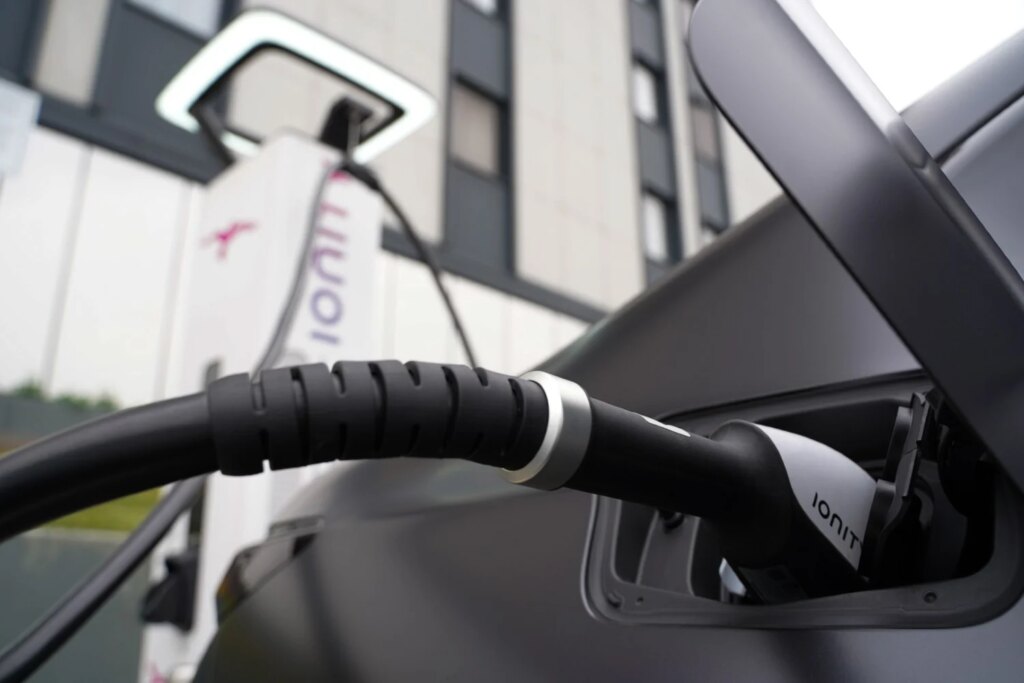
Less than a year ago, Ionity opened a new charging park in Elverum, where electric vehicles could charge up to 500 kW. The hardware for this site was supplied by Ekoenergetyka. It was the first location on Ionity’s European network to feature the Polish manufacturer’s energy-sharing technology, or so it seemed.
Due to repeated failures, Ionity stopped the pilot, removed the hardware, and replaced it with Huawei charging stations. A company spokesperson confirmed this to electrive. The issue was first reported by charging infrastructure expert Syed Haseeb Hassan in his own analysis.
Ionity’s decision to switch to Huawei on-site charging hardware is not entirely unexpected. At Power2Drive in Munich this summer, both companies publicly announced their collaboration. At Elverum, this partnership is now coming to fruition after the failed trial with Ekoenergetyka’s new technology.
On site there are now three charging stations with six charging points, combined with an adjacent power unit. According to the Ionity website, available charging power includes 4 times up to 600 kW and 2 times up to 500 kW. In addition, an Alpitronic charging station with two 400 kW charging points continues to exist on site under the Ionity brand.
However, this fact does not automatically call into question the collaboration with Ekoenergetyka. Ionity has been working with the Polish company since summer 2023. To date, Ionity has consistently ordered all-in-one charging stations with a power of up to 350 kW from Ekoenergetyka. The first installations have been carried out in recent years, mainly in Croatia, Slovenia and Finland. According to a 2025 LinkedIn post by Ekoenergetyka, the charging park at Elverum was explicitly designed as a test for the new charging solution. In this configuration, two DLBS power cabinets dynamically distribute a total power of 800 kW in 66.7 kW increments to six fast charging points.
Meanwhile, detailed information about the Huawei system remains unavailable. However, it is said to be a decentralized charging solution that features three slim satellite units and one power unit. What is clear is that Ionity is not alone on site: there are also 28 Tesla Superchargers, eight Kople charging points with up to 180 kW and four 200 kW charging points from Recharge. The highest power class, however, is offered by Ionity, and now, presumably, reliably.
etechvolution.com, youtube.com