Support CleanTechnica’s work through a Substack subscription, on Patreon, or on Stripe. Help us produce all the original, high-quality content we publish week after week despite the challenges of AI deleting content, anti-social media, inflation and other obstacles.
…with a spotlight on rising star Great Wall Motor ORA 5.
Technical Cleaning Readers probably expected the increase to continue rising in Australia. Was. However, it appears to have remained stable. It was not the flash that motor lovers expected, at least. In September 2026, 108,778 passenger vehicles were sold, including all transmissions. See the graphics here.
Battery electric vehicles (BEV) reached a market share of 24.2% (26,287 units), outselling gasoline and diesel vehicles. Add 10,072 hybrid plug-in (PHEV) sales and you get a plug-in penetration rate of about 34%. PHEV sales are the fastest growing segment in Australia, increasing 122% year on year. For those who care, 17,843 HEV vehicles were sold in October (a 20% year-over-year increase). I am looking forward to peak HEVs, followed by peak PHEVs, as we have seen in the more mature Scandinavian markets.
Australia’s electric vehicle penetration rate (including BEVs and PHEVs) has remained between 30% and 30% over recent months. I’m not sure what the future holds, but even maintaining this pace for a few months will make a difference.
Nothing beats the lived experience. My neighbors now ask how much it costs to refuel. One came in yesterday for a coffee and stayed for a spin in our new Model Y. He was very impressed with the technology, the finish and, above all, the running costs. He confided in me that he had just filled up his wife’s Honda Civic ($A82) and her Isuzu D Max ($A121).
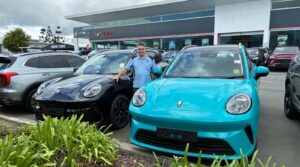
On a recent shopping trip, we counted 10 electric cars in the parking lot, out of 50 vehicles. Not only Tesla and BYD, but also Zeekr, Geely, GWM ORA 5 and Deepal. Battery electric vehicles are making their presence felt. But not all my friends can see them. They can detect Tesla and BYD vehicles, but they tell me they don’t see any other electric vehicles on the road. Yes, we have tried to educate them, but it is still not working. “See if it has an exhaust pipe. Does it have a sealed front?”
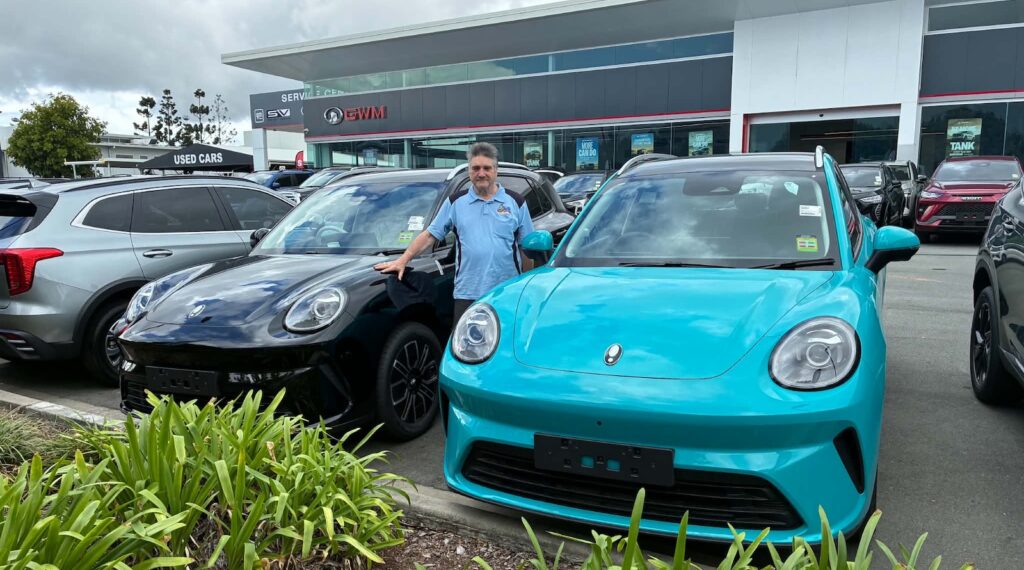
One car I’m seeing in increasing numbers is the refreshed Great Wall Motors ORA, now with an SUV body and a much cheaper price. When it launched in 2023, I expected great things (see our review here). Unfortunately, the Funky Cat (as it is known in China) did not live up to expectations. It was Australia’s cheapest EV at the time (AU$46,000), but it couldn’t compete with the BYD Dolphin and MG 4. Now, re-launched as an SUV and more appropriately priced (AU$34,000 – scratch that, I just got an email dropping another grand off the price), I see them everywhere – 6 on the road just yesterday.
Let’s move on to the best-selling BEVs on the Australian market in October 2026:
- Tesla Model Y: 3,105 units sold in the month; so far this year, 39,105
- Sea lion WORLD 7 – 2,524 – 22,488
- Geely EX5 – 1,789 – 14,534
- Jaecoo J5 — 1,714 — 12,378
- Zeekr 7X — 1,441 — 12,241
- Geely EX2 – 1,350 – 4,314
- Tesla Model 3 – 945 – 6,720
- MG4 Urban — 894 — 3,824
- WORLD Atto 2 – 747 – 9,420
- WORLD Atto 3 – 709 – 5,070
Practically the same as last month. Evidently, BYD was the best-selling brand, closely followed by Tesla. BYD has six cars in the top twenty BEVs. There are no cars from Korean, Japanese or European manufacturers in the top ten BEV numbers. When all powertrains are considered, BYD is the second best-selling brand behind Toyota in the Australian market. It seems like there is talk in the auto news about Tesla and BYD being considered “legacy” brands – who would have thought?
Expect big things from Geely as it aggressively expands across Australia. Geely recently announced that it opened 100 dealerships in the last 18 months. Its EX5 sales figures are putting pressure on competition in the Mazda CX-5, Hyundai Tucson, Mitsubishi Outlander and Nissan X-Trail midsize SUV segment.
Utes still dominate the Australian market. When an attractive BEV offer becomes available, the top ten may change again. I was excited to see the KGM Musso BEV ute, but it failed to gain traction. Only 269 have been sold in recent months. The Toyota BEV Hilux only has 14 units in the country; They will probably be protesters. PHEV vehicles seem to be doing much better, led by BYD Shark. More than 15,000 have been sold so far this year.
Now for some news: dealers of established brands are calling for a temporary ban on new car brands (read Chinese-made cars) from entering Australia as they cannot compete. The head of the Australian Automobile Dealers Association says the industry has reached crisis point, with the latest quarter recording its first loss since the global financial crisis. Chinese brands now own 36% of new car sales.
“This is a clear warning that the business environments that support our industry are becoming unsustainable,” Voortman said. He speculates on the potential risks to consumers: “…the influx of new brands also puts consumers at risk as it can lead to rapid depreciation of vehicles, a delay in the supply of spare parts, longer repair times and orphaned vehicles if those companies decide to leave the country.”
However, what we are seeing in Australia is that legacy brands, mainly European, are the ones leaving the country.
FUD continues as misconceptions and outdated information are presented as facts. If you want to review these arguments, see this. Trigger warning: Some of you may want to scream at the screen. The author gets tangled up trying to argue that the wrong Australians are buying electric vehicles. I’d say the right people are buying EVs: those commuting from the outer suburbs of our expanding cities. The data shows that it is these people who are behind the boom in electric vehicle sales we are currently experiencing, and they are the ones who benefit the most from not paying the inflated gasoline costs caused by Iran’s unwillingness to admit defeat and grovel at the feet of the orange country. Please excuse my sarcasm. All of this is documented in the Electric Vehicle Council’s 10th annual report. We reviewed this report here.
Despite the desperate attempt to promulgate fear of “these new gadgets” (creating doubt and uncertainty), each month shows how smart the average consumer is in their pursuit of a better, electrified, brighter future.
Sign up for CleanTechnica’s Weekly Substack to get in-depth analysis and high-level recaps from Zach and Scott, subscribe to our daily newsletter, and follow us on Google News.
Do you have any tips for CleanTechnica? Do you want to advertise? Want to suggest a guest for our CleanTech Talk podcast? Contact us here.
Subscribe to our daily newsletter to receive 10-15 new cleantech stories per day. Or sign up to receive our weekly newsletter on the week’s top stories if the daily grind gets too much.
CleanTechnica uses affiliate links. See our policy here.
CleanTechnica Comment Policy