It’s November. Here in northern Europe, the weather is turning cold and, for many in the northern hemisphere, thoughts are already turning to next summer’s holiday, perhaps somewhere in the south, such as the south of France or Spain. Or maybe a road trip across Europe. And for those planning such a trip in an electric car, in addition to hotel costs, tolls and the question of how many pairs of shoes can realistically fit in the suitcase, there is usually one more factor to consider: charging time. Now BMW has made this calculation considerably easier.
For the 5,886.7 kilometer journey from the North Cape at the top of Norway to Tarifa in Spain, the charging time of the new i3 50 xDrive was just 2 hours, 45 minutes and 54 seconds. The so-called “Pan-European” route took BMW through eight countries. The focus was not on achieving the shortest driving time, but explicitly on minimizing loading time at predefined checkpoints. The team was free to choose which publicly accessible fast charging stations to use and could adapt the route to the most powerful charging infrastructure, as well as weather and traffic conditions.
BMW claims that the average charging power over the entire trip was 275 kW. With this, the i3 surpasses the previous pan-European record from 2017 by more than seven hours.
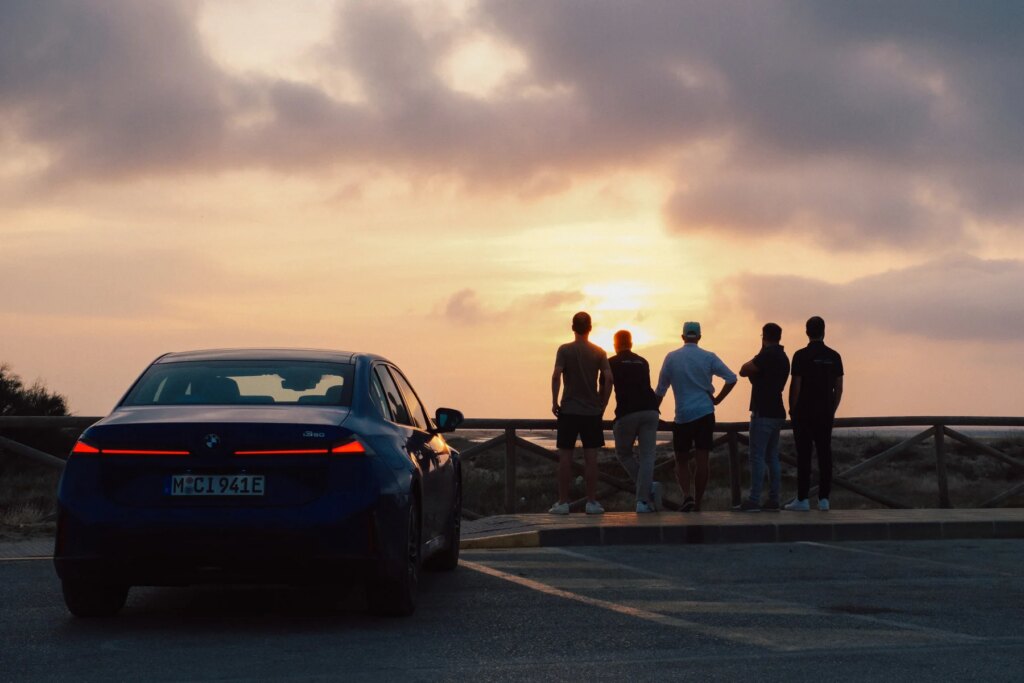
The BMW i3 on its pan-European journey of almost 5,900 kilometres.
The total driving time amounted to 3 days, 2 hours and 41 minutes. During this time, the i3 reached an average speed of 79.7 km/h and, according to BMW, consumed an average of 12.5 kWh/100 km. This figure is even lower than the official combined WLTP consumption of the i3 50 xDrive, which ranges between 13.4 and 18 kWh/100 km. Charging along the road was carried out exclusively at publicly accessible charging points.
BMW equips the i3 with a charging power of up to 400 kW
The technical basis for the short charging time is the sixth generation of the BMW eDrive system. The new i3 features an 800-volt architecture and cylindrical cells, achieving a maximum DC charging power of 400 kW. Under optimal conditions, up to 423 kilometers of WLTP range can be recharged in just ten minutes.
The i3 50 xDrive used for the record drive is equipped with an electric motor on both the front and rear axles. Together, the two engines deliver 345 kW (469 HP) and 645 Nm of torque. This all-electric vehicle with all-wheel drive accelerates from 0 to 100 km/h in 4.7 seconds and reaches a top speed of 200 km/h.
The useful capacity of the high-voltage battery is 108.7 kWh. BMW specifies a WLTP range of up to 912 kilometers for the i3 50 xDrive. The vehicle uses the NMC variant of the new Gen6 battery. However, BMW has no intention of offering the Neue Klasse exclusively with this cellular chemistry in the future. As recently confirmed by BMW CEO Milan Nedeljković, LFP batteries will also be used in selected models. An early example is the iX3 30L developed for China, while variants positioned higher up will continue to use NMC cells. BMW does not plan to make a wholesale change to the LFP.
Efficiency is also enhanced by a resistance coefficient (cd) of only 0.21 and tires with low rolling resistance. According to BMW, energy losses from the Gen6 electric motors have been reduced by 40 percent compared to the previous generation. The volumetric energy density of the cylindrical cells has increased by 20 percent compared to Gen5’s prismatic cells.
Regenerative braking also plays a role. BMW claims that more than 95 percent of all braking operations are controlled by the central computer, “Heart of Joy,” via electric motors, allowing a large portion of the kinetic energy to be returned to the battery.
BMW also highlights that the vehicles used for the Pan-European challenge were fully representative of the series production standard, both in hardware and software. In addition to the record-breaking vehicle, another i3 and an iX3 50 xDrive accompanied the journey as support vehicles. The new electric 3 Series is produced at the BMW plant in Munich.
Of course, a record-breaking trip optimized for minimal loading time is different from a family vacation in August. There are traffic jams, road construction, hungry passengers and people who only five minutes after the last charging stop realize that they need to go to the bathroom after all. But if the car requires less than three hours of charging for almost 6,000 kilometers, at least one of the classic problems of electric cars seems to be gradually reducing. Now BMW just needs to find a solution to the analogue challenges of a European road trip: roadworks, for example.
bmwgroup.com