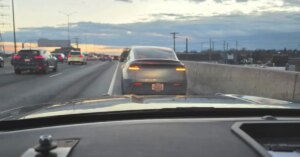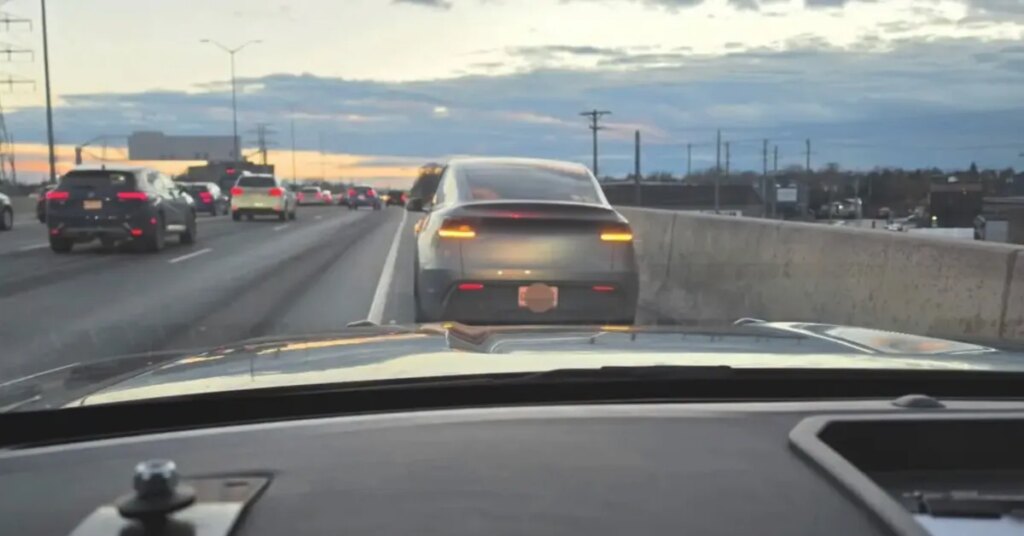
A Tesla driver caught asleep at the wheel on Ottawa’s Highway 417 during Tuesday’s rush hour now faces a reckless driving charge by Ontario Provincial Police. The photo shared by OPP shows a new generation Model Y in traffic.
The charge carries a fine of $490 and six demerit points upon conviction. It’s at least the fifth time this year that Canadian police have made public that a Tesla driver is asleep, and it’s no coincidence that this is happening as “fully autonomous driving” improves.
What happened in 417?
The OPP Eastern Region posted about the stop Wednesday morning. Police did not name the brand or the driver assistance system, but the message was clear: “even if your vehicle has a self-driving function, drivers should take due care and attention when behind the wheel.”
According to OPP, the officer could see that the driver’s eyes were closed and his hands were off the wheel. Instead of shining a light on the patrol car, police moved in to capture body camera footage first.
Reckless driving is not a parking ticket in Ontario. The $490 is the set fine, but if the case goes to court, the Highway Traffic Law allows fines of up to $2,000, up to six months in jail and a license suspension of up to two years.
Good.
Canada keeps catching them
Ottawa is the latest case, but British Columbia has been dealing with this all year:
- March 17: British Columbia Highway Patrol fines a 37-year-old woman on the Trans-Canada Highway during the morning rush hour: $368 for driving without due care and attention, plus $138 for speeding. She said she had “disconnected.” Police said video inside the car showed she was “literally asleep at the wheel.”
- July: A witness filmed a Tesla driver asleep behind large sunglasses on the mountainous stretch between Golden and Revelstoke, with two children behind him. We break down how Tesla’s driver monitoring missed the point. Revelstoke RCMP followed up with the owner.
- August 11: BC Highway Patrol tickets a 45-year-old woman allegedly asleep in a Model Y on Highway 1 in North Vancouver ($368).
- Aug. 27: Another driver allegedly asleep in a Tesla on Highway 1 in Langley received the same $368 fine, plus $81 for failure to present a license.
This is not new in Canada either. In 2020, the Alberta RCMP went further and criminally charged a Tesla driver who was caught sleeping on Autopilot at 150 km/h with dangerous driving.
The United States has the same problem with less law enforcement. In September, the Colorado State Patrol received a report of a Tesla driver asleep on I-70 near Georgetown and never found the car. The same month, Rep. Raja Krishnamoorthi put pressure on the DOT after NBC News found 43 videos of drivers apparently asleep in moving Teslas, 17 of them released in 2026 alone.
And in October, a driver told CHP he was asleep in FSD when his Tesla entered a closed accident scene and crashed into a patrol car in Fairfield, California. Two officers were seriously injured.
Better FSD, sleepier drivers
A few years ago, FSD needed an intervention every few kilometers, so no one was taking a nap. You couldn’t.
Now the FSD can manage long stretches of highway without the need for acquisition, and it is precisely then that supervision fails. A human who is asked to observe a system that works correctly 99% of the time stops looking. That’s complacency in automation, and it’s one of the most studied problems in aviation and driving research.
Waymo learned this the hard way. In 2013, Google allowed its employees to use its driver assistance prototype on the road and discovered people falling asleep at high speed. He decided that a system that works most of the time but still needs a human to detect its errors was the worst of both worlds, and went straight to the driverless system.
Tesla took the other path. It sells a Level 2 system called “Fully Autonomous Driving” that is good enough to lull people to sleep and places all the responsibility on the now-asleep human.
Tesla’s driver tracking is too easy to beat
Since FSD v12.4, Tesla has primarily relied on the cockpit camera located above the rearview mirror to make sure the driver is looking at the road. But look at what Tesla’s own owner’s manual says about it: the camera “does not require full visibility of the driver’s eyes to monitor attention” and the system “remains active, for example, if the driver is wearing sunglasses.”
In other words, it’s often about judging the position of the head, not whether the eyes are open. When you can’t see your hands, it again asks for a little torque on the steering wheel, which a sleepy driver resting his hand on the rim can provide.
The penalties are also mild. Five “strikes” suspend the FSD for a week, and each strike is forgiven after three and a half days.
And Tesla has been moving in the wrong direction. Musk said in December 2025 that FSD v14.2.1 allows drivers to send text messages “depending on the context of surrounding traffic.” In May 2026, he said that version 14.3.3 “is also less annoying.” When the car detects drowsiness, the Tesla alert says “Drowsiness detected. Stay focused with FSD.” That pushes the tired driver to lean more into the system instead of stopping.
Compare that to GM’s Super Cruise, which uses a steering column camera with infrared LEDs to track head and eye position, and only works hands-free on pre-mapped highways.
The Ottawa driver had his eyes closed and hands off the wheel in rush-hour traffic, and the car was still moving when an officer pulled up next to him. Whatever the Tesla camera was checking a foot away, it hadn’t stopped the car before a cop in the next lane did.
Electrek’s opinion
We are glad that the Canadian police are treating this seriously. A $490 fine and six points is a true deterrent, and the OPP’s message is correct: It doesn’t matter what Tesla calls it, you are the driver.
But the police can’t fine their way out of this. These drivers are no longer edge cases. They are the predictable result of a system that works well enough to make people relax, sold under a name that tells them that relaxing is okay.
The solution is on Tesla’s side and is not complicated. It detects closed eyes, even behind sunglasses, which is what infrared eye tracking is designed for. When a driver is unresponsive, slow down and stop immediately rather than increasing warnings for minutes. Stop telling drowsy drivers to “stay focused with FSD.” And making the strike system really hurt.
NHTSA has already forced a recall of more than 2 million Teslas in December 2023 due to weak Autopilot monitoring. Three years later, people are still sleeping during peak hours in FSD.
If you drive an electric vehicle, charging it with home solar can reduce your fuel costs to almost zero. With electricity rates increasing nearly 10% last year and expected to continue rising, solar energy is one of the best ways to protect yourself against rising costs. And with leasing and PPA options, you can do it with no upfront cost and start saving right away. If you want to find the best deal, check out EnergySage. It’s a free service with hundreds of pre-vetted installers competing for your business, so you save 20-30% compared to going it alone. No sales calls until you choose an installer. Get your free quotes here.
FTC: We use automatic affiliate links that generate income. Further.