That does not mean that there is No electorate for the base model MacBook Pro, which is still the cheapest way to get a 120Hz ProMotion display or the anti-glare nanotexture screen finish of one of Apple’s laptops. I just wish paying this amount of money was enough to get the best technology from Apple.
look and feel
There’s no shiny Apple logo here.
Andrew Cunningham
There’s no shiny Apple logo here.
Andrew Cunningham
The keyboard and trackpad are still excellent.
Andrew Cunningham
The keyboard and trackpad are still excellent.
Andrew Cunningham
There’s no shiny Apple logo here.
Andrew Cunningham
The keyboard and trackpad are still excellent.
Andrew Cunningham
The ports are another selling point. On the right side there is an SD card reader, a Thunderbolt 4 port, and an HDMI port.
Andrew Cunningham
The ports are another selling point. On the right side there is an SD card reader, a Thunderbolt 4 port, and an HDMI port.
Andrew Cunningham
On the left you have MagSafe, two more Thunderbolt ports, and a headphone jack.
Andrew Cunningham
On the left you have MagSafe, two more Thunderbolt ports, and a headphone jack.
Andrew Cunningham
The ports are another selling point. On the right side there is an SD card reader, a Thunderbolt 4 port, and an HDMI port.
Andrew Cunningham
On the left you have MagSafe, two more Thunderbolt ports, and a headphone jack.
Andrew Cunningham
There’s nothing new here compared to the MacBook Pro M5, but in case it’s been a few years, let’s go over the basics and go over what makes this laptop different from the MacBook Air.
Although it’s a few years old now, this version of the MacBook Pro design still looks and feels good, particularly with a nano-texture display installed. The laptop looks and feels (and is) thicker and heavier than the 13- or 15-inch MacBook Air, but it also comes with more ports. In addition to the MagSafe port, a pair of Thunderbolt 4 ports, and a headphone jack on the left side of the laptop, you also get a dedicated HDMI port, another Thunderbolt 4 port, and an SD card reader on the right side.
For those using USB-C chargers, it’s nice to be able to plug in the laptop to charge it from anywhere. For everyone else, it’s nice to have more ports and need fewer dongles.
The MacBook Pro’s keyboard and trackpad are generally pretty comparable to the Air’s, although if pressed, I’d say the Pro feels a little crisper and firmer when typing.
| 13-inch MBA M5 | 14 inch MBP M6 | 15 inch MBA M5 | 14-inch OLED MBP | |
|---|---|---|---|---|
| Screen size/technology | 13.6 inch LED | 14.2 inch Mini LED | 15.3 inch LED | 14.2-inch OLED touchscreen |
| Screen brightness | 500 nits | 1,000 nits (SDR), 1,600 nits (HDR) | 500 nits | 1000 nits (SDR), 2000 nits (HDR) |
| Resolution | 2560×1664, 60Hz | 3024×1964, 120Hz | 2880×1864, 60Hz | 3024×1968, 120Hz |
| Weight | 2.7 pounds | 3.4 pounds | 3.3 pounds | 3.0 pounds |
| Starting price | $1,299 | $1,999 | $1,499 | $2,899 |
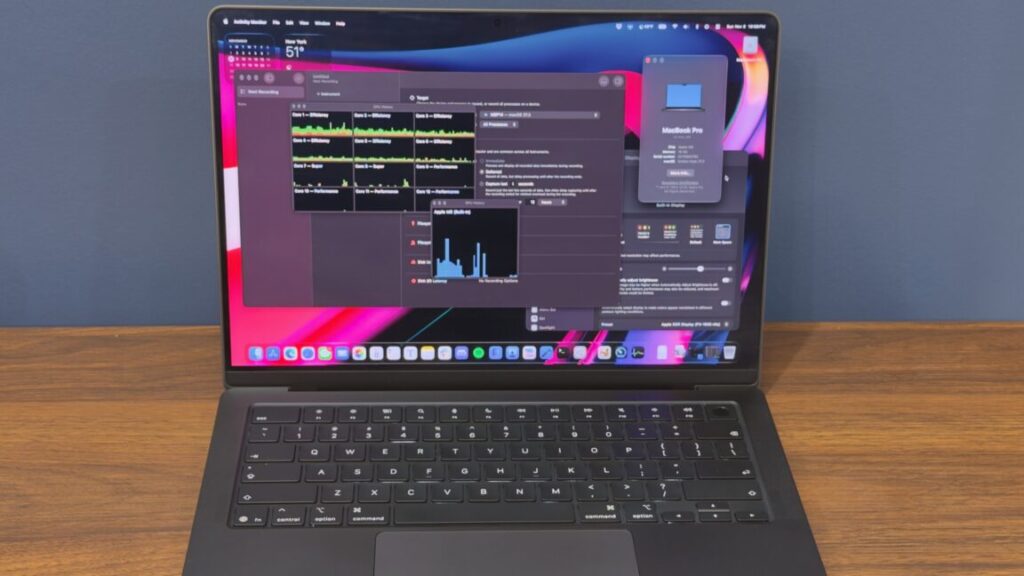
At 14.2 inches, the MacBook Pro’s display falls between the 13.6-inch and 15.3-inch MacBook Air, though in practice it feels closer to the 13. And while it’s not OLED, it still comes with some notable improvements over the older 60Hz IPS displays on the Air laptops. These include a mini LED display panel with local dimming support that helps improve contrast and reduce black levels, a higher resolution than any of the MacBook Air displays, a maximum SDR brightness of 1000 nits and HDR brightness of up to 1600 nits, the $150 nano-texture matte screen upgrade, and of course, the 120Hz ProMotion refresh rate.