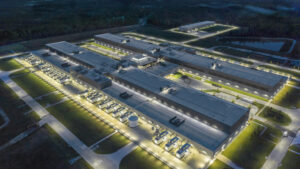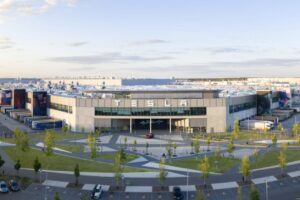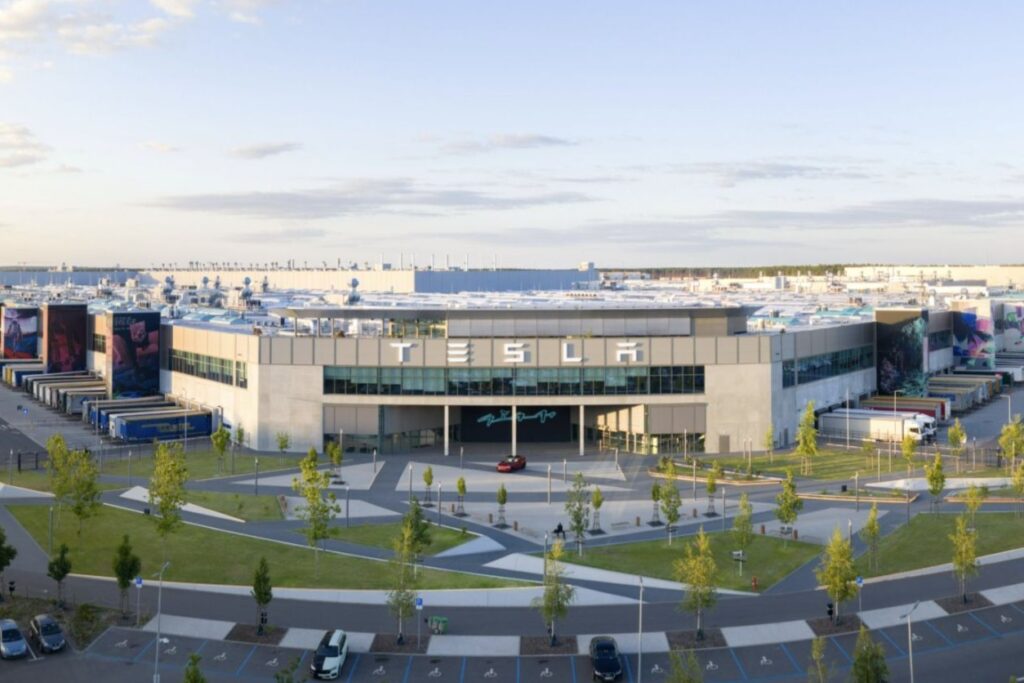
Tesla plans to invest three billion euros in the expansion of its Gigafactory in Grünheide. The American electric vehicle manufacturer plans to build a new production building and several auxiliary buildings at its facilities. An additional wastewater treatment plant is also planned. “This will lay the foundation for the most technologically advanced Tesla factory in the world,” explains André Thierig, plant manager of the Gigafactory in Grünheide.
Up to one million Cybercabs will be manufactured per year in the new production hall. The Cybercab is an autonomous robotaxi without a steering wheel or pedals, designed to transport passengers without a driver. In the US, some private customers can also book the robotaxi in advance.
Cybercab will roll off the assembly line in 2029
Tesla has already established a schedule to implement the expansion in Brandenburg. At the end of this year, the company intends to submit the official permit application for the new building to the authorities. This application is based on a previous full submission from 2023. Construction work is planned to begin in the first half of 2027, with production of the first robotaxis beginning in 2029.
The Brandenburg state government reacted very positively to these plans. Dietmar Woidke, Minister President of Brandenburg and member of the SPD, comments: “The investment of three billion euros and the prospect of producing up to one million Cybercabs in Grünheide in the future are a decision of enormous economic importance.”
After a global sales crisis in 2024 and 2025, which forced Grünheide’s expansion plans to be temporarily suspended, the plant, operational since March 2022, is now experiencing a notable recovery. Its production capacity of around 375,000 electric vehicles per year had not been fully utilized until recently. Last year, approximately 200,000 Model Y units left the factory. Weekly production is currently around 7,000 vehicles, approaching the current technical limit of 7,500. Domestic battery cell production is also expected to reach full capacity by mid-2027.
The workforce, which had been reduced to 11,000 employees and has now grown again to 12,600, reflects this evolution. Thierig has also requested applications on LinkedIn, especially “in the construction and production planning sectors” in Grünheide. Battery production still requires 1,500 additional workers, plus several hundred specialists to prepare and build the new robotaxi hall. However, long-term staffing needs for the new production facilities have not yet been quantified.
The site expansion will be carried out in three phases
Tesla’s expansion plans are fundamentally divided into three phases, each of which requires partial approval. The first partial approval was already granted in October 2024 by the Brandenburg State Environment Office. Tesla submitted the corresponding application in March 2023 as reported here. According to a previous report by the Märkische Oderzeitung newspaper, the expansion covers 70 hectares in the northern part of the site. Although land clearing was still included in the current development plan, Tesla had to re-apply for expansion work at its own factory facilities.
While the first phase focused on modernizing the existing hall and creating additional storage and logistics areas at the Tesla site, the upcoming second phase focuses on the construction of a second production hall. The third partial approval will subsequently cover, among other things, the equipment of the factory and the construction of a freight railway station on the factory site. RBB noted in a previous article that although “all three phases were requested in partial approvals in 2023, additional documents must still be submitted for phases two and three.”
RBB highlights an important detail of future planning: the design of an additional water circuit, including wastewater treatment. Water consumption has been a sensitive issue in Grünheide from the beginning. RBB states: “The new hall and the additional employees would consume more water in total than before; however, due to the internal treatment, no additional sanitary wastewater would be generated. Therefore, the quantities of fresh and wastewater contractually agreed with the Wasserverband Strausberg-Erkner (WSE) should also be sufficient for further expansion. The expansion of wastewater treatment would be an internal effort by Tesla at the factory premises.”
spiegel.de, rbb24.de, faz.net, linkedin.com (all in German)