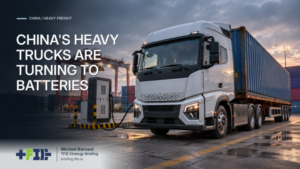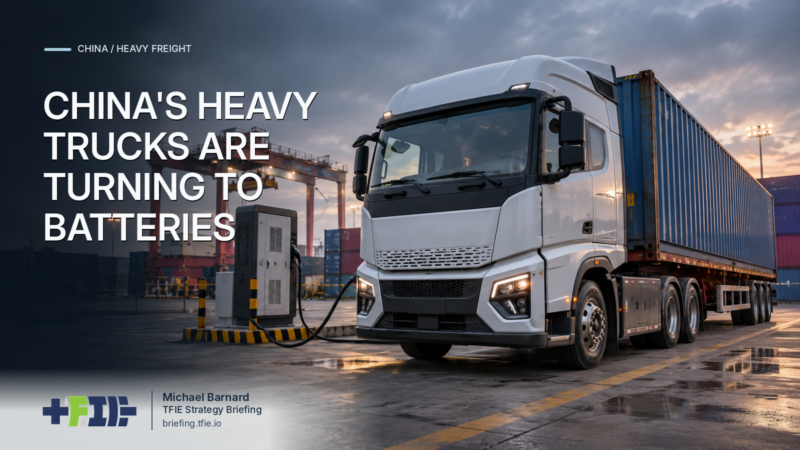
In September 2026, battery electric trucks captured 49.8% of China’s new domestic heavy truck registrations. Of the 65,800 registered trucks, 32,800 ran on batteries. Another 36 used hydrogen fuel cells. Battery electricity accounted for more than 99% of the broader new energy category. China’s transport operators are buying batteries on a scale that puts pressure on diesel and LNG suppliers.
The change has accelerated. Battery electric vehicles accounted for around 13% of domestic heavy truck registrations in 2024, 28% in 2025 and almost 38% in the first nine months of 2026. The figures come from compulsory insurance registrations for trucks sold on the domestic market, excluding exports. China’s total domestic truck market remains below its pre-pandemic levels. Battery-powered trucks are gaining share while the market for new heavy-duty trucks remains limited.
From May to September, new energy heavy trucks exceeded 40% of new registrations for five consecutive months. The category reached approximately 226,400 vehicles in the first nine months, 64% more than in the same period in 2025, and almost 99% were battery electric. Tractor trucks pulling semi-trailers are leading the change. In September, 64.48% of new national tractor registrations belonged to the new energy category. Electric trucks transport cargo on ordinary trade routes, including work beyond ports and industrial yards.
My comprehensive TFIE strategic report tracks China’s heavy truck sales from 2015 to 2026, examines actual transportation costs and charging options, and assesses the implications for manufacturers, logistics companies and fuel demand.
Operating economics explain much of the appeal. Trucks make money by transporting cargo, so annual kilometers, payload, electricity prices, charging stops and vehicle availability are as important as the price on the invoice. High mileage routes make electricity and maintenance savings more valuable. An expensive network connection or charging queue can eat into those savings. Fleet operators must evaluate the truck and its route together.
Recent case studies on ICCT document how those economies develop. A Guangdong warehouse fleet of 28 electric trucks had estimated five-year ownership costs to be 16% lower than comparable diesel trucks. In the express delivery service in the Yangtze River Delta, 50 electric tractor trailers plying routes of 300 to 500 km achieved a narrower lead of 3% in six years without purchase incentives. Another operation covering 900 kilometers per day with strategically placed high-power charging showed estimated ownership costs 19% below diesel. The differences reflect the route, utilization and charging provisions.
Those three deals offer a more useful acquisitions lesson than a single range figure cited. The operator starts with charging, schedules and power access, then selects equipment. The narrow 3% margin on express delivery also shows why financing and charging costs can determine whether a viable electric route makes money.
Battery swapping has captured a considerable share of this market. In September, 20.09% of newly registered battery electric heavy trucks were classified as interchangeable. That compares with 22.92% between January and September 2026 and 30.39% for all of 2025. The number of trucks classified as swappable continued to rise, while conventional freight gained a larger share of the expanding electric market. China’s registration classification also includes some trucks with leased batteries that are recharged rather than swapped.
The exchange accommodates dense, repeatable freight operations such as steel mills, ports, and bulk material transportation. Fleet operators and station owners can standardize vehicles and use the stations frequently enough to pay for batteries that are in inventory. Conventional freight serves a wider range of routes and can accommodate scheduled stops, overnight parking and warehouse operations. Both approaches depend on predictable truck traffic and reliable electrical connections.
China is building infrastructure around those transportation patterns. Yunnan put 3,350 kilometers of heavy truck freight corridors into operation in 2025, with 113 stations and 869 connectors. Fujian opened a 649-kilometer coastal corridor in October 2026, including 15 charging stations and eight interchange stations. The IEA’s 2026 tariff review outlines the concentration of heavy vehicle tariffs around freight corridors and industrial centres. Long-haul coverage still has gaps, but the network is expanding where trucks already have work to do.
Hydrogen has found little traction alongside this expansion. China registered 689 fuel cell heavy duty trucks in the first nine months of 2026, compared to more than 223,000 battery electric trucks. LNG has a much larger installed customer base, although its lead over diesel has narrowed as gas prices change. Battery-powered trucks offer a different cost structure based on powertrain efficiency and lower maintenance needs. This makes competition increasingly difficult for equipment and fuel suppliers that rely on combustion engines.
Changes in sales take years to be implemented in the operating fleet. Kpler projects that new energy trucks, predominantly battery electric, will account for around 8% of Chinese heavy-duty trucks in service by the end of 2026. It also estimates that they will displace around 230,000 barrels of diesel per day compared to transporting the same cargo using diesel trucks. Freight vehicles with high daily utilization can have a large effect on fuel demand before they become the majority of vehicles on the road.
China’s June 2026 heavy truck program brings together purchasing incentives, network access, freight corridors, financing and logistics planning. Its 2030 goals include a 40% share of new energy heavy truck sales, a 20% share of the operational fleet and 30,000 kilometers of carbon-free freight corridors. New monthly sales have already exceeded the sales quota target. Building and replacing enough vehicles to meet the fleet goal will take longer.
Other countries have different electricity rates, road networks and freight routes, but the procurement method is the same. Start with the real jobs that trucks do. Identify routes with strong electric economics, plan the charging and grid connections those routes require, and fund vehicles and infrastructure as a single program. Other transmissions can compete when their operating costs or performance are better. Evidence from China’s largest commercial charging applications increasingly favors batteries.
TFIE’s comprehensive strategic report includes historical record series, ICCT cost of ownership cases, freight and exchange corridors and fleet turnover analysis. TFIE Strategy works with fleets, utilities and policymakers on freight electrification scenarios and investment decisions.