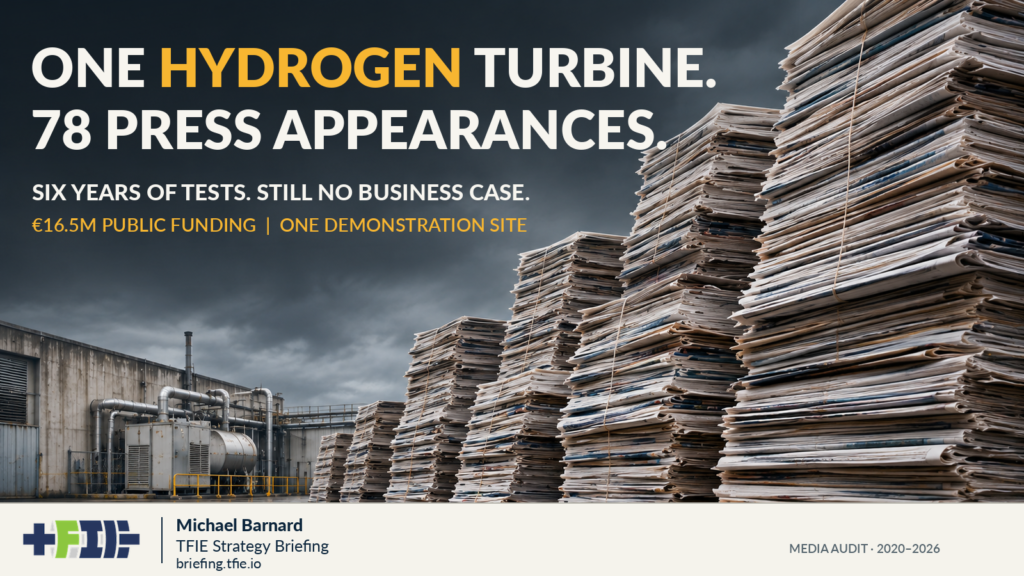
Hydrogen burns. The turbines spin. Its exhaust gases can produce steam. Kawasaki demonstrated the production of electricity and heat from hydrogen on the port island of Kobe in 2018, before Europe funded the first HYFLEXPOWER program. Six years later, Siemens Energy is still running ads about burning hydrogen in a single turbine at a French paper mill. European and British taxpayers have contributed approximately €16.5 million to the two research programmes, and the facility itself has generated at least 78 identified press appearances. Neither subsidies nor advertising have produced a commercial reason to produce hydrogen from electricity and burn it to generate industrial electricity and steam.
Siemens Energy’s latest announcement, dated November 16, 2026, describes an SGT-400 turbine at Smurfit Westrock’s paper mill in Saillat-sur-Vienne that is powered by pure hydrogen during startup, load changes and full-load cogeneration. The equipment can operate in these conditions. Hydrogen combustion and heat recovery were already established. Expanding the operating range of a manufacturer’s turbine has not changed the cost of producing hydrogen, the losses involved in its production, or the available alternatives. No second commercial installation has emerged from the program.
Siemens’ own white paper from March 2024 provides the most important figures. The electrolyzer installed in the paper mill produces 16.4 kg of hydrogen per hour. The turbine consumes about 810 kg per hour when producing 10 MW of electricity. On-site production covers 2.02% of the hourly fuel demand. Nearly 50 times that electrolyzer capacity would be needed to power the turbine continuously at the indicated operating point. Later tests used hydrogen brought to the site.
The 2023 campaign accumulated around 90 hours of hydrogen and natural gas blend testing, including just over four hours with pure hydrogen. Siemens identified the limited availability of hydrogen as the limitation. The 2026 announcement does not provide cumulative full-load hydrogen operating hours, delivered fuel price, or normal cost of electricity and steam. These are the figures that an industrial client needs before purchasing equipment. The announcement of another combustion test avoids the question of who will supply hundreds of kilograms of affordable hydrogen every hour for years.
My full TFIE Strategy Briefing investigation examines Siemens’ financing records, published operating figures, energy balance sheet and an audited timeline of 78 press appearances surrounding the same turbine.
At an illustrative 50 kWh of electricity per kilogram of hydrogen, manufacturing the turbine’s 810 kg of fuel per hour requires approximately 40.5 MW of electricity. The turbine generates approximately 10 MW of electricity plus usable exhaust heat. Compression, storage and delivery add equipment and expense. The mill needs electricity and process steam; Converting electricity to gas and burning it to recover those services introduces losses and costs that direct electrification avoids.
France is an especially poor place for this detour. RTE’s 2025 electricity analysis reports that 95.2% of French generation was low carbon, with average emissions of 19.6 gCO₂e/kWh. Direct power from the grid can supply the electrical load. Industrial heat pumps, mechanical vapor recompression, electric boilers and thermal storage can supply process heat and steam in combinations designed based on the plant’s operational requirements. The program should have benchmarked these complete systems before committing public money to further hydrogen turbine retrofits.
A paper mill in Finland is already doing the industrial work. The Tervakoski plant in Delfort has been using a Turboden heat pump and mechanical vapor recompression installation since January 2026. It supplies around 12 MW of process steam at temperatures up to 170°C, with a coefficient of performance of around two. It provides useful steam without a hydrogen production plant, hydrogen supplies or a hydrogen-powered turbine. The exact plant integration will vary, but the alternative is operating commercially as HyCoFlex continues to issue test announcements.
Funding was directed at the wrong problem. HYFLEXPOWER received €10.48 million in EU aid. HyCoFlex received another 4.44 million euros. A presentation from Siemens identifies approximately €1.56 million more in support from the UK, bringing the public contribution across the programs to approximately €16.48 million. Both programs were designed to make existing gas turbine cogeneration equipment compatible with hydrogen. The grants funded additional operating conditions for the turbines rather than establishing that hydrogen was a sensible way to power the plant.
The economics of the program were weak before the second award. In October 2023, Siemens presented a scenario requiring electricity below €35/MWh to align hydrogen fuel costs with natural gas based on its 2022 cost assumptions. Subsequently, the final HYFLEXPOWER workshop examined favorable operating cases with hydrogen substitution and electrolyzer utilization, both above 90%. European reports also identified renewable electricity below €40/MWh as a condition for a favorable deployment economy. France’s wholesale electricity in 2025 averaged €61.1/MWh. Its hours of negative prices were occasional. They could not supply a plant that was operational more than 90% of the time. These conditions were established before the research program ended, but funding continued for further combustion trials.
Siemens also has a clear commercial interest in preserving turbine markets. Its 2025 presentation explicitly described protecting existing assets and future investments in gas turbines in a decarbonizing world as a benefit of hydrogen compatibility. A turbine supplier has the right to sell its products with its own money. The purpose of public funding for industrial decarbonization is to reduce emissions and costs, not to protect sales of combustion equipment from direct electrical competition.
TFIE’s media audit counted 19 press appearances in 2020, 13 in the installation and combination phase of 2022, 35 around the testing and adjudication of 2023, four in 2024 and seven through November 16, 2026. Those 78 appearances date back to a handful of announcements about one installation. They are not 78 independent engineering advances or 78 deployments. The number of owners increased, while the operational fleet did not.
Public funders should require equipment-neutral comparisons of industrial energy services provided before funding another hydrogen retrofit. The necessary evidence is known: reliable electricity and steam for a year, actual operating cost, life cycle emissions, fuel contracts and performance against direct electric alternatives. HyCoFlex has provided further publicity about hydrogen combustion without establishing those results. The problem wasn’t that Europe couldn’t get a turbine to burn hydrogen. It was that public money continued to flow after the relevant energy and economic questions were already answered.
The full TFIE Strategy Briefing research contains audited financing and media evidence, 2% on-site hydrogen supply calculation and comparison of industrial steam to direct electricity. The TFIE strategy provides evidence-based assessments of industrial energy investments and public programs.