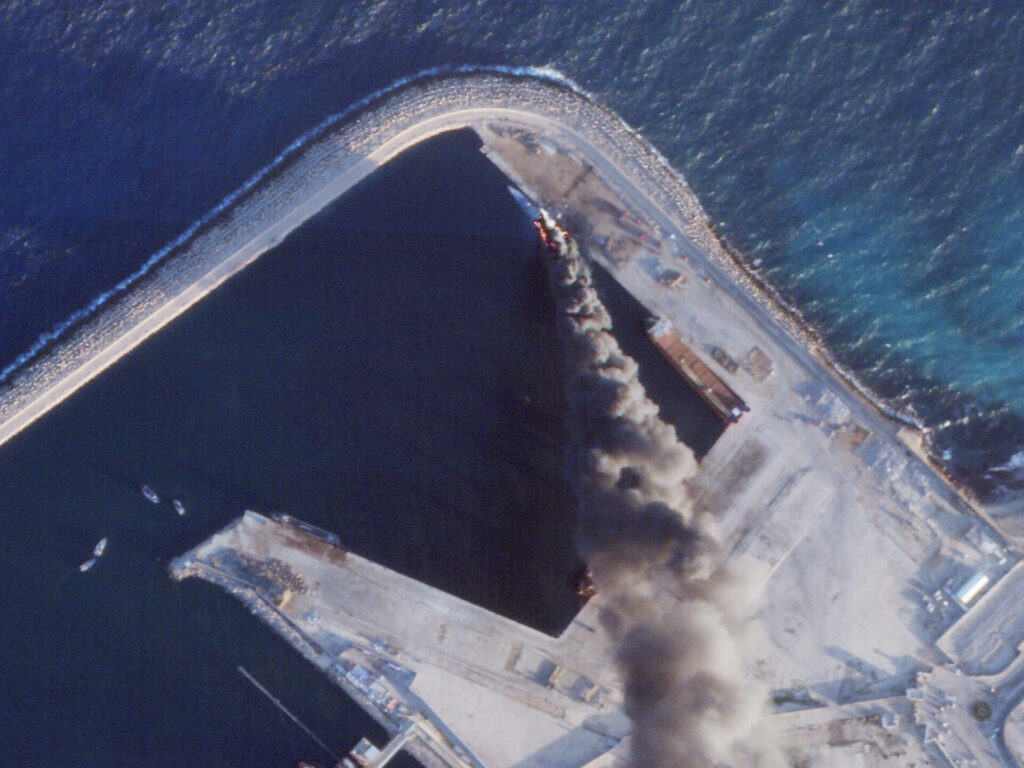
Ukrainian explosive naval drones sank a Russian warship docked in the Libyan port city of Benghazi and also hit an escorting Russian cargo ship. The incident demonstrates the increasing scope of Ukrainian military attacks against Russian ships from the coast of North Africa to the Gulf of Finland.
Russian Navy missile corvette Mercury It sank in the harbor after being hit by at least two Ukrainian naval drones on Nov. 22, according to The Associated Press. The Ukrainian Security Service described the use of seven naval drones launched from a mother ship to attack the Mercuryand Ukrainian President Volodymyr Zelenskyy shared video footage showing the unmanned ships approaching and exploding against both the burning Russian warship and a Russian dry cargo ship. MV Angara.
Zelenskyy noted that a Ka-27 combat helicopter aboard the Mercury was also destroyed. He described the freighter. MV Angara as weapons transport: Russia provides material support to the Libyan National Army which currently controls Benghazi and is fighting the internationally recognized Libyan government based in Tripoli.
The victims of the attacks included at least 10 people, including Libyan and Russian nationals, Libyan National Army officials told The Associated Press. They also mentioned that some injured crew members of the Russian warship were taken to local hospitals.
Mercury It was a Steregushchiy-class missile corvette, designated by Russia as Project 20380, which can carry both anti-ship and air defense missiles. They are also armed with torpedoes to counter submarines and have a deck-mounted naval gun.
Corvette-class warships are typically smaller than the destroyers or frigates that often act as workhorses of modern navies, although NATO has designated Russian missile corvettes as the Mercury as equivalent to frigates.
Mercury It was originally intended to join the Russian Black Sea Fleet. But after Russia launched its full-scale invasion of Ukraine in 2022, the Russian warship was unable to enter the Black Sea because Turkey invoked the 1936 Montreux Convention to restrict warships entering or leaving the Black Sea. Instead, the Mercury operated primarily from Russia’s Northern Fleet bases in Arctic waters, according to naval analyst H.I. Sutton.