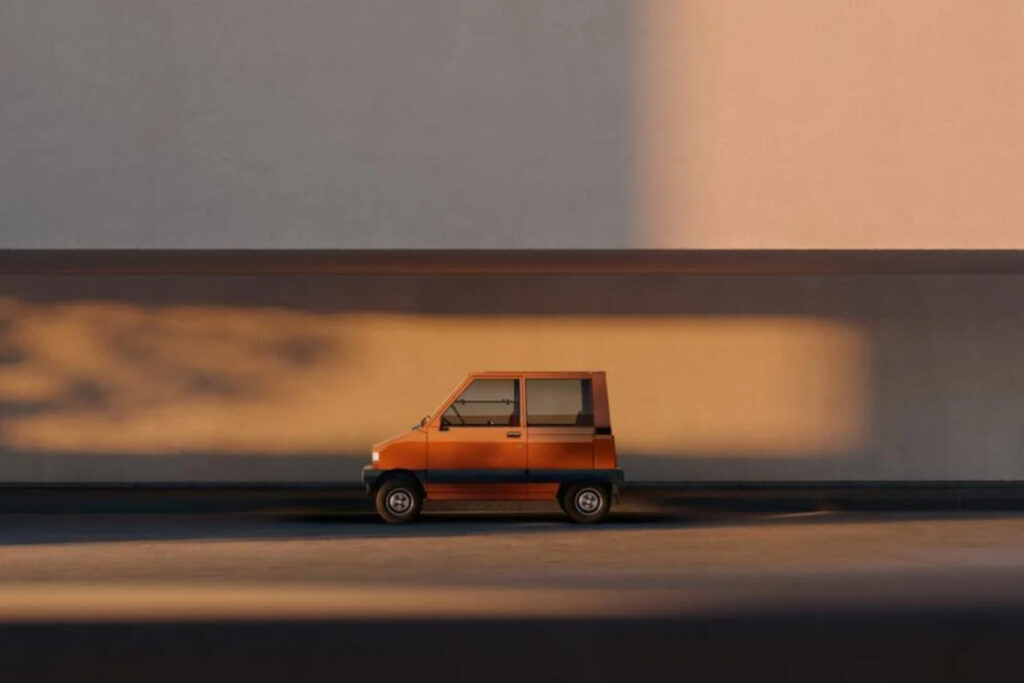
In November 1976, Volvo presented its vision of electromobility with the Elbil. A total of two prototypes were built: a two-seater electric delivery van with a sliding door in orange and four seats, and a two-seater electric delivery van in butter yellow.
The latter was partially financed by the Swedish state and was intended for employees of the then telecommunications authority, Televerket, who were to use it for short, emission-free local trips in the Gothenburg area.
Even back then, Volvo was grappling with a challenge that still drives electric car developers today: weight. While the hood and tailgate were made of fiberglass-reinforced plastic, Volvo used aluminum for the doors and roof panels. The empty weight was 1,200 kilograms.
Propulsion was provided by a 9.5 kW electric motor, compactly integrated by Volvo into the rear axle. Combined with a specially developed continuously variable transmission, the Elbil reached a top speed of up to 70 km/h. Power came from twelve 6-volt lead-acid batteries, which provided a range of about 50 kilometers. After that, the vehicle had to be plugged in for ten hours. Therefore, the little Swede was not suitable for a spontaneous weekend trip, but then again, it was not designed for that.
Between ten hours and ten minutes
Half a century later, Volvo’s vision of the electric future looks quite different. The EX60 in its electric variant P12 AWD with greater range reaches up to 810 km WLTP. According to the manufacturer, in just ten minutes it can be charged up to 340 more kilometers. The power of the propulsion system has also increased more than fifty-fold since 1976, now reaching up to 500 kW.
While Volvo saved weight with aluminum and fiberglass-reinforced plastic back then, the automaker now uses cell-to-body technology for the EX60, integrating the battery directly into the vehicle’s structure, as well as megacasting, where large castings replace numerous individual components.
While with the Elbil you had to sleep overnight before continuing the trip, the EX60 only requires a coffee break under optimal load conditions. And yet, it is still debated today whether an electric car with a range of several hundred kilometers is sufficient for daily use.
Perhaps electromobility has become a bit like modern dating: the greater the choice, the longer the list of demands. And while we still wonder if there isn’t something better, we forget to ask what really suits us and our daily lives.
Therefore, the Elbil story may not only be a story of technological progress but also a story of inflation of our expectations. Batteries have increased in size and charging times have been shortened. The only question that remains unchanged is: how much car do we really need?
volvocars.com