Support CleanTechnica’s work through a Substack subscription, on Patreon, or on Stripe. Help us produce all the original, high-quality content we publish week after week despite the challenges of AI deleting content, anti-social media, inflation and other obstacles.
Being locked in a race for technological leadership with China and the United States, the EU lacks the focus, coordination and financial firepower to transform its industry, ensure long-term prosperity while achieving its climate goals.
This could soon change thanks to the upcoming European Competitiveness Fund that will come into operation from 2028. Yesterday, the European Parliament consolidated its support for a robust fund. Today, EU leaders meet and need to secure an adequate budget for the ECF to deliver.
Since the launch of the US Inflation Reduction Act in 2022, Europe has developed several strategies, master plans and policy initiatives to build a compelling industrial policy. Still, they largely failed to deliver on concentration, coordination, and financial firepower.
With the European Competitiveness Fund (ECF), the Commission proposed a new instrument to support European industry and deliver on its Clean Industrial Agreement. Yesterday, the European Parliament voted on rules that would further strengthen the proposal.
A bigger budget
MEPs increased the ECF’s general budget by €30 billion, to €264 billion. Crucially, they increased the envelope for clean energy and industrial decarbonization to €40 billion, with €4 billion earmarked specifically for clean technology manufacturing.
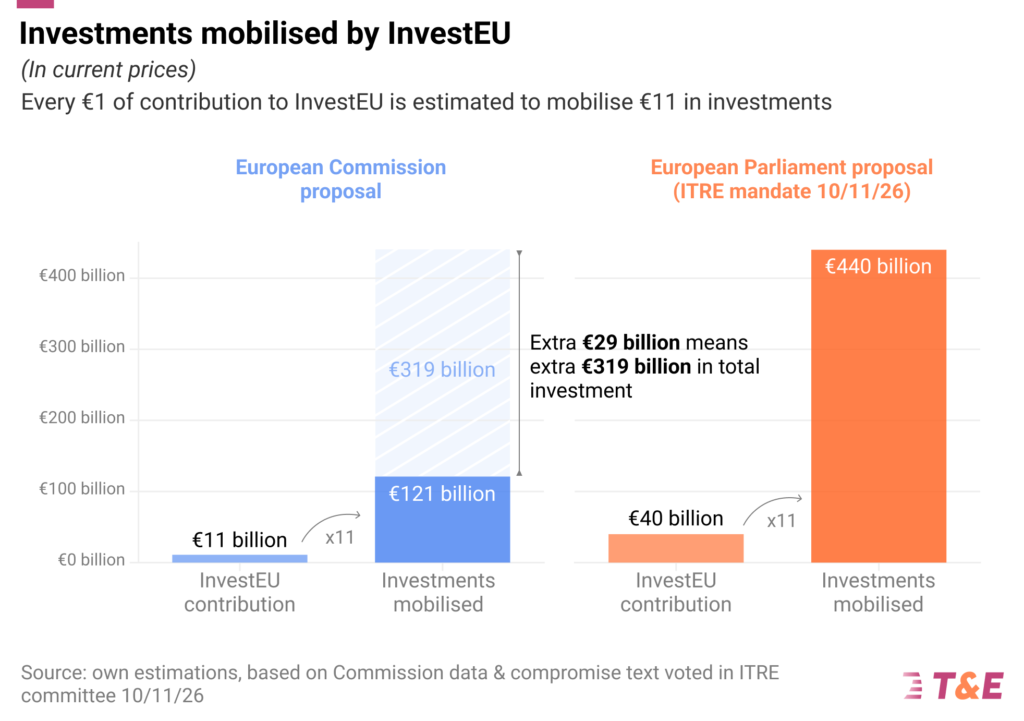
MEPs backed a €40 billion budget for InvestEU, including €15 billion specifically for clean energy and industrial decarbonisation. Through budget guarantees, debt and equity, InvestEU aims to raise private capital for higher risk domestic manufacturing projects that would otherwise fail to reach a final investment decision. This additional €29 billion in additional guarantees compared to the Commission proposal could unlock more than €300 billion in total mobilized investment.
Parliament also allocates €10 billion to the Center for Critical Raw Materials (CRM Centre). The Center is prepared to ensure resilient and sustainable critical raw materials supply chains for Europe by investing in strategic projects. Securing budget resources through the FCE is a crucial step for success.
Expand strategic clean technologies
Over the years, the EU has developed a wide range of funding instruments, but they are still largely focused on supporting research and development. However, each year the EU falls further behind China in terms of manufacturing key technologies such as batteries. This is because existing financing programs neglect the critical, capital-intensive scale-up period. Many new market entrants do not survive due to technological risk, insufficient access to venture capital, and foreign competition.
Europe spends a lot of money to support the industry, both through European funds and at national level under slow-moving state aid schemes. However, many of the support schemes are widely distributed across technologies without sufficient focus or clear priorities.
This makes sense when funding early research to guide innovation. To scale this is different. Today we know what technologies we need to produce in the next 5 to 10 years to reduce emissions and maintain leadership, starting with clean transportation: the battery value chain, zero-emission vehicles, clean maritime and aeronautical technologies and e-fuels.
To achieve the green transition, European financing must be decisively reoriented towards the development of strategic clean industries and essential technology value chains. T&E estimates that the manufacturing of clean transport technologies alone will require at least €39 billion of public funding per year by 2030. The broader decarbonisation needs (industrial heating, buildings and implementation of clean technologies) require much more.
Too often, European cleantech innovators are stuck in the “valley of death” between R&D and commercial production. Parliament’s text addresses this directly by ordering to “increase” support for projects that strengthen critical value chains and reduce foreign dependence, backed by a €4 billion envelope dedicated to clean technologies such as battery cell manufacturing. Finally, the EU will be able to deploy production aid, a model that has proven to have an impact in other jurisdictions such as the United States.
It’s time for governments to do the same
Parliament has put forward a much bolder industrial vision than EU governments, which have so far largely stuck to the Commission’s more limited draft.
An immediate test will decide whether the ECF will make a difference in the future. EU heads of state and government meeting today at a special summit must reverse the steep cuts inflicted on the EGF in recent Council negotiating drafts. They should hear from more than 75 companies who also highlighted the importance of a well-resourced European Competitiveness Fund in the next EU budget.
Designing a smart new industrial investment tool means little if leaders starve it of cash. They must support a Competitiveness Fund with a budget that lives up to their ambitions.
T&E article. By Till Eichler, Public Investment Policy Manager, T&E and Nina Betz, Public Investment Policy Intern, T&E.
Sign up for CleanTechnica’s Weekly Substack to get in-depth analysis and high-level recaps from Zach and Scott, subscribe to our daily newsletter, and follow us on Google News.
Do you have any tips for CleanTechnica? Do you want to advertise? Want to suggest a guest for our CleanTech Talk podcast? Contact us here.
Subscribe to our daily newsletter to receive 10-15 new cleantech stories per day. Or sign up to receive our weekly newsletter on the week’s top stories if the daily grind is too much.
CleanTechnica uses affiliate links. See our policy here.
CleanTechnica Comment Policy