Support CleanTechnica’s work through a Substack subscription, on Patreon, or on Stripe. Help us produce all the original, high-quality content we publish week after week despite the challenges of AI deleting content, anti-social media, inflation and other obstacles.
Last year’s sharp U-turn in energy policy had catastrophic consequences for farmers who were counting on federal assistance for solar power on their land. Still, the pace of innovation in the solar industry never stopped, and farmers can ultimately benefit as long as the political winds blow in a more positive direction. In a particularly interesting development, US startup UbiQD has gathered more evidence that its perovskite-enhanced glass “UbiGro” can help greenhouse farmers improve their yields while saving water.
Perovskite solar cells and the connection of solar glass
For those of you new to the topic, perovskite refers to a new class of relatively inexpensive and easy-to-manufacture solar materials, characterized by a crystalline structure based on the natural mineral perovskite (see much more background here).
Raw perovskite is too unstable to function as a solar material on its own, but it can be combined with more durable materials in a solar cell or solar module. For example, combinations of silicon and perovskite are already emerging on the market.
UbiQD developed its UbiGro glass to incorporate submicroscopic perovskite particles. Particles that size are known as “artificial atoms” or quantum dots, as scientists at Los Alamos National Laboratory skillfully explain:
Quantum dots are ultrasmall fragments of semiconducting matter that can be synthesized with near-atomic precision using modern methods of colloidal chemistry. Its emission color can be adjusted simply by varying its dimensions. Color adjustability is combined with high emissions efficiencies close to 100%.
As Los Alamos notes, quantum dots initially appeared in the LED field of the lighting industry before moving into solar energy applications as a means of increasing the efficiency of solar cells. In 2016, researchers were experimenting with quantum dots in a perovskite solar cell. Pioneering startup Blue Dot was among those seeking the perovskite connection.
Activity began to accelerate in 2025 when UbiQD acquired BlueDot. Meanwhile, UbiQD had previously partnered with US thin-film solar manufacturer First Solar to develop quantum dots for solar panels. That project also accelerated in 2025 when UbiQD closed a $20 million Series B funding round. According to UbiQD, its improvements could double the solar conversion efficiency of First Solar’s bifacial solar panels.
Pumped solar glass can improve crop yield…
In 2025, UbiQD also announced the findings of a study of its UbiGro greenhouse glass. Glass is treated with quantum dots as a way to adjust sunlight to improve crop yields. The study was published by researchers at the University of California – Davis in the journal Materials today Sustainability under the title “Spectrally Selective Quantum Dot Laminated Glass for Photonic Modulation and Climate Regulation in Greenhouses.”
The findings included:
— Fresh biomass increased by 37.8%. The plants were almost 40% heavier, indicating a significantly higher edible yield.
— The leaf surface area increased by 38.0%. A larger leaf area means a larger photosynthetic surface area.
— Root length increased by 38.0%. Deeper roots improve water and nutrient absorption, resilience and lifespan.
— Light use efficiency increased by 41.0%. Plants used sunlight more efficiently, with more biomass per photon.
— Nutrient concentrations (N, P, K, Mg, Zn, Cu) were significantly high. The crops were more nutritious, with higher levels of essential nutrients.
— The red:blue spectral ratio increased by 61.0%, without significant PAR losses. More red light was delivered without sacrificing total usable light levels.
“The findings highlight a promising path towards climate-smart greenhouse envelopes that integrate photonics with sustainable food and energy strategies,” the research team concluded.
…And it also saves water.
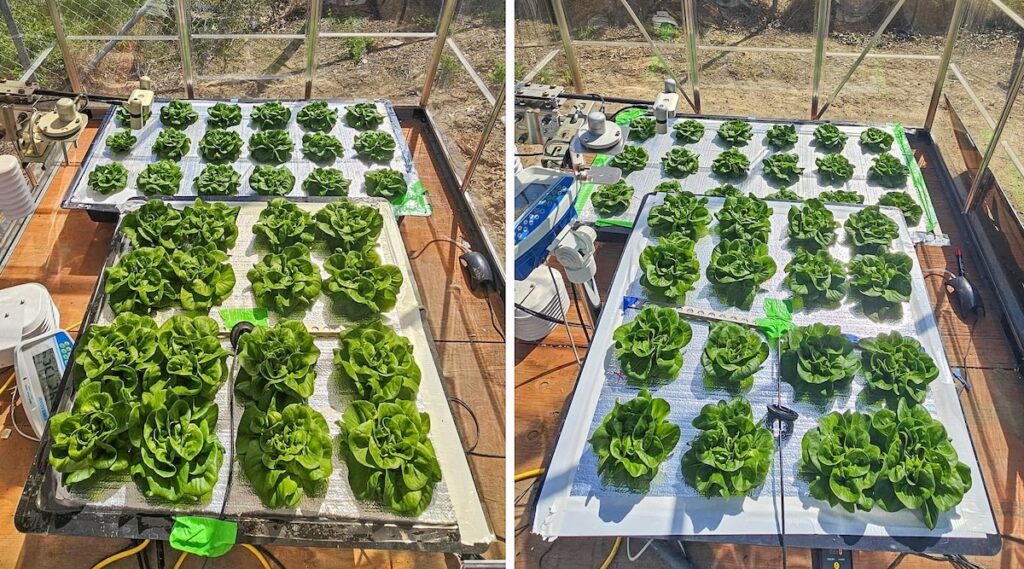
In a series of follow-up trials last spring, UC-Davis focused on the impact of UbiGro on the water consumption of greenhouse-grown lettuce. The results were equally encouraging.
“Water use efficiency improved by approximately 9%. Lettuce grown under QD glass produced 101 grams of fresh biomass per liter of water compared to 93 grams per liter under conventional glass,” UbiQD noted.
“Unlike technologies that require additional energy inputs or changes to irrigation infrastructure, UbiGro glass works passively by optimizing sunlight already entering the greenhouse while optimizing water use efficiency,” UbiD emphasized in a press release.
UbiQD VP of Sales and Marketing Eric Moody also weighed in. “It’s an important new area of validation for UbiGro as we continue to explore how our technology can help producers get more out of the resources they already use,” Moody said.
Do you want more details? See the study, “Estimation of Crop Water Use and Evapotranspiration in a Deep Water Hydroponic Culture System in a Quantum Dot Glazed Greenhouse,” presented by UC-Davis Ph.D. candidate Mala Parvin at the American Society of Agricultural and Biological Engineers 2026 Annual International Meeting in Indianapolis last July.
Next steps for perovskite solar cells
First Solar has also been making some moves of its own. The iconic American firm is of particular interest for its focus on CdTe (cadmium telluride) solar film rather than the silicon formulation commonly used around the world. Here in the United States, the Department of Energy has been promoting CdTe since the early 1990s as an alternative to domestically sourced silicon, and it has become particularly popular in utility-scale applications.
First Solar has been embroiled in patent disputes lately, but the dust seemed to be settling last month when the company announced a non-exclusive patent licensing agreement with US firm CubicPV Inc.
Among other undisclosed terms of the deal, First Solar will have access to CubicPV’s patents covering perovskite solar technology in the United States. “The license further clears the way for First Solar to continue its development of photovoltaic (PV) devices built with a perovskite semiconductor for the U.S. residential, commercial, industrial and utility markets, and applies to sales and distribution of those products nationwide,” First Solar explains.
Ironically, if US President Donald Trump were to lend his full support to the domestic solar industry, First Solar would be a feather in his cap. First Solar bills itself as the largest producer of thin-film solar in the world and the largest manufacturer of solar of any type in the Western Hemisphere.
First Solar is also among the solar energy stakeholders contributing to the president’s oft-stated ambition to bring more manufacturing to the U.S. during his term. “The company’s investments include a new perovskite development line at its Perrysburg, Ohio, campus that produces small form factor modules with a perovskite semiconductor, enabling First Solar to achieve key internal milestones in its perovskite development program, including early-stage efficiency, stability and manufacturability goals,” First Solar notes.
That’s just for starters. By the middle of next year, First Solar hopes to have a pilot line up and running at a facility in Ohio, which will apply the technology to its existing Series 6 solar modules.
Additionally, last month First Solar announced the start of Phase I operations at its sixth US facility. Located in Gaffney, South Carolina, the new factory represents another step in First Solar’s offshoring plan for Series 6 production.
“The second phase is anticipated to be completed in mid-2027, at which time the approximately $330 million facility is expected to double its annual nameplate capacity to 3.4 gigawatts (GW) and produce the company’s CuRe technology, while supporting nearly 700 jobs. Approximately 500 of those jobs have already been filled,” First Solar explains.
For the record, the Gaffney facility expands First Solar’s existing presence in South Carolina. The company also operates in Alabama, Louisiana and Ohio. In total, First Solar expects to have a total of 17 gigawatts of domestic solar module manufacturing under its belt by the end of this year, which is just around the corner.
Photo: Greenhouse lettuce thrives in natural sunlight filtered through specialized glass from perovskite solar startup UbiQD, while conserving water resources (cropped, courtesy of UbiQD).
Sign up for CleanTechnica’s Weekly Substack to get in-depth analysis and high-level recaps from Zach and Scott, subscribe to our daily newsletter, and follow us on Google News.
Do you have any tips for CleanTechnica? Do you want to advertise? Want to suggest a guest for our CleanTech Talk podcast? Contact us here.
Subscribe to our daily newsletter to receive 10-15 new cleantech stories per day. Or sign up to receive our weekly newsletter on the week’s top stories if the daily grind is too much.
CleanTechnica uses affiliate links. See our policy here.
CleanTechnica Comment Policy