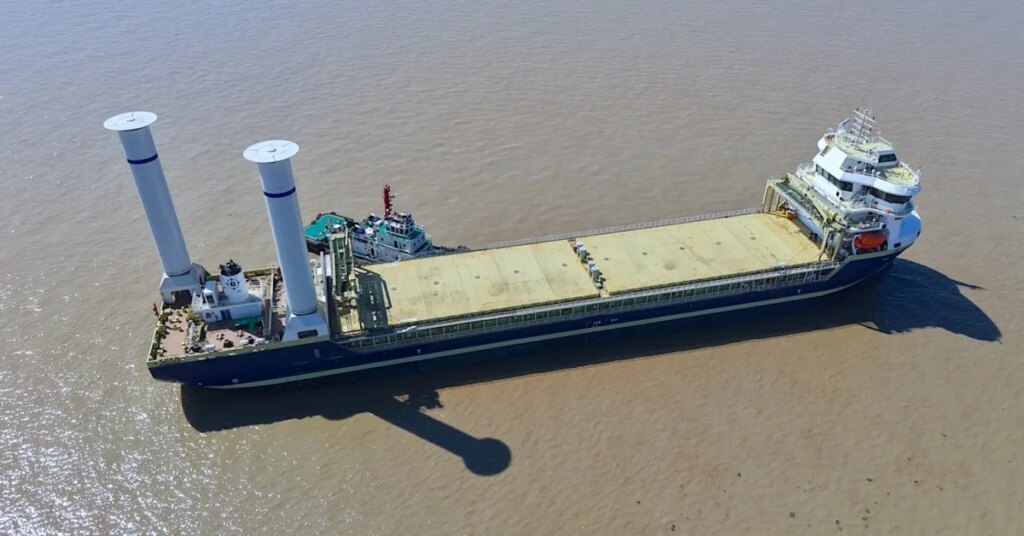
Moving millions of tonnes of coal, sugar and other bulk cargo is serious business, and decarbonising that business presents a number of unique problems, but if the new BRF Froan bulk carrier proves anything, it’s that battery size is not one of them. The new electric freighter carries an incredibly huge 23,500 kWh battery.
Equipped with the equivalent of nearly 300 long-range electric car batteries, the 130-meter (426-foot) BRF Froam built by SOHO Marine Heavy Industry for Norwegian shipping company Berge Rederi Future (BRF) will use the ship to transport up to 13,250 deadweight tons (DWT) along the 230 nautical miles (or about 265, as the crow flies) between ports in Brønnøy and Elnesvågen without burning a drop of diesel.
“It will go back and forth, back and forth, like a ferry,” explains Oivind Berge, co-owner of Berge Rederi Future, in a Trade winds interview. He added that the round trip takes around 24 hours, with charging facilities installed at the loading and unloading ports. “Then we can come and go continuously.”
The 130 million-long vessel BRF Froan left the Jiangsu SOHO Marine Heavy Industry shipyard in China last week and is currently en route to Norway, where it will begin shipping huge chunks of marble early next year.
Above the chimneys
The ship’s massive battery sends electrons to 6,000 kW (about 8,000 hp) electric motors that turn the propellers. How that works is obvious; What might be less obvious is what those big indirect deals behind the BRF Froan are.
They’re called rotor or spinning sails, and they surpass the old-school version by using something called the Magnus effect to produce forward thrust. Basically, as the tall cylinders rotate, the wind flowing around them creates a pressure difference that creates lift perpendicular to the wind. That lift produces forward thrust, which helps propel the boat and reduces the amount of electricity it needs to draw from its batteries once underway.
The company estimates that the two rotating sails will save around 339 kW per trip, while switching to battery will save another 10,000 tonnes of harmful carbon emissions and 220 tonnes of nitrous oxides each year.
interesting engineering reports that the total cost of the project is approximately $52 million (500 million Norwegian krone). A second vessel, called BRF Frøya, is already under construction in China and is scheduled for delivery in 2027.
SOURCE | IMAGES: BRF, via Naval Porto Estaleiro.
Rising energy costs mean that more people than ever are considering solar energy, and it’s always a good idea to get quotes from some installers. To ensure you find a reliable installer near you at a competitive price, check out energywisea free service that makes it easy for you to use solar energy. They have hundreds of pre-vetted solar installers competing for your business, ensuring you get high-quality solutions and save 20-30% compared to going it alone. Plus, it’s free to use and you won’t receive sales calls until you select an installer and share your phone number with them.
Your personalized solar quotes are easy to compare online and you’ll have access to unbiased energy advisors to help you every step of the way. Start here.
FTC: We use automatic affiliate links that generate income. Further.