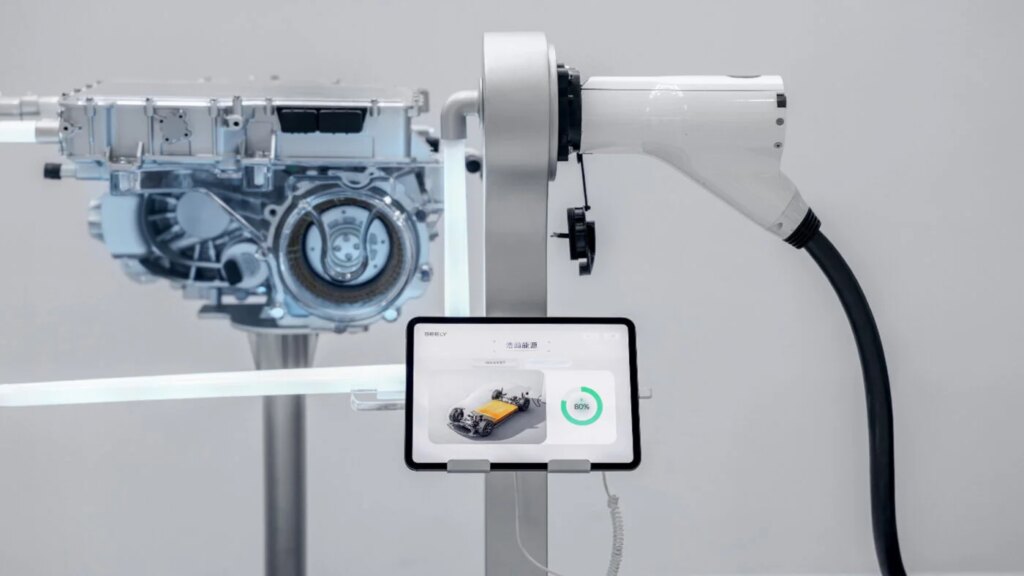
The Chinese automaker unveiled the new technology in Ningbo alongside its fifth-generation Geely smart charging station. According to the manufacturer, the system can reach a maximum power of up to 2,250 kW. On paper, this surpasses the flash charging column that BYD introduced in March, which delivers a maximum of 1,500 kW through a single connector.
However, CnevPost Now he reports that the high power column is only part of the system. Geely pairs this with its ‘Shendun Golden Battery’, which is designed for ultra-fast charging and supports a maximum charging speed of 12C. In practical tests, the Lynk & Co 10 and Zeekr 001 models equipped with this battery took 4:30 minutes to charge from 10 to 70 percent, and 8:40 minutes to reach 97 percent.
This slightly undercuts the figures cited by BYD for its second-generation Blade battery. BYD claims that when combined with its Flash Charging system, the battery can be charged from 10 percent to 70 percent in five minutes and from 10 percent to 97 percent in nine minutes at normal temperatures. A test published in July by FAW’s Hongqi brand achieved an even faster time of 3:41 minutes, from 10 to 70 percent, although a timetable for mass production of this technology has not yet been announced.
Geely relies on 12C and AI charge control
To manage the high charging power, Geely uses the ‘Xingrui PowerMind’ model, developed in collaboration with the Chinese artificial intelligence company StepFun. This system connects the vehicle, the battery, the charging station, the cloud, the electrical grid and the stationary storage, adapting the charging strategy to the vehicle and the battery.
The system is said to predict the battery temperature up to 30 seconds in advance and adjust the charging power accordingly. Geely aims to keep the average temperature during fast charging below 55°C and the maximum temperature below 65°C. Thermal management is supported by a liquid cooling system that extends from the stationary battery storage, through the charging station, charging cable and connector, to the vehicle battery.
Geely also addresses the impact of repeated fast charging on the battery. A lithium ion pulse regeneration process uses micropulses to reactivate lithium ions that have accumulated on the negative electrode. Combined with AI-based cargo management, this technology is claimed to increase cycle life by up to 20 percent. However, the company does not specify its exact useful life at this time.
For home charging, Geely is following a low-power strategy to reduce the effects of frequent fast charging on the battery. Additionally, for more affordable electric vehicles, Geely is developing the next generation of its ultra-short blade battery. A patented laser welding process is said to reduce heat generation during charging by ten percent, while increasing the maximum charging speed to 6°C.
Competition for extremely short loading times has recently intensified considerably in China. The focus is increasingly not only on batteries and vehicles, but also on building the right megawatt charging infrastructure. BYD had already installed 10,000 of its Flash charging stations by the end of August and aims to reach 20,000 by the end of 2026. Battery manufacturer Sunwoda has also introduced a fast-charging battery (link in German) and plans to build 10,000 megawatt charging stations by the end of 2027.
cnevpost.com, globenewswire.com, carnewschina.com