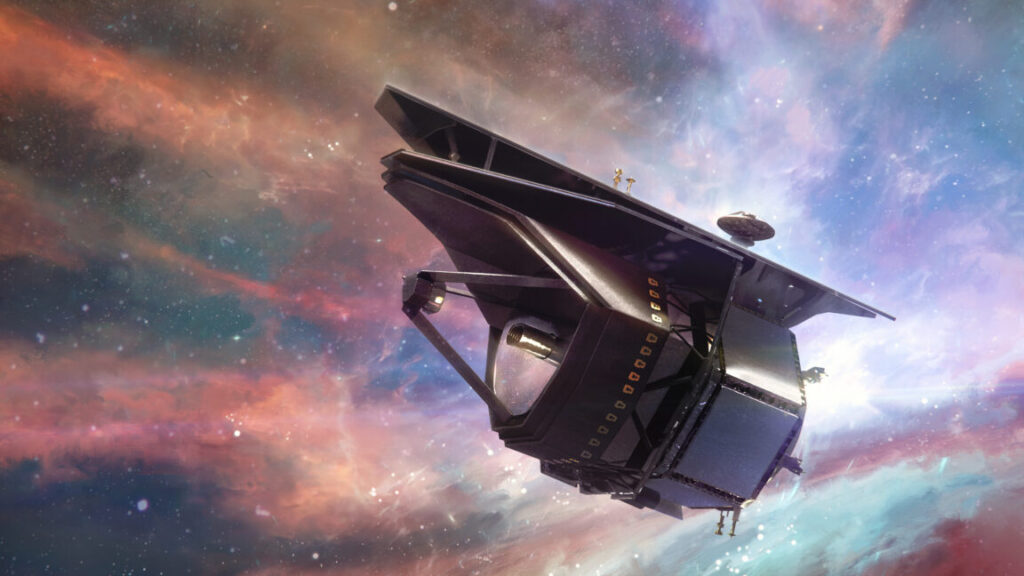
Initial cost estimates for the Habitable Worlds Observatory are around $11 billion, on par with Webb, which far exceeds the original cost forecast.
“This is a sufficiently ambitious observatory that requires whole-of-government participation [approach]” Domagal-Goldman said Tuesday at a meeting of the National Academies’ Committee on Astronomy and Astrophysics. “Frankly, we’re also going to need our partners at the international level to be a big part of this. But we need the best and brightest from across the country, whether at Goddard, another NASA center, an industrial partner, a new commercial space partner or a university, to be part of our work.”
Domagal-Goldman said this week that NASA wants to use its experience developing and deploying the Roman telescope on budget to help put future flagships like HWO under tighter cost controls.
“With the launch of Nancy Grace Roman, ahead of schedule and on budget, we have proven that it is not a law of nature for these projects to go over schedule and over budget,” he said. “That doesn’t mean they’re easy, and it doesn’t mean we can lightly assume that they’ll always stay on schedule and on budget, because that too has been debunked.”
Among the lessons NASA has learned in implementing flagship projects, according to Domagal-Goldman, is the importance of defining the architecture and requirements of the mission and ensuring that the underlying technologies are well understood before engineers begin building flight hardware.
“To put it bluntly, you have to understand the challenge, have a mission that understands the challenge incredibly well, and then once you understand it, go full throttle and get the observatory to the launch pad as quickly as possible,” he said.