Today the new BMW i3, the first fully electric BMW 3 Series, debuts. For the Munich-based manufacturer, this mid-size model is essential, especially because it introduces the traditional 3 Series into the electric era. It is also fundamental for BMW, as the electric saloon represents the evolution of the Neue Klasse: after the iX3 electric SUV, the electric i3 is the second representative of BMW’s completely new platform generation, including the 800-volt architecture. The four-door model rolls off the production line at the main plant in Munich, where series production began in August.
In any case, today’s presentation comes with a certain delay: BMW had already brought forward the start of i3 orders at the beginning of summer. Since June, a “First Edition” of the mid-size electric sedan can be ordered, starting at 75,340 euros. BMW has also already published the price of the individually configurable i3 50 xDrive (from 65,900 euros). We know what the BMW 3 Series looks like from a design preview back in March. Combined with the start of series production almost two months ago, it’s about time BMW released the technical specifications.
The electric BMW i3 is only available with all-wheel drive, for now
So here they are. Initially, the i3 will reach dealerships in two fully electric variants: the i3 40 xDrive and the i3 50 xDrive. They will be joined by new soft-hybrid combustion variants of the 3 Series and, from 2027, a plug-in hybrid. But that is beside the point; Our attention is focused solely on purely electric models. It is clear that the word ‘xDrive’ in the names of the electric models means BMW’s all-wheel drive system. The company has not announced a single-engine electric variant. However, since the technically related iX3 offers a rear-wheel drive variant, at least a similar single-engine version is likely for the i3.
BMW specifies the dimensions of the mid-size electric sedan at 4.76 x 1.87 x 1.48 meters, with a wheelbase of 2.90 meters. The powertrain incorporates BMW’s sixth-generation technology, including the well-known current-excited synchronous motor (maximum power 240 kW) on the rear axle and, in the case of the all-wheel drive system, an additional asynchronous motor (123 kW) on the front axle. This is combined with 800 volt technology and an NMC battery now made up of round cells.
The new BMW i3 50 xDrive uses this modular technology to achieve a system power of 345 kW and a maximum torque of 645 Nm. The battery is a 108.7 kWh (net) high voltage unit. Overall, the five-seater accelerates from 0 to 100 km/h in 4.7 seconds, slightly faster than the iX3 of identical power, largely due to aerodynamics. BMW claims an impressive WLTP range of 912 km, more than 100 km more than the iX3. Here too the saloon’s favorable air resistance plays an important role. With this autonomy, the i3 leaves the competition behind.
Charge from 10 to 80 percent in 21 minutes
In terms of charging power, the first two models of the Neue Klasse are on par: the DC charging power is up to 400 kW and the charging time is specified at 21 minutes for the range from 10 to 80 percent. For AC charging, 11 kW and 22 kW options are available. In this case, the 100 percent charging time is estimated at 11 hours or 5:30 hours, respectively. In addition, the electric sedan supports the full range of bidirectional charging (V2L of 3.7 kW, as well as V2H and V2G of 11 kW).
While the i3 50 xDrive will cost from 65,900 euros, BMW is also launching a more affordable AWD variant at the same time: the i3 40 xDrive has a smaller battery and less powerful motors, but is already priced below 60,000 euros. Specifically, the i3 40 xDrive has a 195 kW unit at the rear axle combined with the same asynchronous motor at the front (123 kW) as in the i3 50, resulting in a system power of 275 kW. The battery is the same 82.8 kWh (net) unit already introduced in the single-engine iX3, which in the i3 offers a range of up to 710 kilometers.
In terms of charging capacity, the i3 40 xDrive has a slightly lower DC charging power of 300 kW, but thanks to the smaller battery it charges as quickly as the 50th, i.e. 21 minutes, from 10 to 80 percent. When it comes to AC charging, 11 kW is standard and 22 kW is optional. This should fully charge the battery in 8:15 hours or 4:15 hours, respectively. BMW also claims that this i3 version is fully capable of bi-directional charging. The following table provides an overview of key technical data:
| bmw i3 | i3 40 xDrive | i3 50 xDrive |
|---|---|---|
| Transmission | AWD | AWD |
| Force | 275 kilowatts | 345 kilowatts |
| Torque | 520Nm | 645Nm |
| Acceleration | 5.4 seconds | 4.7 seconds |
| Maximum speed | 200 kilometers per hour | 200 kilometers per hour |
| Battery net capacity | 82.8 kWh | 108.7 kWh |
| Range | 710 km | 912 km |
| DC charging power | 300 kilowatts | 400 kilowatts |
| DC charging time | 21 minutes | 21 minutes |
| Price | from €59,900 | from €65,900 |
In addition to these two versions, BMW also announces a third variant at today’s premiere, and it is something unexpected: an “extremely high performance” M version of the electric i3 will arrive in 2027, under the name BMW i3 M60 xDrive. The manufacturer describes this new top model in the series as “an extraordinarily dynamic variant in the portfolio of the new BMW i3”. At the other end of the scale, base versions are also likely to follow, but as mentioned, there are no concrete details yet on possible single-engine derivatives.
Four eyes dominate the design.
Across all drivetrains, 3 Series versions share BMW’s positioning of the model as a mid-size all-rounder with athletic performance, precise handling and long-distance comfort. The electric variants are said to offer “sovereign and light driving behavior” thanks to a new central propulsion computer (called ‘Heart of Joy’). According to those responsible, this control unit works ten times faster than previous systems, establishing “new references in driving dynamics.”
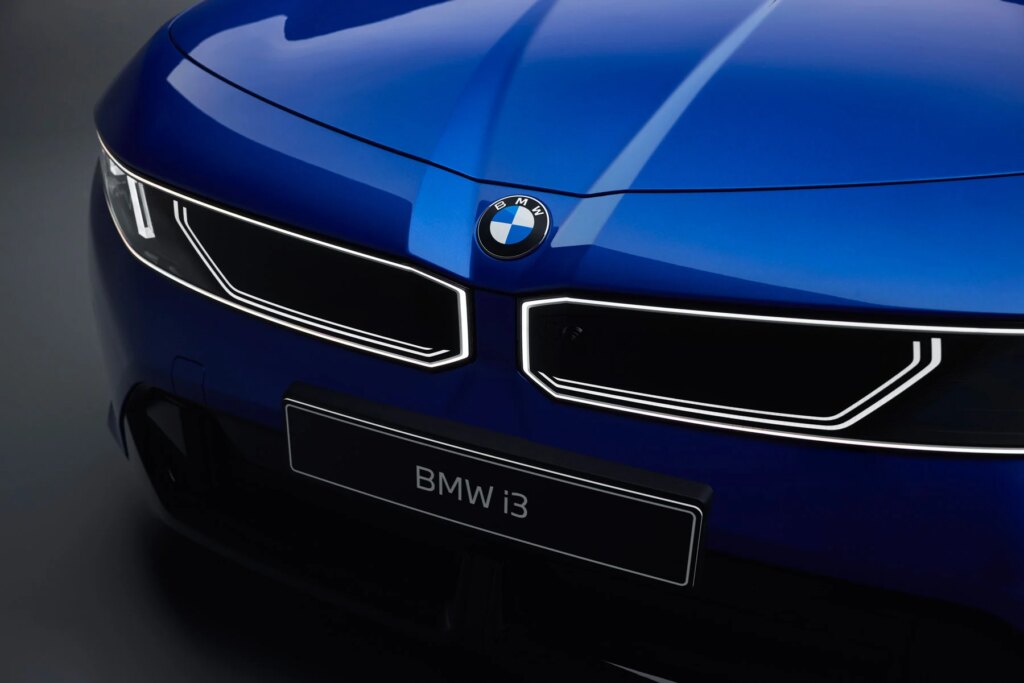
As for the design already revealed, the i3 remains very close to the “Vision Neue Klasse” study, which was presented at the IAA in 2023. This includes the headlights, which form a visual unit with the BMW kidney grille. BMW refers to this design solution as the “four-eyed face” and a new interpretation that is innovative yet familiar. At the rear, the design of the horizontally mounted taillights is also inspired by the study: the lights extend almost to the central BMW logo.
Trademark: a wide stance on the road
Very typical of the i3, the model also features a long wheelbase, short overhangs and profiled wheel arches. The door handles are now flush integrated and the range of wheels for the electric versions ranges from 19 to 21 inches. Optionally, customers can order the M Sport package and M Sport Pro package for an even sportier look. As for exterior colors, BMW is adding a new metallic blue shade to its range and, throughout 2027, numerous individual paint finishes will be available in addition to the standard color selection.
Inside, there are few surprises following the world premiere of the BMW iX3. Typical of the Neue Klasse is a minimalist design language, a striking steering wheel, a central touchscreen with angled sides and the BMW Panoramic iDrive, a continuous display strip on the lower edge of the windshield. The control logic is based on touch surfaces, haptic controls and voice-based interaction. The latter will become more dialogue-oriented in the future thanks to the integration of Amazon’s Alexa+ AI technology.
Another highlight is the large panoramic roof with climate comfort glass, which, according to BMW, combines with the window surfaces to create a “particularly airy and bright ambience.” The standard-equipped seats already offer electric adjustment options, including a memory function and Travel & Comfort System. On request, multifunction seats and M Sport seats are also available. The rear seats are optionally heated. The boot capacity specified by the manufacturer is 420 liters and a 31-litre boot is also located under the front bonnet. Maximum towing capacity (12 per cent) is 1.8 tonnes (braked) or 750kg (unbraked), with a permissible roof load of 75kg.
Hands-free highway up to 130 km/h
As for driver assistance systems, BMW says it has incorporated more advanced technologies and artificial intelligence into the vehicle. Specifically, SAE Level 2 driver assistance systems are included, such as the BMW Symbiotic Drive highway assistant, which allows hands-free driving up to 130 km/h in many countries. New functions for partially automated driving in urban areas will also arrive next year.
The i3 is manufactured at the main plant in Munich and in just over a year, only the Neue Klasse fully electric vehicles will roll off the production line there, as previously reported. The production of combustion engines at the site will therefore be phased out. Currently, in addition to the electric i3 and i4, conventionally powered Series 3 and 4 models are also produced in the state capital, including the Series 3 Touring, the Series 4 Gran Coupé and the M3. Thanks to this corporate policy, Munich will become the group’s second exclusively electric vehicle plant after the completely new factory in Debrecen, Hungary, where the BMW iX3 is manufactured. Other Neue Klasse models are expected to appear shortly, to “ensure the future viability of the main Munich plant for decades to come,” as BMW says.