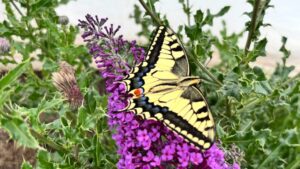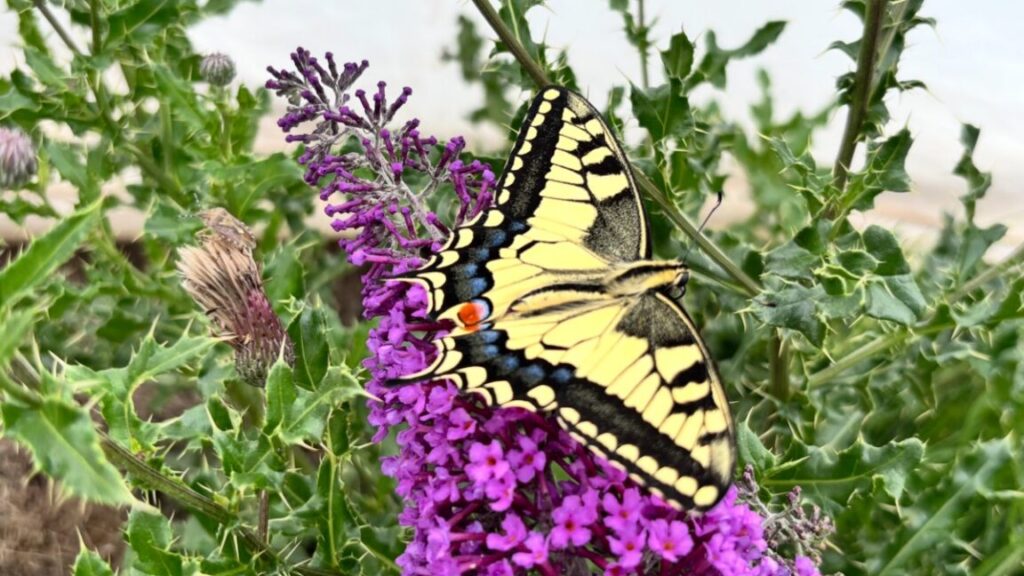
In other words, the motion effects closely resembled the illusion of a barbershop pole. This has to do with the nature of butterfly flight: the wings deform when they beat, come together when they hit, and separate when they hit. This causes the stripes to shift their angle and point in different directions. Combine that with their unpredictable flight paths, and you have an extremely effective predator control strategy. According to the authors, this is the first empirical evidence of motion glare effects caused by butterfly wings.
Photo credit: George RA Hancock and Jolyon Troscianko
Next, they created simulations of nearly 400 European butterfly species to see whether motion illusion patterns were widespread; they were. In a third phase, human volunteers interacted with the virtual butterflies and attempted to catch them on a touchscreen. Finally, the team ran genetic algorithms to simulate the development of over 50,000 wing patterns, programmed to select those that produced the strongest motion blinding effects. The algorithms selected patterns that were strikingly similar to those found in nature, so this illusory effect could be an important evolutionary driver.
The blinding effect can be achieved in several ways: contrasting vertical forewing stripes, a single vertical band, or internally contrasting wing edge patterns. And this feature likely complements other proposed adaptive functions of butterfly wing patterns. The next step is to improve the simulations to account for ventral wing patterning as well as more complex flight dynamics. However, the authors do not believe this will change their overall conclusions, just that these initial results will become more nuanced.
“The iridescent stripes on zebras and snakes have long been suspected of confusing the motion perception of predators, but hard evidence has been elusive until now,” Troscianko said. “Our study gives us a truly new way to analyze motion vision, and we believe that motion confusion is likely far more widespread in nature than previously thought, from the flapping wings of birds to the tail movements of lizards and fish. It opens an exciting new research avenue.”
Nature, 2026. DOI: 10.1038/s41586-026-11062-w (About DOIs).