
Thuringian AfD in focus: deprivation of voting rights up to ban – how to deal with the Höcke AfD?
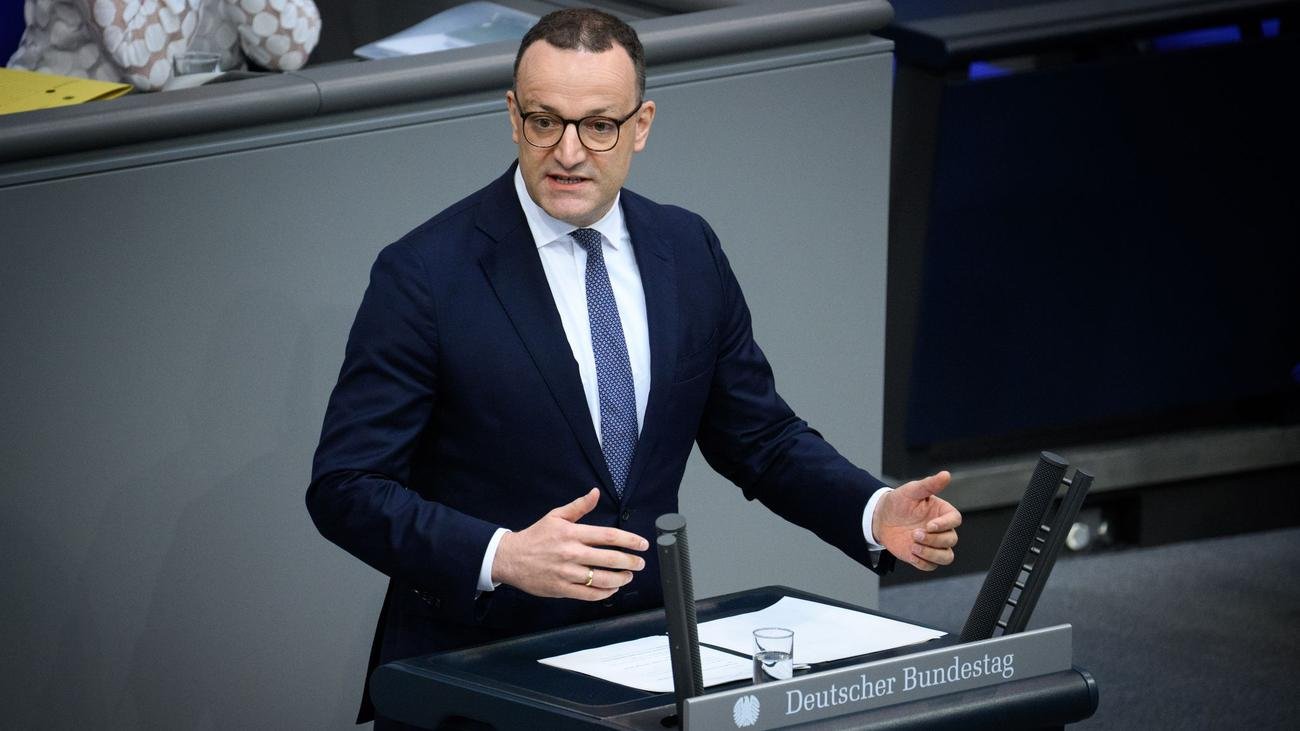
In the debate about a possible procedure to ban the AfD There is movement – the focus is on the Thuringian regional association with its boss Björn Höcke. After several CSU politicians in Bavaria had shown themselves open to banning proceedings against the Thuringian AfD regional association, Union parliamentary group leader Jens Spahn is now bringing the withdrawal of Höcke’s right to stand as a candidate into play.
“Everyone always talks about banning procedures. “How about we just do a trial and see whether we can take away the active and passive voting rights of someone on the extreme right like him,” said Spahn in the “Focus” podcast “Power People”. The active right to vote is the right to vote in an election, the passive right to vote allows you to run for office and be elected.
SPD Interior Minister speaks of rethinking in the Union
Thuringia’s Interior Minister Georg Maier (SPD) sees a rethink in the Union on the issue. That is understandable, Maier told the dpa. “Obviously the party conference at the weekend, this staging of unity, which basically conceals the fact that further radicalization has also taken place in the federal executive board, also had an impact,” said Maier. Höcke secure more and more power potential. “This makes it clear that the time is now ripe.”
At the AfD federal party conference in Erfurt, Stefan Möller, a close confidant of Björn Höcke, was promoted to the party’s board of directors and was elected deputy federal spokesman. The personnel is seen as evidence that Höcke’s influence on the federal party is growing.
A motion to revise the AfD’s incompatibility list was not voted on, but the list is now to be revised by the federal executive board. The motion, supported by Höcke among others, intended to significantly relax the rules for not admitting new party members.
Spahn and Söder emphasize demarcation
Spahn reiterated his demarcation from the AfD in the “Focus” podcast. “Anyone who is on the road for Putin, who spies for China, who is extreme and radical in their language, we separate ourselves from them, I clearly distance myself from them – politically, in terms of content, humanly,” said Spahn.
Also CSU boss Markus Söder emphasized the course of demarcation in a conversation with “Spiegel”: “Our position is clear: no cooperation with the AfD,” he told the magazine. And: “The Union must never become the AfD’s stirrup holder.” The AfD party conference in Erfurt made it clear that Höcke was the real center of the party. “He has a clearly ethnic narrative. “With anger and hatred he is preparing the breeding ground for a different political culture,” Söder told “Spiegel”.
Höcke, who was convicted twice by the Halle regional court for using a banned SA slogan, is considered a right-wing extremist in his party. His Thuringian AfD was classified as definitely right-wing extremist by the state Office for the Protection of the Constitution in 2021.
A possible ban against the AfD has been discussed for years. But the hurdles are high and there are concerns as to whether proceedings at the Federal Constitutional Court would be successful.
Federal Constitutional Court decides on deprivation of voting rights
Maier pointed out that the hurdles remained high both in seeking a partial ban and in efforts to revoke Höcke’s right to stand as a candidate. “If you think the hurdle would be lower: that’s not the case. Such a deprivation of fundamental rights is also associated with high hurdles.” In his opinion, it would still be promising to try it.
In mid-June, the SPD politician and former Federal Finance Minister Peer Steinbrück also advocated withdrawing the right to stand for election from individual representatives of the AfD, for example Höcke. The Federal Constitutional Court would also decide here, based on Article 18 of the Basic Law.
Maier advocated a ban on the AfD state association. “The Thuringian AfD is the Höcke AfD,” he said.
The openness in the CSU for such a step is new – the CSU leadership, including party leader Markus Söder, has always rejected a ban on the AfD as a party in recent months.
The federal constitutional body would have to initiate a partial ban
Bavarian CSU parliamentary group leader Klaus Holetschek said it would be much more effective than a complete party ban to solve problems and thus regain people’s trust in politics. However, he also added: “We still have to closely monitor parts of the AfD such as the Thuringia regional association, keep an eye on the threat situation and not categorically rule out at least a partial ban.”
According to Maier, the application for a partial ban would also have to come from one of the federal constitutional bodies – i.e. the federal government, the Bundestag or the Bundesrat.
There are different opinions in expert circles about the possibility of a partial ban on the party. Maier also pointed out that there was also the possibility of withdrawing party funding from the AfD. “But you have to know: the hurdles for all of these measures are almost the same,” he said.
© dpa-infocom, dpa:260710-930-364819/1