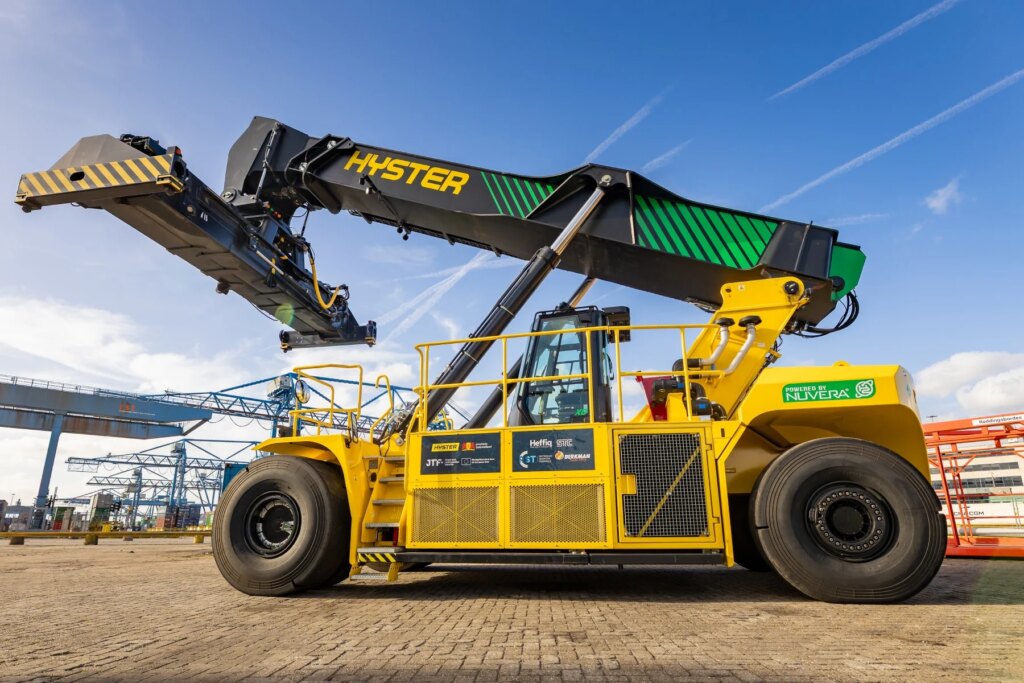
Hyster, a US provider of forklifts and container handling solutions, has equipped the Port of Rotterdam in the Netherlands with a hydrogen fuel cell-powered ReachStacker following a previous deployment in Valencia, Spain. The RSJ46-33XDH/62 model will operate at Rotterdam Shortsea Terminals (RST), Europe’s largest specialized port for short sea shipping. It will primarily handle 45-foot containers and is equipped with a dedicated spreader for this purpose.
The ReachStacker is powered by Nuvera’s 60 kW fuel cell engine, which converts hydrogen into electricity to power a 130 kWh lithium-ion battery. Hyster also emphasizes a uniform software architecture across all of its products to enable consistent operation, diagnosis and maintenance.
The Reach Stacker is part of a multi-year innovation project aimed at decarbonizing heavy material handling. The project is funded by the Province of South Holland and the Just Transition Fund (FTJ) co-financed by the EU, among others. In addition to Hyster and RST, the consortium includes Berkman Energie Services, STC Next, HarborHUB and local Hyster distributor Heffiq.
Hyster experts work closely with the dealer and customer throughout the project. “South Holland is at the forefront of the energy transition, and innovative projects like this hydrogen fuel cell-powered ReachStacker are keeping us there,” said Jeroen van Dijken, member of the South Holland provincial government.
“Ports and terminals are under increasing pressure to reduce emissions without compromising performance,” explained Lucien Robroek, President of Global Big Trucks, Hyster. “Hydrogen fuel cell technology has the potential to play an important role in applications where equipment must combine zero exhaust emissions with the power and uptime required for intensive container handling. Working together with RST and the wider project team will help us better understand how this technology can meet the future needs of the industry.”
The Rotterdam site serves as a real-world laboratory, as the project will also test a modular hydrogen refueling station to enable independent operation of a supply network. Another key component is a joint Experience Center, where employees, students and logistics experts will receive training on the energy transition and the safe and efficient handling of hydrogen.
“For us, sustainability is not just an ambition for the future; it is about the decisions we make today,” explains Arno Storm, CEO of RST. “This hydrogen refueling station and the ReachStacker powered by hydrogen fuel cells allow us to explore the transition in practice. We want to play our part, learn along the way and contribute to a cleaner, more sustainable future for generations to come.”
globonewswire.com