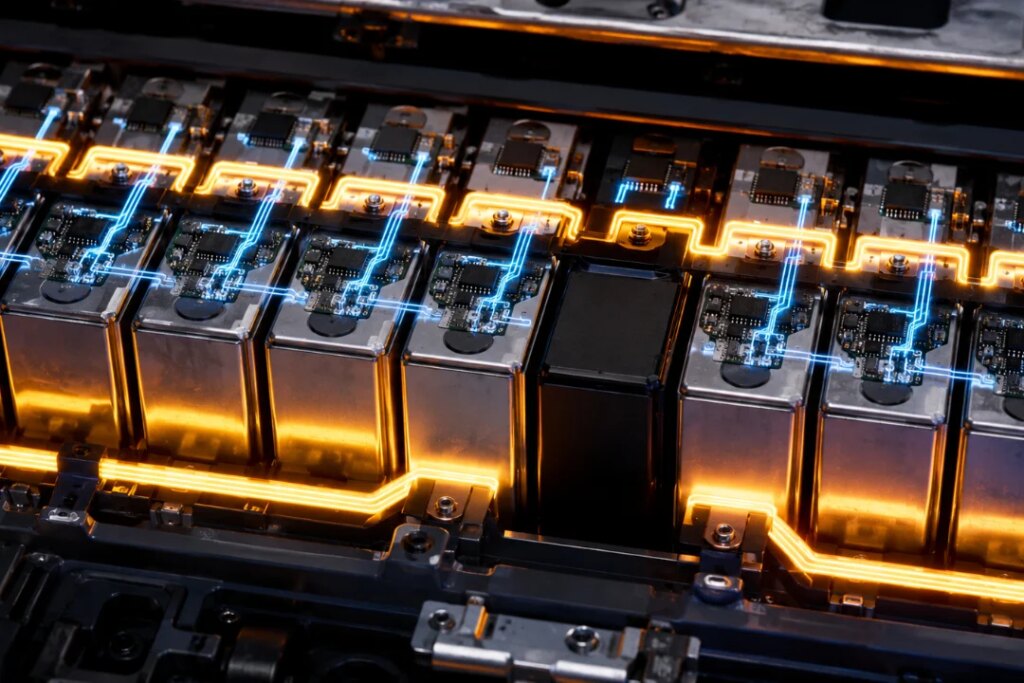
Electric vehicle battery packs consist of numerous interconnected cells that do not age at the same rate. Therefore, in conventional architectures, a particularly weak cell can limit the usable capacity and lifetime of the entire package.
This is precisely where a new study carried out by researchers at Chalmers University of Technology comes into play. It examines so-called reconfigurable battery packs, in which switches and control systems can alter the wiring of individual cells or groups of cells. In this way, weaker cells can be selectively ignored while the remaining capacity is still used.
In the most advanced case, where each cell can be controlled individually, simulations show that the lifespan of certain high-voltage vehicles can be extended by more than 20 percent. According to the study, the potential is especially significant for electric trucks and long-range electric cars with many cells connected in series.
Reconfigurable battery packs aim to avoid weak cells
To illustrate the magnitude of the effect, the researchers use an example with an 80 kWh battery and an annual mileage of 12,000 kilometers. If a conventional battery is replaced after ten years, the reconfigurable battery of the model only reaches the same aging state after about eleven years, that is, about 14 months later.
Additionally, the residual value is higher because the package has aged less. Although the technology requires additional electronics and therefore results in higher upfront costs, the study suggests that a longer lifespan and higher residual value can offset these additional costs under realistic conditions.
The technology is not yet available in production vehicles. However, it has already been tested in industrial and research prototypes. In practice, groups of cells are more likely to be used than an individual control for each cell. Therefore, more than 20 percent longer service life represents a theoretical upper limit.
Beyond extending shelf life, researchers also see advantages in production. Nowadays, cells with more similar properties must be thoroughly tested and combined. Reconfigurable packets could tolerate larger differences between cells, thus reducing the effort required for so-called cell matching.
The architecture could also offer benefits for second-life applications. Battery packs could remain in use in vehicles for longer and subsequently be better reused as stationary storage systems, as weaker individual cells would not necessarily force the entire pack to stop working.
Chalmers is already investigating several approaches to extend battery life. In May, a university team presented an AI-based fast charging strategy that adapts the charging process to the state of the battery and is expected to extend its life by about 23 percent in simulations. On the other hand, the recently studied reconfigurable battery architecture works directly within the battery pack and is designed to selectively avoid weaker cells.
The study, titled “System-level evaluation of dynamic reconfiguration for life and cost outcomes in electric vehicle battery packs,” was published in the journal Nature Communications. Researchers from Chalmers University of Technology participated, as well as representatives from PHINIA and Scania.
cision.com