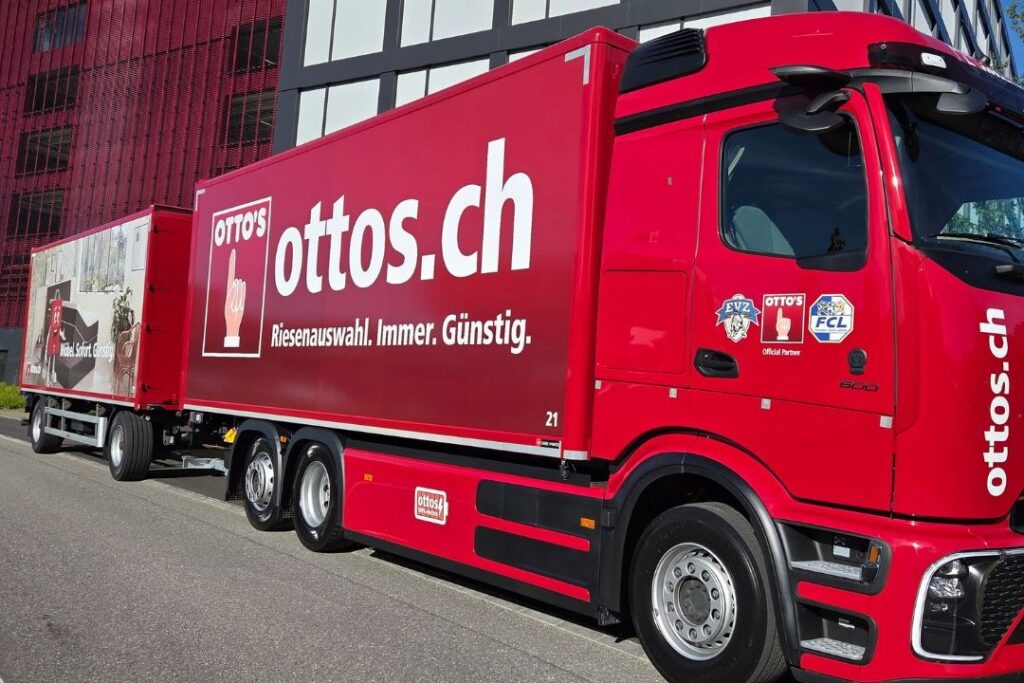
The bodywork of the 22 electric trucks was supplied by the Swiss vehicle manufacturer Lanz + Marti. The company announced on LinkedIn that it had built a full series of 22 vehicles based on the Mercedes-Benz eActros 600 for OTTO’S. The order also included two-axle trailers with plywood bodies, allowing the eActros vehicles to operate as road trains.
OTTO’S claims that, thanks to the eActros 600’s range of up to 500 kilometers, it can cover most routes without intermediate stops for charging. “Approximately 80 percent of all daily transport routes are located over this distance,” explains OTTO CEO Mark Ineichen. The eActros 600 vehicles reportedly make two to four runs daily and periodically return to the company’s headquarters in Sursee in the canton of Lucerne, where they can be charged and prepared for their next deployment.
Charging infrastructure powered by own solar energy
To electrify its fleet, OTTO’S also relies on its own energy supply. Most of the electricity needed will come from the photovoltaic system at its headquarters. The company also plans to inject solar energy from its branches into its internal network and use it to operate charging infrastructure.
With this transition, OTTO’S combines the electrification of freight transportation with the expansion of the use of renewable energy. The company’s announcement did not include details on installed charging capacities, investment costs or the specific timeline for full commissioning of the 22 vehicles.
“With the full electrification of our truck fleet, we have reached an important milestone in the development of our logistics,” says Ineichen. At the same time, the transition aims to ensure that branches can continue to receive goods efficiently and reliably in the future.
eActros 600 for long-distance transport
The Mercedes-Benz eActros 600, which has been in series production since November 2024, is designed for heavy, long-distance transport. Its three battery packs with lithium iron phosphate (LFP) cells have a combined capacity of 621 kWh. The manufacturer specifies a range of about 500 kilometers without intermediate charging. Actual range depends, among other factors, on load, route profile and driving style.
Charging is standard via CCS up to 400 kW. This makes it fundamentally possible to integrate recharging into operational processes where vehicles return to the depot between runs or during longer downtimes. For OTTO’S, the combination of autonomy and regular returns to Sursee is particularly relevant: according to the company, four out of five daily trips are within the vehicle’s autonomy.
By adding the 22 eActros 600 units to its fleet, OTTO’S is implementing electrification not only selectively but for its entire truck fleet. The deployment also demonstrates how battery electric heavy commercial vehicles can be used in branch logistics when a large proportion of the routes are within the available range and the vehicles regularly return to a central depot.
nau.ch, linkedin.com