When the ‘Transportation in Charge’ project was launched in April 2023, the landscape of the electrification of freight transport was very different: at that time, neither the Mercedes-Benz eActros 600 nor the MAN eTGX were available on the market and, consequently, German manufacturers were not producing battery-electric heavy trucks for long hauls. As a result, there was little demand for charging infrastructure tailored to trucks with huge batteries of around 600 kWh capacity.
Funded by the German Federal Ministry for Economic Affairs and Climate Action, ‘Transportation in Charge’ (TiC) initially focused on fundamental research, exploring how concepts could be designed for charging infrastructure planning for battery electric commercial vehicles on industrial estates and freight transport hubs. The underlying principle was that transport companies should not operate in isolation but adopt cooperative approaches, which makes a lot of sense in this context.
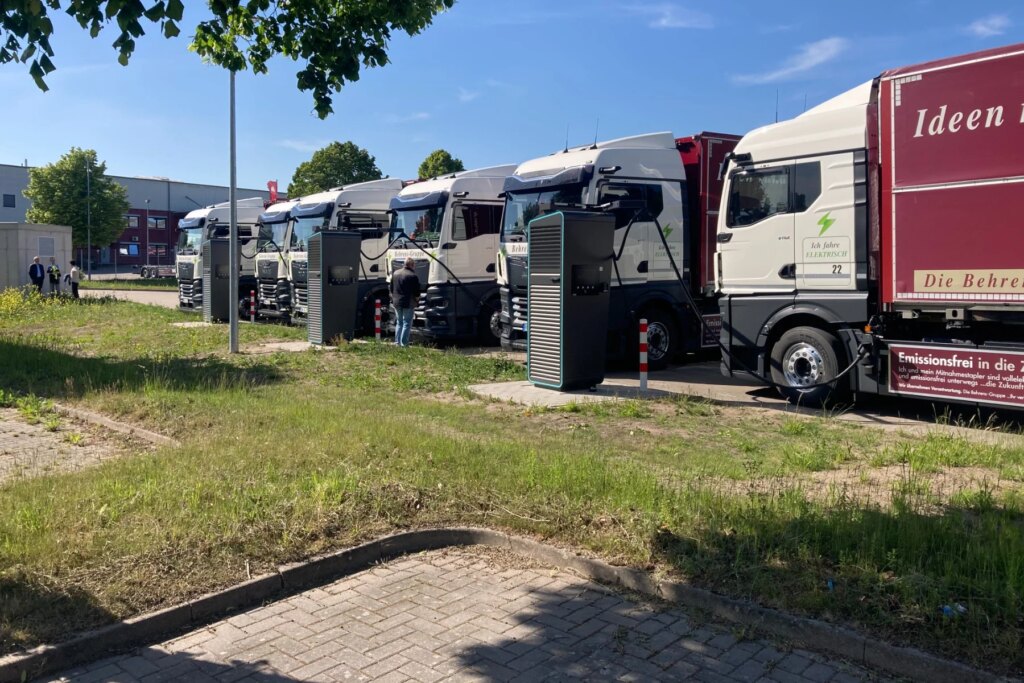
Three years later, TiC has already concluded. The project was able to closely accompany the launch of Germany’s first heavy-duty electric trucks and their corresponding charging infrastructure, with practical partners such as the Behrens Group and Rhenus Home Delivery, both operators of electric commercial vehicles. And now, project leader Sönke Stührmann and his colleague Karl Glökler from the Fraunhofer Institute for Manufacturing Technology and Advanced Materials (IFAM) have shared the main results of the project with electrive.
A central premise of the study is that industrial estates and freight transport centers represent a kind of nerve center for the electrification of freight transport. After all, these areas are where the warehouses of logistics companies are located, as well as the companies’ distribution centers and production plants. Equipping these locations with charging infrastructure allows electric commercial vehicles to be charged overnight or during loading and unloading, reducing reliance on public charging stations.
Grid connections: the bottleneck for truck charging stations
However, industrial estates also present significant challenges for the deployment of charging infrastructure, especially with regard to grid connections. Without a suitable medium voltage connection, ultra-fast chargers can only be implemented with dedicated photovoltaic systems and battery storage. Consequently, the recommendations for action published at the end of the project (available for download here) place the responsibility on the network operators: they “play a central role, since the electrification of logistics fleets can only be expanded if sufficient grid connection capacities are available in commercial and logistics areas.”
Consequently, logistics companies and transport hubs cannot simply purchase electric trucks without simultaneously ensuring the necessary charging options, and they depend on network operators to do so. “The electrification of large truck fleets will only be successful if we consider industrial estates as a holistic system. The key is an early and coordinated collaboration between companies, network operators and municipalities; technical solutions alone are not enough,” explains Stührmann.
At the same time, companies that want to integrate electric trucks into their fleets must recognize that there is no one-size-fits-all solution for charging infrastructure; Each case must be evaluated individually. The required charging power should be determined based on vehicle utilization and idle time: while standard overnight depot charging often requires 50 to 100 kW, highly scheduled transport operations may demand 200 to 350 kW. Grid connection and site conditions must also be considered from the beginning. In the practical examples examined, it was necessary to implement flexibly expandable medium-voltage connections and DC charging stations.
The TiC project also addressed how significant capital expenditures (CAPEX) for network expansion and charging hardware could be distributed across multiple stakeholders. The project’s exploration of load sharing (i.e. the joint use of charging infrastructure in industrial estates) proved to be a turning point. This approach is detailed in more detail in specific guidance and a legal opinion, both of which can be downloaded from the TiC website.
Shared pricing as a cost reduction lever
“Charge-sharing infrastructure is not just a theoretical concept, but a key lever to reduce costs, relieve grid pressure and accelerate fleet electrification. The prerequisites are clear legal frameworks, transparent roles and trust between all parties involved,” emphasizes Stührmann.
A case study from the TiC project shows that selling charging electricity to third parties can reduce total costs for fleet operators: while a fleet of ten electric trucks in the base scenario (with a holding period of five years and an annual mileage of 60,000 km per vehicle) costs around €352,859 (compared to €367,974 for diesel), these costs fall to €336,903 when additional sales of electricity to third parties. This speeds up the break-even point, but requires careful coordination of access rights and contractual frameworks. By the way, the Fraunhofer Institute IFAM generally assumes that an electricity price of around 30 cents/kWh is enough to break even with diesel trucks, even without load sharing.
“Our analyzes of real-world operational data clearly show: electric trucks are reliable today and can be economically viable. Those who integrate charging infrastructure, energy management and fleet strategy comprehensively create the foundation for a sustainable transformation,” concludes Stührmann.