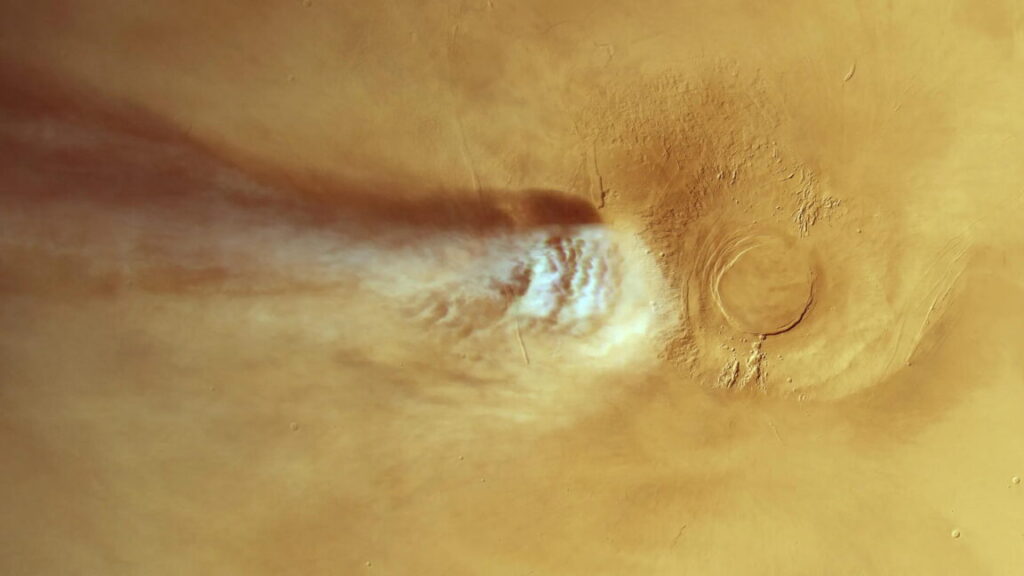
On Earth, clouds typically form when water vapor forms droplets or ice crystals in the presence of tiny particles such as dust or salt. The new study, published in Nature Geoscience, instead suggests that AMEC could form through so-called homogeneous nucleation, in which steam turns directly into ice crystals without the help of debris.
“It is comparable to droplets of condensation appearing in the middle of the room rather than on a window,” Hernández-Bernal explained. “It’s completely unexpected.”
This phenomenon requires extreme conditions – a sharp drop in temperature of 30° Celsius within 10 minutes and high relative humidity. The Arsia Mons volcano also plays a key role. When a wind current hits the 65,000-foot-tall volcano, it creates a powerful wave that sends moist air high into the atmosphere within minutes.
Scientists believe a similar phenomenon could occur in the upper atmospheres of other planets, including Venus and even Earth, but it has never been observed. That’s not all that surprising considering that this phenomenon requires extreme humidity, more than 100,000 times higher than any level measured on Earth.
Before this modeling, it was not known that this humidity also existed on Mars. “We don’t have nearly as much information about Mars’ atmosphere as we do about Earth’s, so reproducing the AMEC at this scale is a major achievement,” Hernández-Bernal said, adding, “The result is remarkable.”
This story originally appeared on WIRED Czech Republic and Slovakia and was translated from Czech.