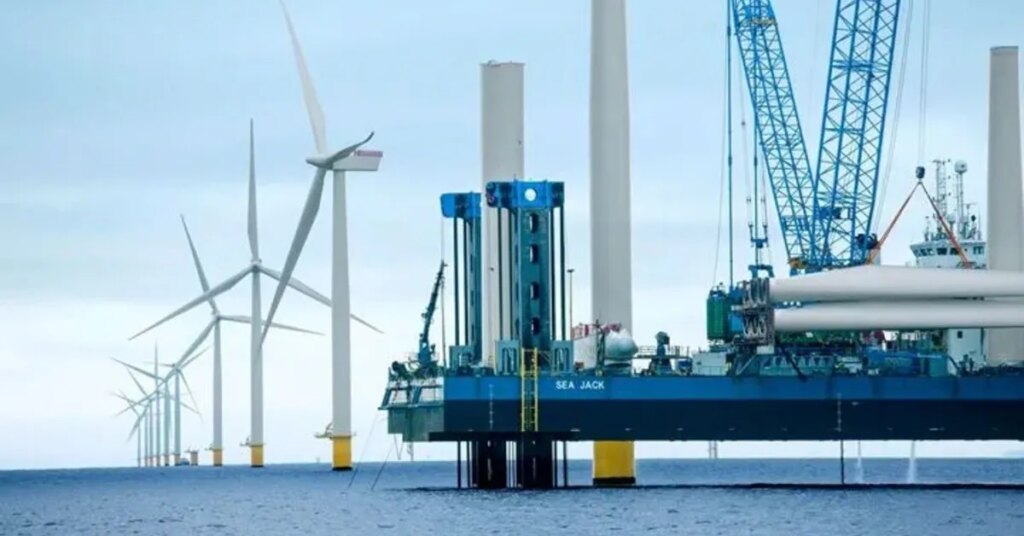
Photo: Ørsted
Over the next year, renewables’ share of total generation capacity will grow from 37.7% to 40.4%, surpassing that of natural gas and quintupling nuclear capacity, according to new data released by the U.S. Energy Information Administration (EIA) and reviewed by the SUN DAY Campaign.
Renewable electricity generation grew more than 10% during the last year
According to the EIA’s latest “Electric Power Monthly” report (with data through August 31, 2026), renewable electricity generated during the first two-thirds of 2026 was 10.2% higher year-over-year. Growth was led by utility companies. [>1 MW] solar power (up 20.0%), small-scale solar power (up 12.0%), wind power (up 7.8%), hydropower (up 4.2%), and geothermal (up 3.8%).
From January to August 2026, wind produced 333,367 gigawatt-hours (GWh), 10.6% of total US electricity generation, while small and large-scale solar combined produced 329,119 GWh (10.5%), hydroelectric produced 180,940 GWh (5.7%), biomass produced 29,917 GWh (1.0%) and geothermal. 10,766 GWh (0.34%).
By comparison, electricity production from U.S. nuclear and natural gas plants grew more slowly: just 2.6% and 1.3%, respectively. Electricity produced by US coal plants fell 8.7%.
During the first eight months of 2026, the combination of wind and solar energy, including small-scale solar, accounted for almost 21.1% of national electricity production, with wind 10.6% and solar almost 10.5%.
During the first two-thirds of this year, wind and solar combined produced 44.4% more electricity than coal and 24.8% more than nuclear.
As of the end of August, all renewables combined, including biomass, accounted for 28.1% of total U.S. electricity generation, up from 26.2% a year earlier.
Over the past year, renewable energy capacity increased by more than 43,000 MW
Between September 1, 2025 and August 31, 2026, large-scale solar installed capacity increased by 27,141.7 MW, while small-scale solar and wind capacity grew by 6,526.1 MW and 9,979.1 MW (including 800 MW of offshore wind), respectively. The combined capacity of all renewable energy sources, including hydropower, biomass and geothermal, expanded by 43,497.9 MW.
Additionally, utility-scale battery energy storage capacity increased by 17,586.9 MW.
In comparison, coal capacity fell by 2,703.4 MW, while nuclear capacity remained unchanged. However, natural gas capacity increased by 5,316.0 MW. Combined net new fossil and nuclear fuel capacity amounted to just 2,612.6 MW.
Thus, the expansion of renewable energy capacity was almost 17 times greater than the net growth of fossil fuels and nuclear energy combined.
Utility-scale renewables will add more than 53 GW of new capacity next year
The EIA projects that the rapid growth of renewables over the past year will accelerate next year.
As of September 1, 2026, renewable energy’s share of total U.S. utility-scale generation capacity was 34.5%. The EIA projects this will grow to 37.3% by August 31, 2027. Utility-scale solar will add 44,603.1 MW, expanding its share from 13.4% to 16.5%, while wind will grow by 8,312.3 MW (including 3,355.0 MW of offshore wind), increasing from 13.4% to 13.5%. The mix of other renewable energies (hydroelectric, biomass and geothermal) will add 201.9 MW.
The combined net capacity growth of all utility-scale renewable energy sources over the 12-month period (53,117.3 MW) is almost 44% higher than that aggregated over the previous 12 months (36,971.8 MW). It would raise the share of renewables in total U.S. utility-scale generation capacity to 37.3%.
Meanwhile, the EIA projects no new nuclear generation capacity and a net decrease of 1,997.0 MW in fossil fuel capacity.
With new small-scale solar, renewable energy capacity is on track to surpass natural gas by summer 2027
The figures cited above do not include small-scale solar energy. The estimated capacity of small-scale solar systems grew by 6,526.1 MW over the past year, bringing its total to 63,192.6 MW. The EIA does not provide a forecast for small-scale solar capacity growth over the next 12 months, but the SUN DAY campaign assumes it will roughly equal the 6,400 MW added on average over each of the past five years. Therefore, it is conservatively assumed that an additional 6,000 MW or more will come online next year.
If small-scale solar increases by approximately 6,000 MW by September 1, 2027, installed renewable energy capacity will increase to approximately 550,000 MW. In comparison, the projected natural gas generation capacity would amount to 518,312.8 MW.
Solar’s share alone would be more than one-fifth (20.7%) of the total US generating capacity.
Battery storage will increase by almost 44% next September
The EIA projects battery energy storage will add another 23,656.2 MW by September 1, 2027, an increase of 43.7%, bringing the total to 77,753.2 MW.
Therefore, the combination of utility-scale renewable energy sources and battery energy storage will provide 76,773.5 MW of new clean energy capacity by the end of summer 2027. With the inclusion of small-scale solar, that figure could increase to 82.8 GW of new generation capacity.
“Each new edition of the EIA’s ‘Electric Power Monthly’ reinforces the theme that the growth of solar, wind and battery storage has become unstoppable,” said SUN DAY campaign executive director Ken Bossong. “Meanwhile, the share of the country’s electricity generation and generating capacity provided by fossil and nuclear fuels continues to shrink.”
Read more: EIA: 83 GW of renewables and storage to arrive in 12 months as fossil fuel capacity falls
If you have ever considered going solar, make it easy by finding a trustworthy and reliable solar installer near you that offers competitive prices by asking energywise. They have hundreds of pre-vetted solar installers competing for your business, ensuring you get high-quality solutions and save 20-30% compared to going it alone. Plus, it’s free to use and you won’t receive sales calls until you select an installer and share your phone number with them.
Your personalized solar quotes are easy to compare online and you’ll have access to unbiased energy advisors to help you every step of the way. Start here.
FTC: We use automatic affiliate links that generate income. Further.