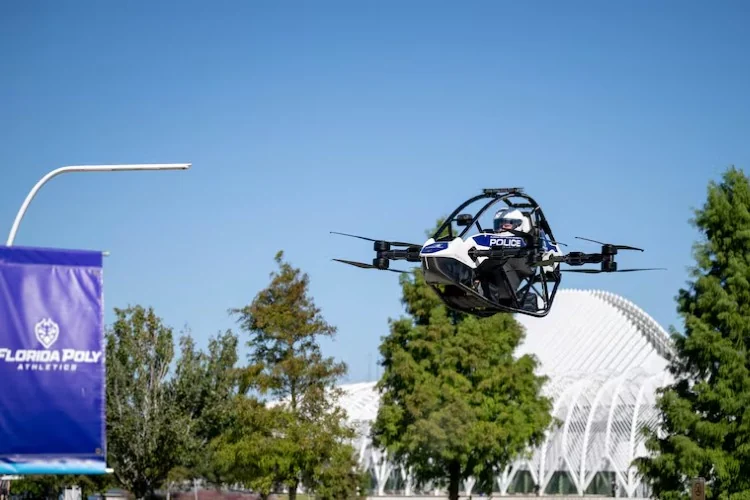
The eVTOL called “Astro” from the American manufacturer Jetson is used as a patrol aircraft. According to Florida Polytechnic University, the device is still under review by the Federal Aviation Administration (FAA) for this specific use case, and the approval process is reportedly in its final stages.
In the future, eVTOL is expected to improve the department’s ability to monitor the campus and surrounding areas, access locations difficult to reach with conventional vehicles, assist in cleanup efforts after storms, and deliver emergency supplies quickly when needed. University Police also plans to collaborate with law enforcement agencies across the region to use Astro to support emergency responses and other public safety measures.
The vertical takeoff and landing (VTOL) aircraft in question is the single-seat Jetson ONE model. According to the data sheet, the device measures 2.7 x 1.6 x 1.22 meters, with wings that can be folded to even more compact dimensions. The manufacturer Jetson specifies that the total weight is 115 kg, including lithium-ion batteries. These support a flight time of approximately 20 minutes. The maximum speed is 102 km/h. The company has not provided further details about the powertrain or batteries.
“Advanced air mobility is a growing technology and we can choose to be proactive or reactive as it develops,” said Aaron Murray, University Police Chief. “We want to stay at the forefront of this technology and understand how it can be used to improve public safety and airspace security as a whole.”
Stéphan D’haene, CEO of Jetson, adds that his California-based company prioritized Florida Poly’s order for the Jetson ONE aircraft despite a three-year wait list, due to the university’s focus on STEM and the police department’s goal of ensuring public safety. Both align with Jetson’s vision for the future of safe flight. “In our business plan and consistent with our mission, we have always looked for the use case beyond recreational intent,” D’haene said. “We believe this project is so important and so aligned with what we want to do that we made it a priority.
Beyond its applications in public safety, “Astro” is also intended to serve as a practical learning and research tool for students and faculty at the university. This fall, the university introduced a new degree program called “Aerospace Engineering,” which gives students the immediate opportunity to study new flight technologies in a hands-on environment, according to an accompanying release.
Central Florida is already at the forefront of developing new air mobility solutions. For this reason, the American state was recently selected to participate in the Federal Aviation Administration’s “Advanced Air Mobility and eVTOL Integration Pilot Program.” The program aims to integrate next generation aircraft into the national airspace. Conveniently, just four miles from Florida Polytechnic University is the nation’s first dedicated air test track, where initial eVTOL testing will begin later this year. The so-called SunTrax facility in Auburndale is operated by the Florida Department of Transportation (FDOT).
yahoo.com, floridapoly.edu, jetson.com