Support CleanTechnica’s work through a Substack subscription, on Patreon, or on Stripe. Help us produce all the original, high-quality content we publish week after week despite the challenges of AI deleting content, anti-social media, inflation and other obstacles.
I’ve been using the Jackery HomePower 1000 Plus v2 in a wide range of applications for the past few months in my apartment in Queens, New York. The flexibility and portability make it especially useful for people who live in apartments. I had previously written about the Jackery HomePower 1000 Plus v2 when it was released. You can read more about the technical specifications in that article.
Overall, the battery charged in about an hour. It starts charging at just over 1000W and then drops to just over 800W as it charges. The first thing I connected to the battery was a fan, which consumed about 50 watts. I then plugged in my laptop, which charged at another 50 watts. I was able to work comfortably for a day without battery and with capacity to spare.
Staying on the cool side, the battery was easily able to run my 12,000 BTU window air conditioner on a warmer day. Being in a century-old pre-war building, the isolation could leave a lot to be desired. Additionally, my corner apartment with large windows and 10-foot ceilings contributes to the load. Air conditioners can be a challenge for power, as power consumption tends to increase when the compressor kicks in, but it was not a challenge for the battery. On a day in the mid 80s Fahrenheit, the battery was able to keep the interior temperature in the mid 70s Fahrenheit all day with capacity to spare. Also, since my wife likes to plug her 1750W clothes iron into the same circuit as the air conditioner, adding the battery could reduce the chance of the circuit breaker tripping when the compressor kicks in. It would be helpful to maintain comfort during a power outage.
In terms of keeping things cool, the battery tends to use a little more than 3% of its capacity per hour in my 14.1 cubic foot Midea High Efficiency refrigerator during the day with the door opened periodically. With the door closed, it would be closer to 2% per hour. That could potentially prevent food from spoiling for a couple of days during a power outage. While Jackery makes the FridgeGuard specifically for this application, the Jackery HomePower 1000 Plus v2 could be useful for additional capacity during an emergency.
The battery would also be useful for people with fish tanks to keep the pumps running during a power outage. I have an aquaponics setup with some small fish to grow herbs and sow seeds in the spring. The battery can easily power filters, pumps and heaters, as well as powerful plant lights. However, for someone with exotic fish in a saltwater aquarium, battery backup could be essential to keep the fish alive during a power outage.
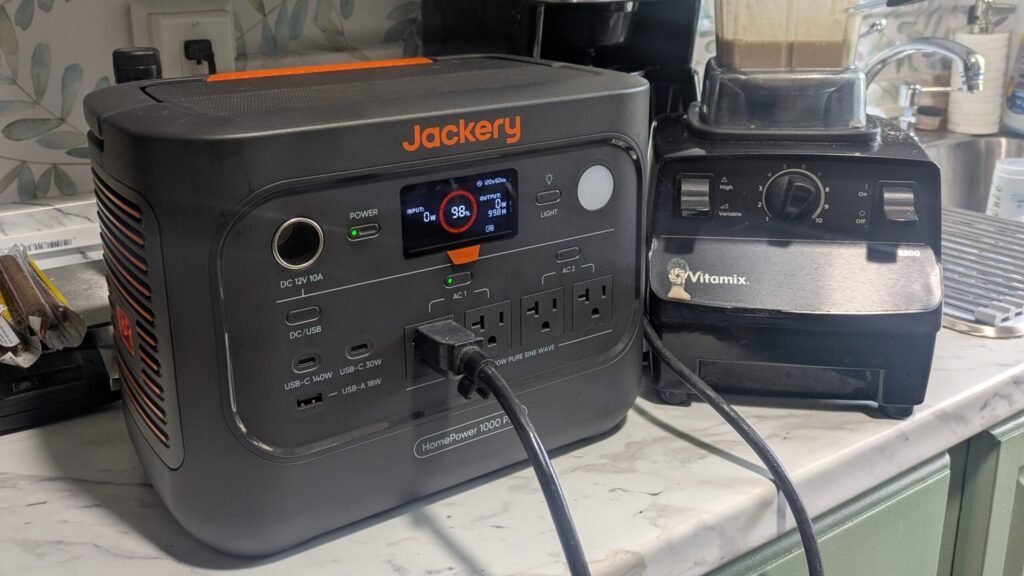
Additionally, I was able to run my Vitamix blender with the HomePower 1000 Plus v2. The powerful motor can consume more than 1000W, but it doesn’t take long to prepare a smoothie or frozen drink. As such, you can easily make frozen margaritas at a backyard party by using the battery to power the blender.
In terms of cooking, the battery could easily handle my rice cooker and Instapot pressure cooker for long cooking times. I was able to cook an 8 pound pork roast in the pressure cooker. It also had enough power to run my air fryer and microwave. However, since the air fryer draws up to 1700W, it depletes capacity quickly, even though the load is within the battery’s 1800W continuous rating. Having a kettle or coffee maker is not a big challenge. You could also use an electric grill, although I haven’t had a chance to try it yet. This could make an outdoor meal more convenient, as well as reduce the risks associated with fire-based grills in dry areas.
After all that, I needed to clean up. I was able to run my dishwasher on the battery. Heating water is clearly an energy-intensive area, but I was able to run the dishwasher through a full cycle with room to spare. I was also able to run my portable washing machine off the battery. While the loads were not massive, the voltage fluctuates significantly while operating. It didn’t create a problem for the battery. Of note, these are efficient appliances the size of a New York apartment. Many Europeans use similarly sized appliances, but Central American McMansions tend to use more energy-efficient models. Your mileage may vary.
Change to a work environment. I was able to easily charge my laptop, run the router, charge my phone, etc., with capacity to spare. You could easily keep an office running during a power outage. Or set up a remote office during the day and charge it again at night.
I also used the battery to power my Bambu Labs X1-C 3D printer. Overall, the charge is small enough to produce large prints that last for hours using only the battery for power. However, when plugged in, the battery can ensure consistent power across multiple prints. I used a power strip to turn the battery on and off on several occasions. There was not a flicker or the slightest variation in the print layers. If you’ve ever had a power outage during a complicated, multi-hour print, the benefit is clear. In the future, I wouldn’t use the printer on large prints without the battery. In addition to serving as a high-capacity UPS, I was also able to change the printer’s electricity consumption over time.
Using the Jackery app, I was able to easily configure the battery to use a TOU utility plan. By entering hours and rates, you can even calculate savings. Additionally, you can program the battery to retain a set amount of capacity as a backup, seamlessly switching to input power when that capacity level is reached.
For Con Edison small business TOU rates, the maximum electricity supply from 8 am to 10 pm is $0.5443/kWh from June 1 to September 30 and $0.2680/kWh all other months. In low season it costs only $0.0199. Of note, this does not include service charges, delivery charges and separate taxes, which on my last utility bill came out to $0.3378/kWh in addition to electricity supply charges. Electricity is expensive in New York. However, many small businesses rent and do not have panel access to take advantage of the potential TOU savings of a larger battery at that location. Smaller batteries can be deployed at the point of use, such as a workstation. As such, a battery like a HomePower 1000 Plus v2 in each workstation could save approximately $0.50 per day in summer and $0.25 in winter. Payback could come in a few years. If a company changed locations, it could easily take the batteries with it. However, the ability to provide UPS battery backup could also pay for itself quickly if work could continue uninterrupted, work in progress could be saved, and sensitive equipment could be protected.
To go a step further, the HomePower 1000 Plus v2 can directly take solar DC input. This does not feed back into the grid, but could provide energy for different uses. This could be useful when camping or even with a more permanent solar installation to power an appliance, workshop or small office. While it would not replace the capacity of balcony solar, the ability to run small-scale solar-powered appliances that do not feed into the grid could provide some of the benefits while balcony solar regulations are determined.
Overall, I found the battery to be more useful than I originally anticipated. I tended to look at the power rating of different devices and assumed that they would consume it all the time and drain the battery quickly. However, many turn on and off, making the 1024 Wh of battery last much longer than I would have thought. Additionally, the Jackery’s power and capacity ratings appear to be conservative, allowing me to use it up to the nominal limits without problems. And the portability allows me to comfortably test it in a wide range of applications. Living in an apartment with efficient appliances also fits many of my potential use cases. And it offers people who live in apartments and don’t have the ability to modify the panel many of the benefits of battery storage. However, if the HomePower 1000 Plus V2 turns out to not be enough for your needs, Jackery also offers expansion batteries to increase capacity, in addition to offering higher capacity models. While travel conflicts haven’t yet given me a chance to try it out for camping, I hope to use it outdoors soon.
Of course, Jackery also offers much larger batteries. And there are some even smaller batteries coming. But that is for another article.
Jackery provided the HomePower 1000 Plus v2 for review, but did not pay for the review. The thoughts here are my own.
Sign up for CleanTechnica’s Weekly Substack to get in-depth analysis and high-level recaps from Zach and Scott, subscribe to our daily newsletter, and follow us on Google News.
Do you have any tips for CleanTechnica? Do you want to advertise? Want to suggest a guest for our CleanTech Talk podcast? Contact us here.
Subscribe to our daily newsletter to receive 10-15 new cleantech stories per day. Or sign up to receive our weekly newsletter on the week’s top stories if the daily grind is too much.
CleanTechnica uses affiliate links. See our policy here.
CleanTechnica Comment Policy