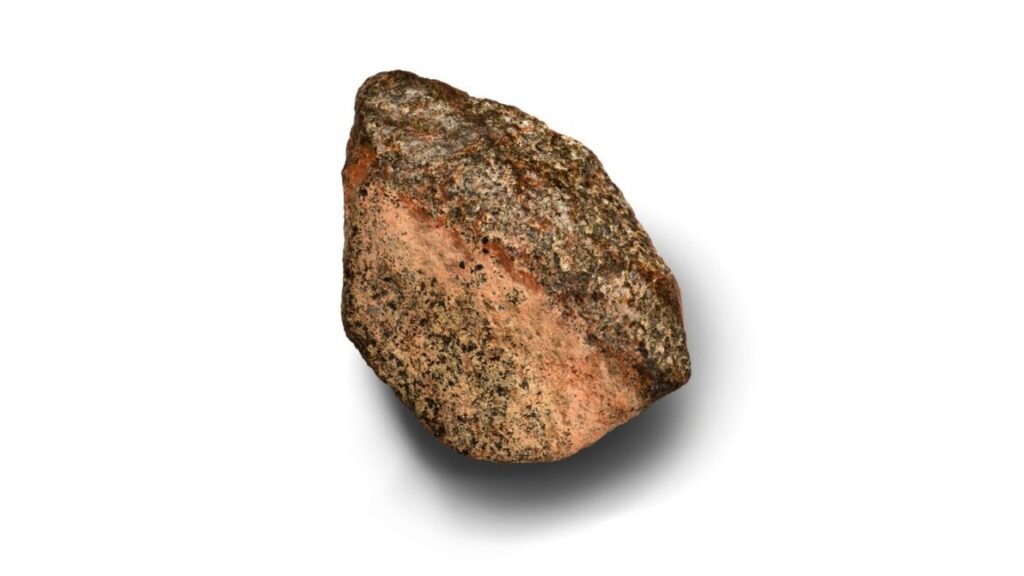
Teghaza 001 was acquired through the desert meteorite trade, in which hunters comb the Sahara for dark stones that stand out against the sand. Its eight stones, weighing a total of just under 800 grams, were purchased by a private collector who sent a piece to the University of New Mexico for classification. There, planetary scientists Carl Agee and Karen Ziegler measured its oxygen isotopes. “Each planetary body has a very characteristic oxygen isotope value,” says Liu. The values of Teghaza 001 were consistent with those of other Martian meteorites.
Initially, the rock was classified as shergottite, the most common (and youngest) type of Martian meteorite. But Agee noticed some oddities and turned to Liu. One of Teghaza’s minerals was altered internally while its external part remained pristine – the opposite of how weathering works on Earth. The oxygen isotopes looked a bit strange and there was manganese-rich material, similar to what Liu had examined in Black Beauty.
“When I got to rehearsal, I looked around and said, ‘This is boring,'” Liu said. “The high manganese material actually comes from Earth, but I quickly realized that the sample was very different and very special.”
Teghaza 001 is mostly composed of feldspar, a light-colored mineral found in the crust of rocky planets. There are darker pyroxene crystals mixed in; According to Liu, these are similar to some rocks exposed in the lunar highlands. Its crystals are quite large, up to a millimeter in diameter, which scientists interpret as an indication that it cooled slowly. “Rocks that cool slowly tend to have time to grow larger,” Liu said.
By comparing the crystals with laboratory experiments and terrestrial rocks, the team estimated that Teghaza 001 cooled by about 0.01° Celsius per year, suggesting that it formed from magma that never erupted but solidified within the crust.