The previous roadmap called for each generation to increase this number, with the 2027 version expected to reach 10,000 gate operations while maintaining the hardware qubit count of 120. But instead of increasing the number of qubits in the processor, daisy-chaining multiple chips would increase the number of qubits. This is something it will have to do at some point in order to also offer a useful number of error-corrected qubits. In fact, the company’s most recent roadmap called for connecting three Nighthawk processors together in 2026 to create a 360-qubit machine.
It doesn’t look like that’s going to happen this year. Instead, this year’s Nighthawk r2, released in September, is offered as a single chip. But IBM says it offers a big performance boost compared to r1.
The main reason for the boost is that IBM has dedicated a lot of hardware to resetting qubits to the default state. This includes physical qubits that are not used for computation – the company says there are 458 physical qubits, but only 120 are programmable.
“This is an additional physical qubit that we integrate on the chip for each programmable qubit and allows us to quickly remove energy from one of our programmable qubits and return it to the ground state,” said Oliver Dial, vice president of Quantum Systems. “This capability allows our users to run circuits on this chip faster than ever before.”
This isn’t necessary for every process, but it does seem to speed things up significantly – IBM reports up to 19x speedup for some processes.
(The devices in question here are physically identical to programmable qubits, but cannot be used as qubits, so the terminology is a bit strange; in some cases IBM refers to them as “dissipative reset gadgets.”)
Connections
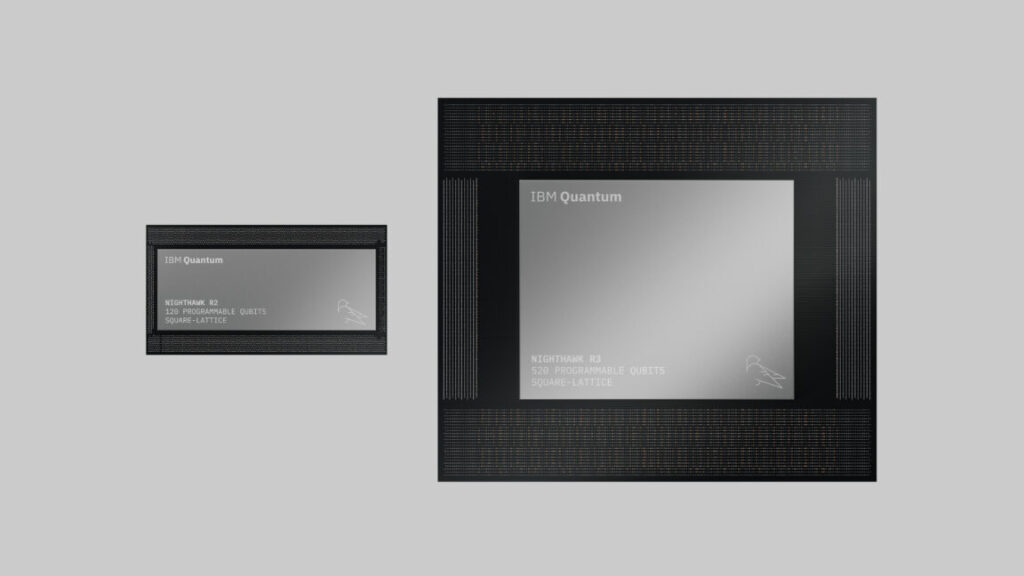
The plan for Nighthawk r3 in 2027 is apparently to retain this performance-enhancing technology and combine it with other hardware improvements to further increase the number of operations that can be performed without errors becoming too likely. It will also significantly increase the number of qubits, with a goal of 520 programmable qubits. Assuming the ratio of programmable qubits to reset devices remains the same as the R2, that would suggest the company will make a chip with around 2,000 individual qubit-like devices. That’s about twice the size of the largest quantum processor the company has offered to date.