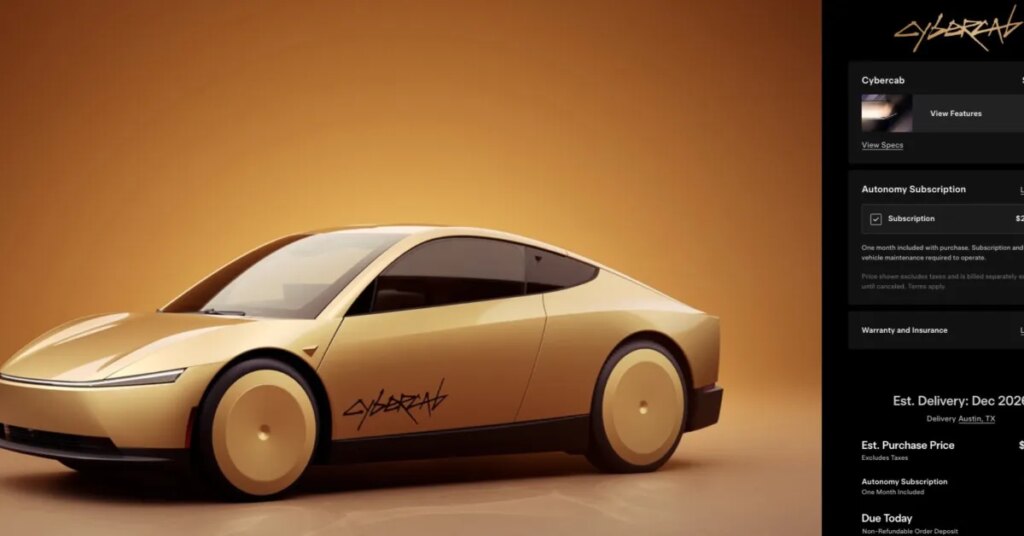
Tesla is now inviting “select customers” to purchase a Cybercab for personal use for $29,990, but the car won’t move unless you also pay $299 a month for an “Autonomy Subscription.”
And it only works within Tesla’s Robotaxi service areas in Texas and Florida, the same geofences that turned out to be significantly smaller than Tesla advertises.
What Tesla sells
Tesla’s official Robotaxi account announced the invitations on X on Friday with screenshots of the order page and invitation email.
The order page lists the Cybercab at $29,990 before taxes, with delivery estimated for December 2026 in Austin, Texas. A $1,000 non-refundable deposit is required to place your order.
Subscription is not optional. It’s pre-verified on the order page for $299 per month, with one month included, and the fine print says “Subscription and regular vehicle maintenance required to operate.”
Email is even more direct. Its asterisk says: “Only available in supported service areas. Subscription required to operate.”
The rest is what we already knew. Two seats, a 21-inch center touchscreen, 20.1 cubic feet of cargo space, and no steering wheel or pedals. Tesla calls it “fully autonomous” and says “you’ll manage your ride in the app.”
Musk had promised a Cybercab “for less than $30,000” when he presented it in 2024. Technically he delivered. He just didn’t mention the $3,588 a year it takes to use it. Over five years, that works out to about $47,600 for a two-seater, before insurance, maintenance, taxes and fees.
“Supported service areas” means Texas and Florida
Tesla operates its Robotaxi service in eight cities: Austin, Dallas, Houston, Fort Worth and San Antonio in Texas, and Miami, Orlando and Tampa in Florida. That’s where a Cybercab can work. Everywhere else, there’s a $30,000 sculpture in your driveway.
And those service areas are not what Tesla says they are. Independent tracker Koby Pierce tested thousands of addresses on the Robotaxi app and found that the areas where Tesla actually accepts pickups and drop-offs are only 59% to 78% of the advertised geofences in the six cities he reviewed. In Austin, the same city where Tesla delivers these cars, it’s about 59%.
Railroad crossings are one of the main reasons. In Houston, the creator of Robotaxi Tracker found that the app indicated about 40 minutes to travel two blocks downtown because the vehicle seemed to go around railroad crossings. Tesla also includes the San Antonio airport within its polygon, but does not provide service there.
Then there is the regulatory cloud. NHTSA has ordered Tesla to prove under oath that a car without a brake pedal meets federal safety standards that require it. Tesla responded on October 30 and asked that the entire response be kept confidential. NHTSA has not commented. Regardless, Tesla is now selling the car to consumers.
Electrek’s opinion
I think this is going to be a total disaster. It appears that Tesla is doing this by invitation only and delivering it in Austin to demonstrate that they can deliver an “unattended” vehicle in 2026.
Tesla will sell them to fans who are excited about the idea of having a self-driving car, and many of them will find that the limitations aren’t worth $299 a month on top of a $30,000 car.
Sure, if your monthly Uber bill is over $300 and you live and work within the geofence, maybe the math works out on paper. Until you realize that you have to park it somewhere once you reach your destination. Or that he can’t take you to a friend’s house two neighborhoods away. Or that a 15-minute trip turns into an hour because the car doesn’t cross the train track. With an Uber or a Waymo, that’s someone else’s problem. With a Cybercab, you are paying for the privilege.
And here’s the part that doesn’t make sense to me. The Cybercab runs on the same AI4 computer as the current Model Y. Tesla already runs Model Y Robotaxis unattended on these same geofences. So why can’t Model Y owners who have already paid for “fully autonomous driving” operate unsupervised in those same areas? Wouldn’t it be even easier to activate that in these vehicles that have accumulated much more data? Tesla continues to push for “next year,” currently around the second quarter of 2027, while asking people to buy a new two-seater that can’t do anything else.
If the technology works unattended in Austin, turn it on for Model Y owners in Austin. If not, why should anyone pay $47,000 over five years for a car that only works where Tesla says it works?
As with all other Tesla products lately, the version delivered will be much more disappointing than the one sold on stage.
If you’re purchasing an electric vehicle, powering it with home solar can reduce your fuel costs to almost zero and it works anywhere, without the need for geofencing. With electricity rates increasing nearly 10% last year and expected to continue rising, solar energy is one of the best ways to protect yourself against rising costs. And with leasing and PPA options, you can do it with no upfront cost and start saving right away. If you want to find the best deal, check out EnergySage. It’s a free service with hundreds of pre-vetted installers competing for your business, so you save 20-30% compared to going it alone. No sales calls until you choose an installer. Get your free quotes here.
FTC: We use automatic affiliate links that generate income. Further.