On-demand fuel transfer
For Starship, orbital refueling remains the key to the Moon. SpaceX’s fuel transfer demonstration will involve two spacecraft, one from Florida and one from Texas, docking in low-Earth orbit and transferring a “significant” amount of fuel from one ship to the other, Creech said.
“In the first quarter of next year, we’re going to see a long-awaited fuel transfer test from SpaceX where they launch two spacecraft at fairly close range, actually dock them, and transfer what we call a significant amount of fuel,” Creech told Ars. “That’s going to be a big learning point if they pull that off, because their architecture is based on fuel aggregation and multiple fuel flights.”
The fuel transfer test will be the first time a spacecraft has offloaded a significant amount of cryogenic fuel– in this case methane and liquid oxygen– to another vehicle in space. It is the culmination of decades of government and commercial research into orbital cryogenic refueling. The results will tell engineers how much fuel is lost to evaporation during the transfer.
An artistic illustration of two spaceships docked together in low Earth orbit.
An artistic illustration of two spaceships docked together in low Earth orbit.
Photo credit: SpaceX
That’s one reason why there’s still so much uncertainty about how many Starship tankers SpaceX will need to launch to give the Starship lunar lander enough fuel to fly to the moon. Without refueling, spacecraft are limited to flights in low Earth orbit.
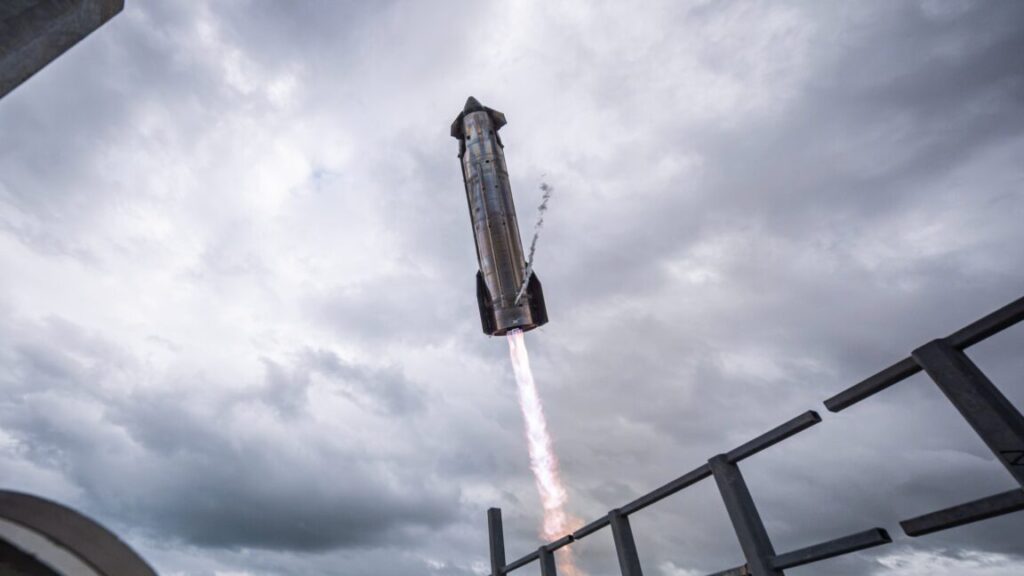
The low end of the estimate for Starship tankers is six to eight refueling flights in support of a Starship lunar mission. These numbers come from Elon Musk, the founder and CEO of SpaceX, and are below NASA’s conservative planning number of 20 refueling launches. Musk’s numbers depend on future Starship upgrades to realize the vehicle’s full potential. SpaceX’s goal is to increase Starship’s carrying capacity to 100 to 200 tons of payload into low Earth orbit. Today’s version of Starship, known as Starship V3, still has far less than 100 tons of payload capacity.
For comparison: a spaceship carries 1,600 tons of fuel with full tanks. During refueling flights with future, fully optimized spacecraft, these tanks could potentially be filled with just six tankers. That is no longer the case today.
SpaceX is working on a larger, heavier spacecraft called Starship V4. It will fly with nine Raptor engines, an improvement over the six-engine variant flying today. In 2025, Musk said the first launch of Starship V4 was planned for 2027. There has been no recent update to the Starship V4 schedule.
The first Artemis lunar missions will use Starship V3, Creech said.