In April 2025, Karambelkar’s team published a paper indicating that this system, called AT 2025abao, was undergoing ongoing flooding. At the time, however, they couldn’t rule out a competing explanation: a single star with instabilities deep in its core. So they kept watching.
Decades of data
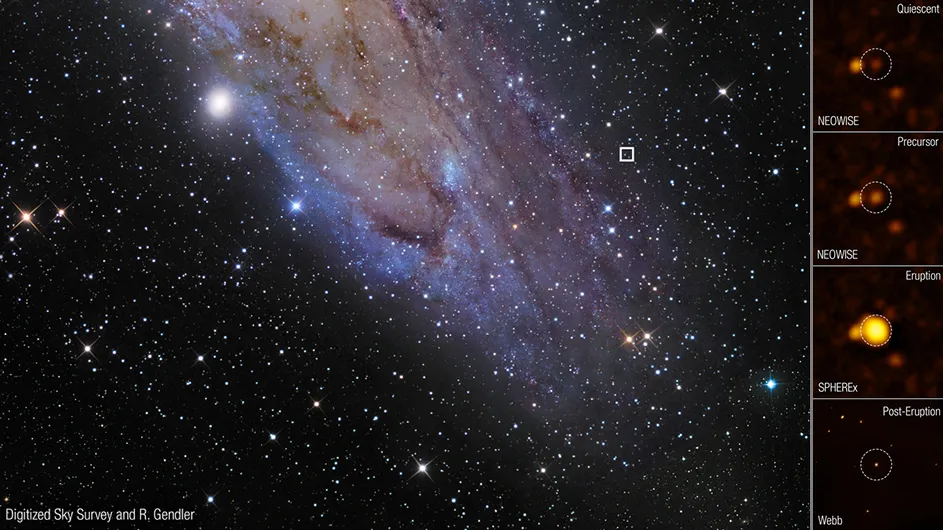
The researchers reconstructed the history of the system using observations from about a dozen telescopes and surveys, going back to photographic sky plates from 1989. Until 2018, the star hardly changed. Modeling these quiet years revealed a late-life giant about 350 times wider than the Sun. However, his companion was not to be seen. “The giant star outshines the smaller star by a factor of 18,000,” said Karambelkar.
To get around this, the team estimated the mass of the smaller companion based on the amount of dust the system shed before envelopment. The estimates suggested a star with about 0.7 solar masses.
Between 2018 and early 2025, the giant brightened and swelled two to three times in visible light, while its temperature remained nearly constant. Karambelkar compares the process to the re-entry of a spaceship into the Earth’s atmosphere. The companion, flying through the giant’s outer layers, saw its orbit gradually shrinking and friction heating the envelope. The energy released by this resistance corresponded to the additional light the team observed.
Then the star’s visible light fell by half, while its infrared light continued to increase. NASA’s SPHEREx space telescope caught it by chance in July 2025, revealing that the giant had grown to about 860 times the width of the Sun and was covered in fresh dust.
A bomb in a star
In October 2025, the star became about 100 times brighter in just 25 days, shining like 1.5 million suns at its peak. “At some point, the rate at which the orbit decayed became very, very fast,” Karambelkar said, comparing the release of gravitational energy to an explosion. “The companion simply fell very quickly, very deeply into the shell of the star, and crashed into the core. This violent fall triggered a bomb inside the star, and this explosion caused it to brighten very quickly and expel some of the material.”