Within the framework of the StruBiPlate research project, the Fraunhofer IWU investigated together with its partners how bipolar plates for fuel cells can be made lightweight using carbon fiber reinforced plastic (CFRP). The focus was on developing new manufacturing and structuring processes to combine the advantages of metallic and graphite bipolar plates. For aviation applications, weight and installation space are particularly critical factors.
Bipolar plates perform several functions within a fuel cell stack. They distribute reaction gases through fine channel structures, enable electrical connections between individual cells, and support thermal management. Until now, metals and graphite were mainly used for this purpose. While metallic bipolar plates are relatively thin and mechanically robust, graphite offers good electrical conductivity and chemical resistance. However, due to its mechanical properties, graphite requires higher wall thicknesses.
CFRP offers an alternative. This fiber composite material combines high strength with low weight. Furthermore, its thermal properties can be tailored by adjusting the orientation of the carbon fibers and the structure of the individual layers of the material.
Initially, the researchers examined whether the necessary channel structures could be stamped directly into CFRP material. However, more than 35 individual tests demonstrated that formability reaches its limits, particularly when the channel paths run perpendicular to the fiber direction.
Fraunhofer combines CFRP with metal
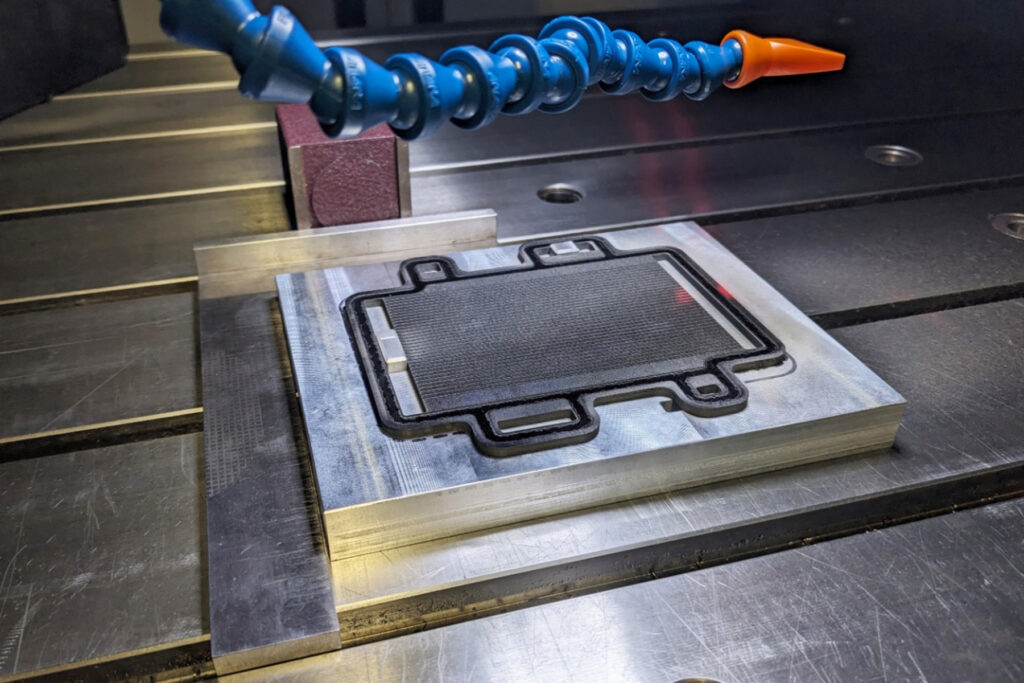
The team then developed a hybrid approach in which a flat CFRP base plate is combined with a metal flow field. To do this, the researchers cut the necessary channel structures from stainless steel and laminated them onto uncured CFRP. The laser pretreatment increased the surface roughness of the metal approximately six times, improving the conditions for joining the two materials. The subsequent lamination process was successful with all five tested surface variants.
In parallel, the Fraunhofer IWU tested the direct structuring of already hardened CFRP plates using ultrashort pulse lasers. By optimizing the process, the team managed to produce complete flow fields and reduce the average deviation of the CAD model to 0.01 millimeters.
The corrosion resistance of the bipolar plates was also investigated. A project partner coated the CFRP samples with a combined layer of copper and nickel. According to Fraunhofer IWU, one of the analyzed samples achieved a corrosion current density and corrosion potential comparable to that of titanium. Finally, the researchers produced bipolar plate demonstrators, developed compatible seals, and assembled a stack of samples. A leak test with nitrogen at a pressure of 1.4 bar showed no pressure drop. However, further investigations revealed that it is necessary to analyze the pressure distribution inside the chimney more precisely.
Further development steps are needed before industrial production can begin. For example, laser processing of a single side of the flow field in the demonstration stage still took several hours. It is also necessary to demonstrate reliable long-term interaction between CFRP, metal structures, coatings and seals.
The StruBiPlate project, funded by the Federal Ministry of Research, Technology and Space, was implemented in collaboration with Connova Deutschland, Sächsische Walzengravur and the Leipzig Research and Transfer Center at HTWK Leipzig. The hydrogen association HZwo participated as an associate partner.
According to Fraunhofer IWU, the results lay the foundation for further development of particularly lightweight bipolar plates. It remains to be seen in future studies whether this will allow the weight and installation space of complete fuel cell systems to be reduced in the future.
Fraunhofer is also expanding its research into hydrogen technology elsewhere. In October, the ZESS Center for Energy Storage and Systems was opened in Braunschweig, which, in addition to solid-state batteries, is also dedicated to the advancement of hydrogen technologies.
iwu.fraunhofer.de