Battery storage systems are now a fixed part of the expansion plans of many fast charging providers. This includes Electra, the French company that recently made headlines with the acquisition of Mercedes-Benz’s 47 fast-charging parks in Europe. With this measure, Electra now operates more than 800 charging parks with around 5,000 charging points in ten countries.
To discuss how important battery storage systems are today and why they will be even more important in the future, we spoke to Paul Tonini, CEO of Electra Deutschland. Not only does he provide hard numbers on the current and future inventory of battery storage systems, he also explains their role in the business model, their limitations, and why he would like to see more support from policymakers and grid operators. He warns: “Battery storage should not be considered a panacea.”
How many sites with battery storage systems does Electra currently operate?
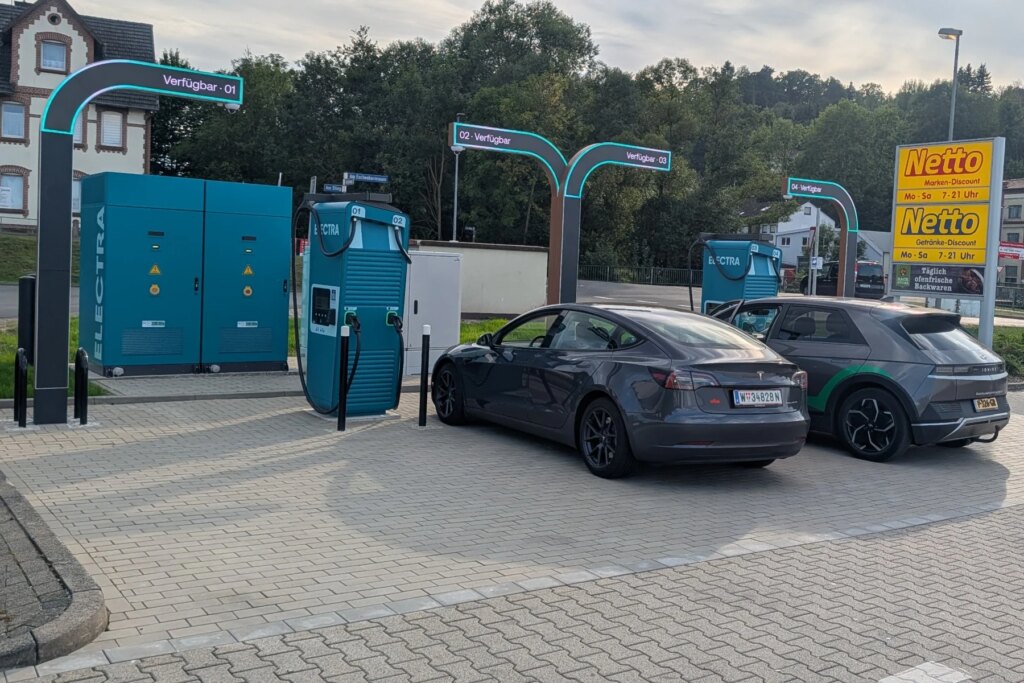
Across Europe, we have implemented around 50 sites with battery storage systems. In Germany there are more than 20. By the end of the year we will have around 40 locations here. We use external storage systems in combination with conventional charging stations, such as those from Alpitronic. This differs from integrated solutions, where storage and charging stations form a single unit. Next year we plan to add almost 60 more storage systems in Germany.
What is the motivation behind using battery storage? Is it mainly about compensating for insufficient grid connection capacity?
It is a mixture of several factors. In areas where we initially receive sufficient capacity through low-voltage connections, we can, for example, already build a charging park and then switch to a medium-voltage connection once the network expansion is complete. This also allows us to reduce the risk of use.
However, there is a certain contradiction here: a well-used charging park requires a lot of network capacity to provide enough power in 24 hours. The better a site performs, the less we need the battery there. In such cases, we might deploy it to another location.
What other benefits do battery storage systems in charging parks offer?
Another aspect is network compatibility. Some network operators explicitly embrace the use of storage systems. For us they are mainly an additional component of the solution that makes us more flexible in the development of the site.
This is particularly interesting in urban areas. In Munich, for example, a medium voltage connection often requires both a transfer station and a transformer station. This takes up a lot of space, which is expensive and scarce in cities. With battery storage systems we can design the spatial layout more flexibly and it is not necessary to place all components next to each other.
However, many grid operators are skeptical about the use of battery storage systems. What are the problems?
For one thing, some network operators don’t necessarily see storage as a way to increase load capacity. They tend to see it more as a home storage system, whose capacity they could, for example, limit to 4 kW. Then we have to explain that although the storage and charging stations form a technical symbiosis, they are two separate units that can function independently in connection to the grid.
A second problem is the so-called short-circuit current contribution at the grid connection point. In the case of storage systems, there is a concern that in the event of a failure, all of the inverter’s installed power from storage could be injected into the grid, even if the grid connection is much smaller. These technical issues can be resolved, but this requires dialogue and experience. Many network operators currently lack a uniform concept for addressing these systems.
For example, we have a plant in northern Germany, where we negotiated the corresponding grid connection contract for gray current storage with the grid operator for a year. Just before the signing, the network operator stopped the procedure. We have now been promised a flexible grid connection contract in the first quarter of 2027. This is naturally frustrating, as we see significant customer potential there and would like to fully realize our vision for the site.
How powerful are the battery storage systems you use? Could it be the case that under high usage they eventually run out of charge and the charging power drops?
On average, we install storage systems with a capacity of between 500 kilowatt-hours and one megawatt-hour. With one megawatt-hour, it would take about 30 consecutive charging sessions to fully discharge the storage. However, the energy continues to arrive in parallel through the grid connection. Additionally, the storage can be recharged during charging breaks.
On a site with 40 to 50 charging sessions per day, it could still be tight. Competitors are already reaching these levels of highway utilization. In urban environments, we are often still far from achieving this, partly because there is a denser distribution of charging stations there.
Therefore, especially on highways, we must carefully consider whether a battery storage system is the right solution. If a large number of customers want to charge one after another during trips, a sufficiently sized medium voltage connection is important. The battery can also absorb peak loads, such as on Saturdays or at the beginning of vacations.
Can battery storage systems really help charging parks come online faster?
This largely depends on the respective network operator. If they agree with the concept, it can be faster. But if I first have to thoroughly explain the technical relationships and present the entire concept, it may take longer than delivering a transformer. It’s not necessarily cheaper either.
The great advantage for us lies in the flexibility when using the network connection and managing its use. It also allows us to open sites that we would otherwise have to exclude from the beginning without storage.
In addition to providing charging capacity, battery storage systems can also be used for energy trading or peak shaving. What role does this play in Electra?
This is very site specific. In low voltage networks, for example, we can benefit from atypical use of the network. We can also store electricity during cheap periods and use it again when prices are higher. Another option is to limit particularly costly peak loads.
We have employees who intensively study which operating concept is suitable for each site. This may change over time. If the utilization of a charging park increases, additional storage management naturally becomes less interesting. The focus is then more on providing energy as cost-effectively as possible for charging processes.
How do you think? Can policymakers and network operators facilitate the use of battery storage systems and the expansion of charging infrastructure?
First of all, battery storage should not be considered a panacea. Politically this is sometimes presented like this, but ultimately it always depends on the respective network operator and whether they accept a storage system and under what conditions.
As operators, we are all interested in expanding our core business: cargo. For this we need access to the electrical grid. At the same time, we responsibly manage available capacities. But for this we also need the support of policy makers and network operators.
Another problem is flexible network connections. In some areas of the network, for example, they offer us connections where we can build a charging park with 800 kVA and six charging points, but the network operator reserves the right to reduce the capacity to 400 kVA for 680 of the 720 hours per month, and within those 680 hours, even up to 200 kVA for a maximum of five days. So I invest in the complete infrastructure for 800 kVA, but this capacity is not guaranteed.
A charging park of this type can cost up to one million euros. For this I need reliable planning to be able to recover the money invested. This is difficult in such conditions.
Thank you for the interview, Mr. Tonini!