I’ve tried a lot of weird and wonderful cycling accessories over the years. Some are genuinely useful innovations, while others are solutions desperately searching for a problem. When I first heard about TriEye sunglasses, which feature small built-in rearview mirrors that allow cyclists to see what’s going on behind them, I thought they’d probably fall into that second category.
I mean, come on. Rearview mirrors integrated into sunglasses? That sounds like something you’d find in the back pages of a ’90s cycling magazine, right next to the x-ray glasses and mail-order hovercraft. It just seemed like a trick.
But after spending the last few weeks traveling with two different pairs of TriEye glasses from Norway, I had to eat my words.
These things not only work, they work surprisingly well. And now I’m at the point where I miss them every time I pick up a different pair of sunglasses. There’s a reason I included them on my list of bike gear I use for all my rides.
A simple idea that works better than you might expect
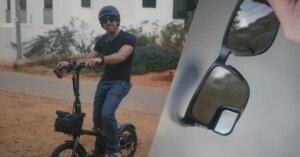
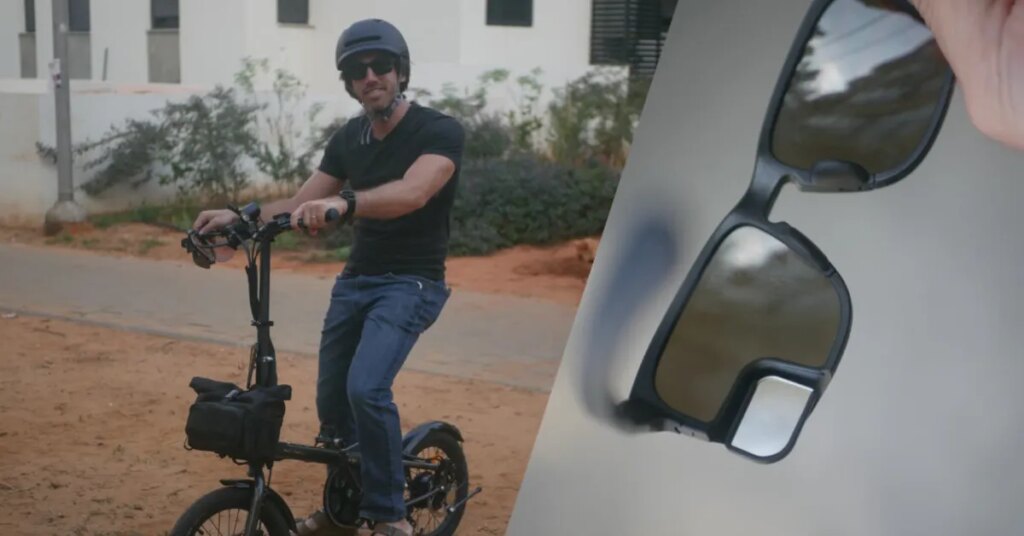
The concept behind TriEye glasses is quite simple. A small mirror built into the outer edge of the lens gives you a view of what’s happening behind you, without needing to turn your head completely.
The standard set has it on the left side for those of us who live in countries that drive on the right side, but there is an inverted option for countries that drive on the wrong side.
I tried two different models: the TriEye Classic, which looks like a pretty normal pair of everyday sunglasses, and the sportier View model, which has a more aggressive wraparound design that makes me feel like I’m auditioning for the next Terminator movie.
They both use essentially the same rearview mirror concept and both impressed me with how effectively they work.
The trick is to learn how to use the mirror. It’s not enough to look straight ahead and magically see behind you. Instead, you turn your head slightly and look into the mirror, which gives you a surprisingly useful image of what’s going on over your shoulder.
For me, that meant turning my head about 10 degrees, similar to how you would look in the side mirror of a car.
It sounds simple and it is, but there is definitely a learning curve. For the first few days, I found myself turning my head too much or not enough. Sometimes I would miss the mirror completely or need to make a second adjustment to get the view I wanted.
But after a few days, it just clicked and now I can get my sight picture right every time with a quick glance. Now I can easily look in the rearview mirror to see if a car is approaching, if another cyclist is approaching behind me, or if the road is clear to avoid an obstacle or another cyclist.
As someone who spends an enormous amount of time riding e-bikes, much of it on city streets and bike lanes, I’m constantly checking in on what’s going on around me.
Whether I’m preparing to change lanes, moving around a parked car, or just trying to figure out if someone is approaching from behind, knowing what’s going on around me is an important part of driving safely.
Typically, that means turning your head to look over your shoulder. It’s not terrible and has been my tried and true method for years. It is still an important skill that I absolutely recommend cyclists practice, as it is not always convenient to practice it every few seconds. There are times when the greatest danger is still ahead, but you also want to know what is happening behind you.
That’s where TriEye glasses really shine.
Instead of completely checking my shoulders every time I want a quick update on the traffic behind me, I can make a small movement with my head and get an immediate picture of what’s happening.
It’s no substitute for looking over your shoulder before performing a maneuver, and I wouldn’t treat the mirror as a substitute for a proper safety check. After all, the mirror only shows part of what is behind you.
But to maintain general situational awareness? It’s fantastic.
I especially appreciate being able to tell if there is a vehicle approaching from behind without taking my attention off the road for more than a moment.
And unlike a handlebar-mounted bicycle mirror, the view moves with your head. You can make small adjustments to see different areas behind you, regardless of which bike you’re riding.
That last point is especially helpful for someone like me who is constantly switching between different e-bikes. I don’t have to install a mirror on every bike I test. I just put on my sunglasses.
And speaking of adjustments, the small mirror element is also adjustable. I keep it set so I can see my face in about 10% of the mirror, so I know I’m basically shooting a directly parallel line of sight across my cheek. It’s like having a little periscope mounted on my face, except instead of looking up, it looks directly behind you.
The classic is my favorite.
While both pairs performed well, I was particularly drawn to the TriEye Classic.
The reason is simple: they look like normal sunglasses.
Well, almost normal. There’s still a small bump where the mirror is integrated into the lens, but it’s fairly subtle compared to the aggressive styling of sportier models. And the Classic even comes with a second “regular” lens that fits in place of the rearview mirror lens. In practice, I don’t do it often and simply accept the knot as part of the aesthetic. But if I’m going somewhere where I don’t want to look weird, I can change the lens and have normal looking sunglasses in about 10 seconds.
But on all my normal rides, I can use the Classic while driving around town without feeling like I’ve gone Terminator.
Don’t get me wrong, the sportier View glasses have their place, especially for cyclists who prefer wraparound cycling glasses. But I appreciate that the Classic doesn’t scream “specialty cycling gear.”
The Classic even comes in some fun color options, although I find that the black frames hide the mirror more easily, making them look even more like “normal” sunglasses.
They’re also lightweight, with flexible frames and UV400 protection. The Classic weighs 28 grams, so it’s not exactly putting a complicated optical contraption on your face.
TriEye offers several lens options, including polarized and photochromic versions, so you have many combinations to choose from.
My biggest regret? Not receiving photochromic lenses
There is one thing I wish I had done differently when choosing my TriEye glasses. I should have bought photochromic lenses. Those are the lenses that automatically adjust their tint depending on the ambient light, becoming darker in sunlight and lighter in low light conditions.
The reason I regret skipping them is that I’ve gotten so used to having a rearview mirror available that I really miss it when I’m not using them.
At night, I obviously don’t wear my usual dark sunglasses. But that means I also lose the comfortable rearview visibility I’ve grown accustomed to during daytime trips.
It’s a strange feeling to put on another pair of sunglasses and realize that I’ve lost an ability I didn’t even know I wanted a few weeks before.
That’s probably the strongest endorsement I can give to these things.
I started trying them out because I was curious to see if the idea really worked. Now I find myself wishing all my sunglasses had little built-in rearview mirrors.
Are TriEye glasses worth it?
The TriEye Classic starts at $99, which I think is a pretty reasonable price for a good pair of sunglasses that also includes a really useful safety feature. You can use our code EBIKE to get another $10 off the price, making this an even better deal.
Sure, you can buy cheaper sunglasses. And you can certainly buy cheaper bike mirrors.
But combining the two into something that works so well, while still being comfortable and relatively discreet, makes the price seem justified to me.
TriEye is also running a Black Friday promotion right now, with discounts of at least 20% across its range and bigger savings on some packs until November 30. That makes an already attractive product even more attractive.
Would I recommend them to all cyclists? More or less, yes.
There are some caveats. You will need some time to get used to the mirror and should not rely on it exclusively as the only way to check traffic. But once you develop muscle memory, it’s an incredibly convenient way to improve your awareness of what’s going on behind you.
And perhaps most importantly, this is one of those rare cycling accessories that has really changed my riding habits.
I went into this review expecting a trick. Instead, I found a product that works exactly as advertised and has become a regular part of my riding gear.
Now I just need to get a pair with photochromic lenses so I can stop missing the rearview mirror every time the sun goes down.
FTC: We use automatic affiliate links that generate income. Further.