Support CleanTechnica’s work through a Substack subscription, on Patreon, or on Stripe. Help us produce all the original, high-quality content we publish week after week despite the challenges of AI deleting content, anti-social media, inflation and other obstacles.
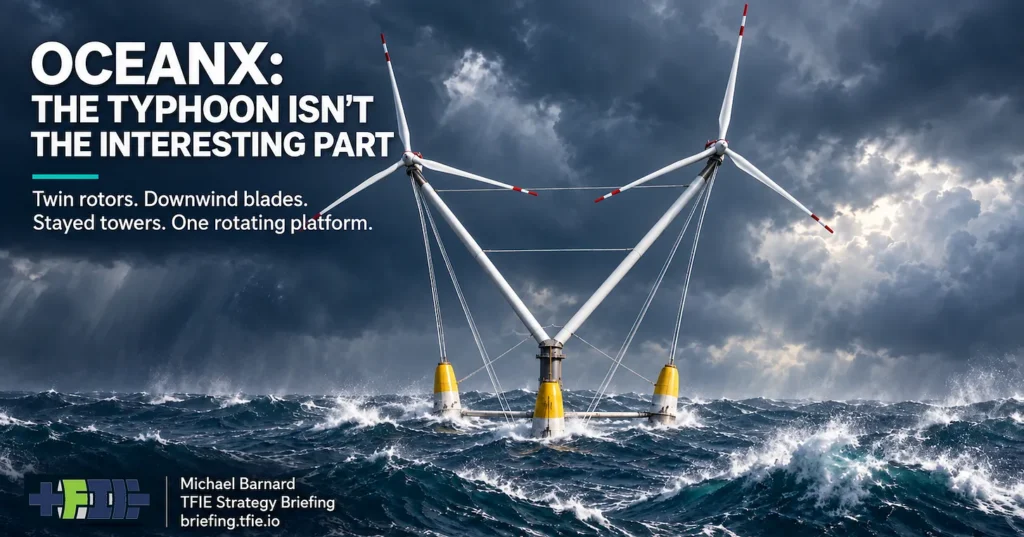
OceanX gave me two immediate reasons to be skeptical. Place two turbines on a floating platform and place the rotors downwind of their supports rather than in front of them. I had looked at both ideas years ago and found good reasons why the wind industry had largely converged on a large three-bladed upwind rotor. OceanX then passed by the Super Typhoon Yagi, and the measurements were good enough to make the unusual machine worth examining rather than discarding it.
During Yagi, Mingyang reported gondola winds exceeding 41.5 meters per second, significant waves of 6.5 meters, a maximum wave of 9.8 meters, and a gondola tilt varying only between zero and three degrees. It also reported that the measured platform response closely followed its pre-storm simulations, with no obvious abnormal resonance or a lasting change in platform attitude. For a large-scale floating machine that carries two widely spaced rotors on long inclined supports, those are useful numbers. The storm did not demonstrate that OceanX was economical or optimally designed, but it did demonstrate that the coupled structure performed credibly under high wind and wave loads.
What changed my opinion was not the typhoon. It was the engineering around the rotors. The full analysis in the TFIE Strategy Briefing separates OceanX into four design options (twin rotors, downwind operation, guyed supports, and full-deck weathervane) because those options solve different problems and the benefits of each should not be attributed.
For readers who don’t spend much time thinking about the architecture of wind turbines, “downwind” simply means that the wind passes through the support structure before reaching the blades. Most modern wind turbines do the opposite: the blades are positioned upwind of the tower. That became the dominant design for good reasons. In a traditional downwind turbine, each blade repeatedly passes through disturbed air behind a substantial tower. The resulting changes in downforce contribute to fatigue and historically also helped produce the characteristic rhythmic noise associated with some downwind machines.
OceanX doesn’t make that problem go away. Instead, the structure that creates it changes. Its supports are unusually thin inclined members held in place by a network of substantial prestressed stays instead of two conventional free-standing tubular towers. If those members produce a much tighter, cleaner wake, then the historical downwind penalty can be materially reduced at its source rather than simply supporting stronger blades and more sophisticated controls.
The floating architecture adds another piece. Instead of relying on two conventional nacelle yaw systems to keep the rotors facing into the wind, the entire platform can tilt relative to its moorings as wind direction changes. That allows the rotors, brackets and tie rods to remain in approximately the same aerodynamic relationship with the incoming wind. For a design whose case depends in part on keeping thin supports properly aligned with the airflow, that’s important.
That’s why OceanX changed my priority to buoyant downwind. The objections that made downwind machines unattractive were not arbitrary conventions. They came from real fatigue and aerodynamic problems. But floating wind creates more freedom to alter the structure in front of the blades, and OceanX uses that freedom in a way that directly addresses historical weakness.
The twin rotors are less convincing. Two turbines mean two nacelles, two transmissions, two hubs and six blades. Splitting the build area between two machines can reduce bushing height and keep individual components smaller, which can have structural and manufacturing advantages on a floating platform. It also duplicates expensive hardware and introduces interactions that a larger rotor does not have to handle.
That distinction is important because the twin rotors dominate all of the OceanX photos. They are the feature that makes the machine look radical, but they are not necessarily the feature that makes it technically interesting. A guyed support, a downwind rotor and a floating vane platform can exist without the need to place two complete turbines on the same structure.
Yagi’s measurements strengthen the argument for taking the overall architecture seriously because the storm affected the entire system at once. Rotor loads, direct wind loads, waves, platform motion, mooring forces and the large cable-stayed upper structure were interacting. The reported nacelle tilt of only zero to three degrees under those conditions is more useful evidence than another representation or simulation of an unconventional turbine.
What it does not tell us is whether architecture will gain economically in 25 years. That requires fatigue data, structural mass, maintenance experience, component replacement procedures and a fair comparison with more conventional floating turbines. Downwind blades still repeatedly pass disturbed structures. Subsea rotating interfaces still require inspection and maintenance. Two transmissions still create more components that can fail.
Those unresolved questions are precisely why OceanX’s deeper analysis in TFIE Strategy Briefing goes beyond the storm outcome and looks at structural load paths, evidence of downwind fatigue, multi-rotor comparison, platform-wide yaw, and life cycle risks before reaching a more limited conclusion.
OceanX has made me much more interested in floating downwind. The combination of a floating platform, thin cable-stayed supports, and passive alignment changes the old comparison enough that the concept merits new consideration. I’m still waiting for the two rotors to justify themselves.
Read the full engineering breakdown in TFIE Strategy Briefing.
Sign up for CleanTechnica’s Weekly Substack to get in-depth analysis and high-level recaps from Zach and Scott, subscribe to our daily newsletter, and follow us on Google News.
Do you have any tips for CleanTechnica? Do you want to advertise? Want to suggest a guest for our CleanTech Talk podcast? Contact us here.
Subscribe to our daily newsletter to receive 10-15 new cleantech stories per day. Or sign up to receive our weekly newsletter on the week’s top stories if the daily grind is too much.
CleanTechnica uses affiliate links. See our policy here.
CleanTechnica Comment Policy