
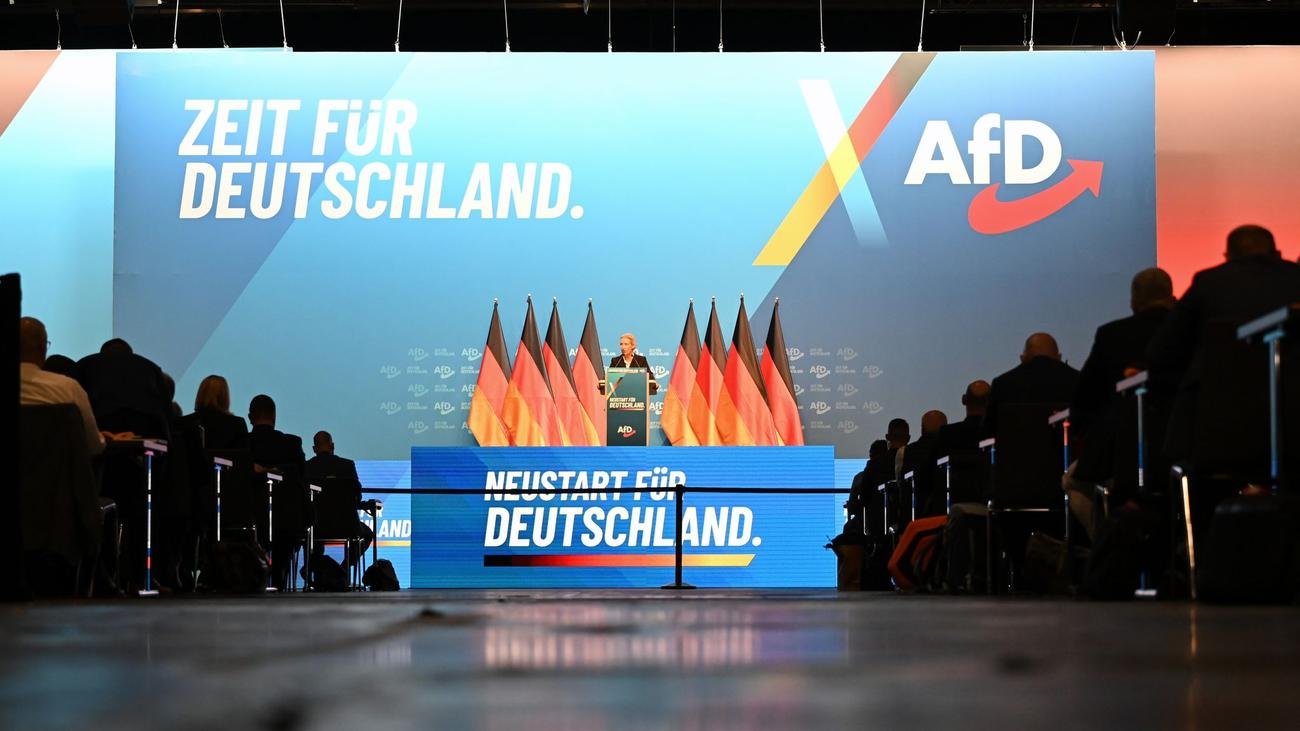
Delegates meeting: AfD party conference ends – protest alliance draws positive conclusions
The AfD ends its party conference in Erfurt with discussions on changes to the party statutes and other internal regulations. After protests involving tens of thousands of people against the meeting, the city wants to comment on the large-scale operation surrounding the party conference in the afternoon. The “Resist” alliance also wants to take stock.
It is unclear whether there will be another protest on the second day of the AfD delegates’ meeting at the Erfurt trade fair. There are no known announcements for larger campaigns.
Tens of thousands at protests – numbers controversial
Already on Saturday, “Oppose” had rated the demonstrations as a success and spoke of the largest blockades that “we have ever set up”. According to the information, around 50,000 people took part in protests – including 17,000 in blockades. The police However, there were a total of around 31,000 people by the afternoon.
However, many AfD delegates arrived so early in the morning in buses escorted by the police that they got to the exhibition center without any difficulty. The Party conference started promptly at 10 a.m. AfD leader Tino Chrupalla opened with mockery: “The early bird catches the worm (…) the Antifa rioters missed their own disruptive maneuver.”
The police were deployed in Erfurt and the surrounding area with thousands of people from almost all federal states – supported by the federal police, who provided water cannons, among other things.
Second day of the party conference was more of a formality
On the second day of their meeting, the AfD delegates will deal with changes to the federal statutes and the financial and contribution regulations. This involves, for example, organizing discussions when accepting new party members, membership fees and holding party conferences.
The party conference quickly ticked off the key points on Saturday. There were no major controversies because the focus is on the upcoming state elections in the east of the country after the summer. The AfD hopes to participate in government for the first time and wants to present itself as a united front.
What hopes co-party leader Alice Weidel linked to a possible first-time participation in government in Saxony-Anhalt, for example, she made it clear that evening on the party’s own “AfD-TV”: “That would suddenly lead to a normalization of our party,” she said.
Explosive topics put aside
The party congress decided quietly and with a large majority that dual leadership would remain the case for the time being. The topic of individual leadership was postponed to the future and the top duo Alice Weidel and Tino Chrupalla confirmed in office for the next two years – Weidel with slightly improved results, Chrupalla with worse results than two years ago.
The delegates also quickly cleared up a potential controversial issue: a motion to change the so-called incompatibility list, which Thuringia’s state leader Björn Höcke had supported, among others, was not discussed in terms of content and was withdrawn after Weidel suggested that the new party executive should revise the list.
Anyone who is a member of an extremist organization on this list is not allowed to be an AfD member. This usually also applies to former members of such organizations.
Baumann speaks of an “oiled machine”
The three deputy positions of Weidel and Chrupalla were completely filled, other board members were also replaced, but without much discussion. “We are now like an oiled machine,” said the First Parliamentary Managing Director of the AfD parliamentary group, Bernd Baumann, to the German Press Agency on the sidelines of the meeting.
Survey: divided opinions on the topic of firewalls
The Union and the SPD are currently ruling out any collaboration with the AfD. According to a survey, people in Germany are divided on this question of the so-called firewall. 42 percent find the rejection of cooperation or coalition more correct, as a survey by the opinion research institute Insa for “Bild am Sonntag” showed. 39 percent think this is wrong. 19 percent did not provide any information or were undecided.
Citizens are also divided on the demand for a ban on the AfD. When asked whether they would be more in favor of a ban, 40 percent of those surveyed said yes, while 45 percent were against it. 15 percent did not provide any information.
“Proximity to Putin cannot be overlooked”
Federal Defense Minister Boris Pistorius wants to prevent the AfD from obtaining classified information if it participates in government – and justifies this with the party’s proximity to Russia. “The proximity to Putin cannot be overlooked. There is also the assumption that there is money from Russia,” he told “Bild am Sonntag”. The SPD politician emphasized that sensitive information should not fall into the wrong hands. “We are working intensively on the question of who we can give access to classified information.”
© dpa-infocom, dpa:260705-930-335291/1