A novel foraging strategy
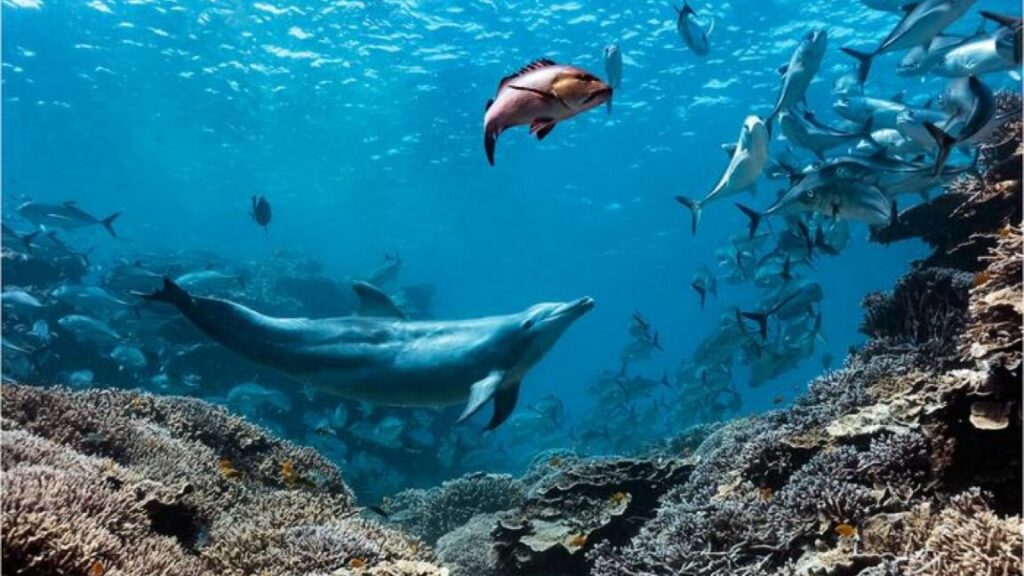
First, Bubbles scanned the environment using echolocation to identify a suitable target fish. The dolphin then chased after that single fish, ignoring the rest of the school. Bubbles reflected the direction of movement of his target, often following him fairly closely. The fish only escaped pursuit when it vomited, likely a stress reaction; Bubbles would then absorb the regurgitated food while the target fish swam away. Bubbles would repeat this process up to ten times in half an hour, and he only seems to do this with bigeye jacks. Bubbles also doesn’t eat the actual fish.
While dolphins typically forage in groups and Bubbles has occasionally been spotted with other dolphins, he prefers to forage alone. According to Haines, this appears to be learned behavior; Bubbles developed a novel feeding strategy that requires less energy-intensive effort than hunting fast-swimming prey. “We observed him repeating this behavior over several years, suggesting that he may have learned to target the fish with the fullest bellies to create the most rewarding meals,” she said.
How can Bubbles even tell which fish have just eaten a filling meal? The authors suggest that this may be related to echolocation during the scanning phase of the dolphin’s feeding strategy. Other species are known to use echolocation to tell the difference between fish species, as different shapes return differently structured echoes. The team sampled Bubbles’ vocalizations from the video footage and noted an intense sequence of clicks and low-frequency tones as he engaged in kleptoparasitism. However, it is unclear whether he uses them to identify targets or to increase the target’s stress response.
As this is also a small sample size (N=1) and a limited data set, further evidence is required, preferably from other dolphins in the region, before concluding that such behavior is common in the species or whether Bubbles is simply special. Haines and her co-authors believe this kleptoparasitic foraging behavior may be underestimated, given how difficult it is to capture events on video in the wild.
“The use of technologies such as animal-borne video camera tags and unmanned aerial vehicles (drones) will likely provide new insights into the cryptic behavior of these elusive marine predators,” they concluded.
DOI: Ecology and Evolution, 2026. 10.1002/ece3.74270 (About DOIs).