Support CleanTechnica’s work through a Substack subscription, on Patreon, or on Stripe. Help us produce all the original, high-quality content we publish week after week despite the challenges of AI deleting content, anti-social media, inflation and other obstacles.
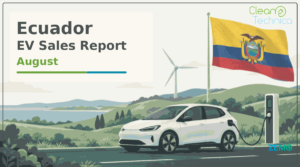
Ecuador is a country that we haven’t mentioned very often in the past, but this may change soon.
For years, the country lagged behind the region, with only a handful of sales and at the bottom of the list with Peru and Argentina in 2023. The last time we reported on this (a year and a half ago), market share had just surpassed 2% and was hovering around 3%. Back then, this was an immense success.
But things are improving faster than anyone expected. In our latest reports on Latin America, Ecuador has been a rising star. The country reached 6% BEV in the first quarter of this year, it has already comfortably surpassed 10% BEV and, if we add PHEVs to the count, it is approaching 20%! If this trend continues, the country could surpass Colombia and become the third most advanced electric vehicle market in Latin America.
Let’s look at the numbers.
Market Overview
An important comment before starting: for years we have only published data on BEV sales in Ecuador. Recently, at ZEMO, we have started manually identifying PHEVs (with a little help from the Ecuadorian association AEADE), which means we can now add them to the count. The exercise dates back to 2017, so there will be no sudden “jump” when PHEVs are added (as was the case in Uruguay, for example).
That said, the growth in 2026 has been exemplary. Over the course of the year, sales increased by 276%, and in August this figure increased to 426%! The country first reached 100 sales in October 2023 and 1,000 in December 2025, but in August it was very close to 3,000.
BEVs dominate Ecuador’s electric vehicle landscape, but PHEVs are more present than in other smaller markets, such as Uruguay, Costa Rica and Colombia. Until 2026, we will see a 70/30 split: BEVs will account for the majority of sales, but PHEVs will still represent almost a third of the market. It’s important to note that August was a pretty impressive month, with BEVs surpassing 2,000 units for the first time and PHEVs surpassing 800. It remains to be seen if these levels will be maintained in the coming months.
And in terms of market share, this means that in August, BEVs managed to get 13.8% of all vehicles sold and PHEVs got 5.5%, for a total of 19.3%! We’re getting pretty close to 20% here.
This growth has come amid an overall automotive boom in the post-pandemic era. This translates into a transition to electric vehicles that has yet to slow the growth of ICEVs. Fuel-based vehicles (ICEV, MHEV and HEV) have had a record 2026 so far, with sales in the January-August period exceeding any other year through 2018, even doubling the total for 2020. This means that, unlike Uruguay, we are not at a point where electric vehicles are reversing the growth of combustion powertrains, but we should find ourselves at that point soon, perhaps as early as next year.
In terms of brands, BYD remained the leader in August, but as in Uruguay, we are seeing more competition and a more balanced market. BYD’s market share has gone from more than 70% in 2024 to less than 30% in 2026. Next, surprisingly, come two legacy automakers: Chevrolet in second place thanks to its rebranded Chinese electric vehicles, and Kia in third place, surprisingly thanks to the success of the European-made EV2.
It seems that the European industry finally has something capable of fighting against the Chinese! (Even if it is not a European brand).
As for the model, we follow exactly the same distribution, with BYD Yuan Up leading the chart, followed by the Baojun Yes Plus Chevrolet Spark EUV and Kia EV2. In fourth position is the BYD Seagull, followed by the DFSK E5, a plug-in SUV. Of note is the newcomer Chery iCar (or iCaur) V23, an affordable all-electric SUV that may prove very popular in the rural areas of the Andes.
So far this year, BYD remains the leader, still with around 30% market share, followed by Chevrolet and then DFSK in bronze. Dongfeng gets fourth position and Kia fifth.
As for the model, we once again see the BYD Yuan Up at the top, followed by the DFSK E5 and the Chevrolet Spark EUV. The Seagull takes the number 4 spot and the Changan CS55 PHEV gets the fifth position. A notable mention for the Kia EV2, which took seventh position despite being sold in the country for only three months this year.
Final thoughts
Electric vehicle adoption in Ecuador accelerated in 2026, following very healthy growth in 2025. The market has become more competitive and the government has long since ended subsidies on gasoline and diesel; However, it began providing aid to diesel bus and truck owners due to rising fuel prices due to Trump’s war in Iran. All of this means that we are seeing a country go from laggard to leader in record time. Just three years ago, Ecuador was firmly at the bottom of our ranking.
This success has to do with the arrival of affordable electric vehicles. With tariff and tax exemptions (helping to make them cheaper) and the end of fuel subsidies, it is no coincidence that the adoption of electric vehicles in Ecuador began to increase after fuel prices rose.
Now, looking at the particularities of this market, there are two models that I find extremely interesting in this small market, as they may herald changes to come: the Kia EV2 and the Chery iCar 23 (or iCaur 23).
Built in Slovakia, the Kia EV2 is the first European-made car we have seen in Latin America at prices we could call “reasonable.” Sure, at $23,000, the mini-SUV (or lifted hatchback, whichever you prefer) may be a little pricey, but it’s in the ballpark of similar ICEV crossovers and costs the same as the BYD Yuan Up, although it’s not much worse overall (it’s 30cm shorter and the battery is 3kWh smaller). From what I have found out, the battery is probably imported from China (at least for the cheapest version), but still, the car is good enough to make an impact and shows that if countries and regions commit to EVs, they will be able to lower prices and in due time compete with the super powerful Chinese.
As for the Chery iCar V23, I think it heralds the entry of electric vehicles into segments that have until now been dominated exclusively by internal combustion engine vehicles. It’s a rugged SUV designed for country roads with two versions (4×2 and 4×4), the latter of which costs the same as a Suzuki Jimny ($28,000), previously the most affordable 4×4 off-roader available. Yes, I’ve ridden in a Jimny and those things can climb up a vertical wall, something I doubt the iCar can accomplish, but most people like them because they have decent clearance and can be driven comfortably across unpaved roads and occasionally off-road areas, and the V23 is perfectly capable of this task. Its price and usability make this vehicle a favorite of people in small towns, rural areas and poorly connected regions.
A small comment: according to official specifications, the V23 appears to be the least efficient electric vehicle in the history of electric vehicles, promising only 420 km (261 m) of autonomy in the 4×4 version with a huge 81 kWh battery… and this in the very optimistic NEDC cycle. It remains to be seen if the efficiency is In fact so bad, or if there was an error on the website and it is 420 km WLTP, something reasonable considering the poor aerodynamics of the car.
In any case, Ecuador seems less like a story of pioneers every day and more like a mature market where electric vehicles are taking off. And if Colombia isn’t careful, they could soon lose bronze to this rising star!
Sign up for CleanTechnica’s Weekly Substack to get in-depth analysis and high-level recaps from Zach and Scott, subscribe to our daily newsletter, and follow us on Google News.
Do you have any tips for CleanTechnica? Do you want to advertise? Want to suggest a guest for our CleanTech Talk podcast? Contact us here.
Subscribe to our daily newsletter to receive 10-15 new cleantech stories per day. Or sign up to receive our weekly newsletter on the week’s top stories if the daily grind is too much.
CleanTechnica uses affiliate links. See our policy here.
CleanTechnica Comment Policy