Support CleanTechnica’s work through a Substack subscription, on Patreon, or on Stripe. Help us produce all the original, high-quality content we publish week after week despite the challenges of AI deleting content, anti-social media, inflation and other obstacles.
Britain’s bus reforms are often discussed as a privatization story. Outside London, reforms in the 1980s deregulated local bus markets and gave commercial operators much more freedom over routes and timetables. London maintained public control of the passenger network while private companies competed to operate specific services. Edinburgh, Dublin and more recently Greater Manchester have developed other combinations of public planning, municipal operation and competitive contracting.
After forty years, that variety is more useful than the ideological argument it usually produces. It is clear that competition can reduce operating costs, but the evidence does not require that commercial operators also control the metropolitan passenger network. Network design and bus operation are separate options, and different British and Irish cities have spent decades demonstrating what happens when those options are combined in different ways.
The distinction has become much more important with electrification. A diesel operating contract can change, reorganize routes and reassign buses. A multi-megawatt electrical connection secured in a warehouse cannot simply be picked up and moved across a city because the next tender produces a different operating pattern.
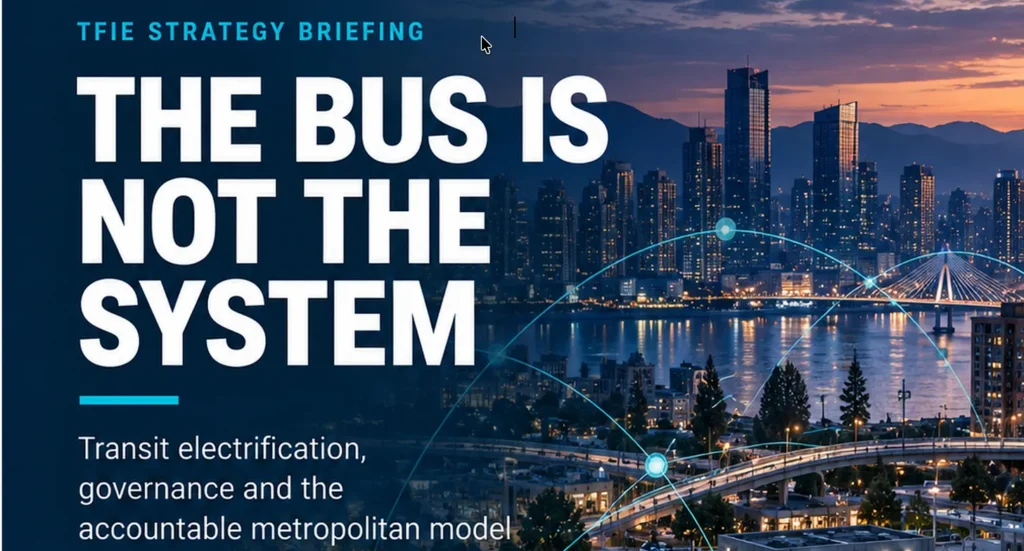
That’s the central issue examined in the 83-page open report The Bus Is Not the System: Metropolitan Transit Governance Strategic Report. It uses the long-standing governance comparison of Great Britain and Ireland to ask what transit authorities, operators, utilities and investors should preserve as bus fleets become electrified.
Passengers provide the starting point. They do not buy a bus, an operator or an operating contract. They buy into the expectation that a full trip will work: the first service arrives, the transfer is usable, fares and information work across borders, accessibility survives every stretch, and there is still a return service after a night shift.
That makes route-level efficiency an incomplete test of a transit system. One company can manage its service efficiently while another operator makes a separate rational decision that breaks an important connection. Each organization can perform competently within its own boundaries while the passenger experiences a poorly coordinated network.
Britain’s experience also shows why the answer is not simply public operation. London maintained public specification of routes, fares and standards, while using competition between private operators. Dublin combines a publicly specified network with both public and private operations. Edinburgh developed a coherent network around a council-owned operator. Network competition, ownership and accountability are different institutional variables and not a single choice between public and private.
Electrification adds another set of variables with much longer lives. Tanks, transformers, substations, chargers, grid connections, software and data rights can remain important to the grid long after an individual operating contract ends. A warehouse electrification project can be technically competent and financially sensible for the current operator, while creating limitations for the metropolitan system in the future.
Consider what happens when the first electric bus contract ends successfully and another company wins the next one. Can the successor use the deposit? Can buses transfer? Is the charging equipment still compatible? Who controls the network connection and operational data? How is residual value handled if the assets installed for the first contract remain essential for the second?
Those questions change the way authorities should think about property. Public ownership can provide continuity, but it is not the only mechanism. Long-term access rights, assignable leases, interoperability requirements, intervention provisions, return rules, and credible replacement options can also preserve network flexibility. What matters is whether the assets and capabilities needed to operate the passenger network remain usable when operating arrangements change.
This creates a practical problem for agencies that already electrify fleets. Most do not have the luxury of redesigning governance, contracts, deposits and the network from a blank sheet of paper. Fleet orders are changing, network applications have deadlines, warehouse leases expire, contracts are extended and network changes are approved, while larger institutional issues remain unresolved.
The useful planning discipline is to identify the next decision that will be costly to reverse. A bus order can remain relatively portable. A warehouse lease tied to a scarce high-capacity connection may not be the case. A contractual provision controlling load data may seem minor during the first operational period and become critical during the second.
That’s where the four-decade governance experiment becomes directly relevant to decarbonization. Bus electrification is often treated as a vehicle transition supported by some charging infrastructure. On a metropolitan scale, it is also a transition in terms of land, electricity, contracts, financing, data and institutional responsibility.
Authorities optimizing each electric bus project separately may still create a system that is costly to change. The best goal is to preserve a coherent passenger network while allowing operators, utilities, financiers and infrastructure providers to optimize the things they actually control.
The open report Bus is Not the System: Metropolitan Transit Governance develops that argument through economic evidence, passenger outcomes, depot and network strategy, asset continuity, climate accounting, and the hard-to-reverse decisions authorities face during electrification. The supporting Test Book is available upon request.
Sign up for CleanTechnica’s Weekly Substack to get in-depth analysis and high-level recaps from Zach and Scott, subscribe to our daily newsletter, and follow us on Google News.
Do you have any tips for CleanTechnica? Do you want to advertise? Want to suggest a guest for our CleanTech Talk podcast? Contact us here.
Subscribe to our daily newsletter to receive 10-15 new cleantech stories per day. Or sign up to receive our weekly newsletter on the week’s top stories if the daily grind is too much.
CleanTechnica uses affiliate links. See our policy here.
CleanTechnica Comment Policy