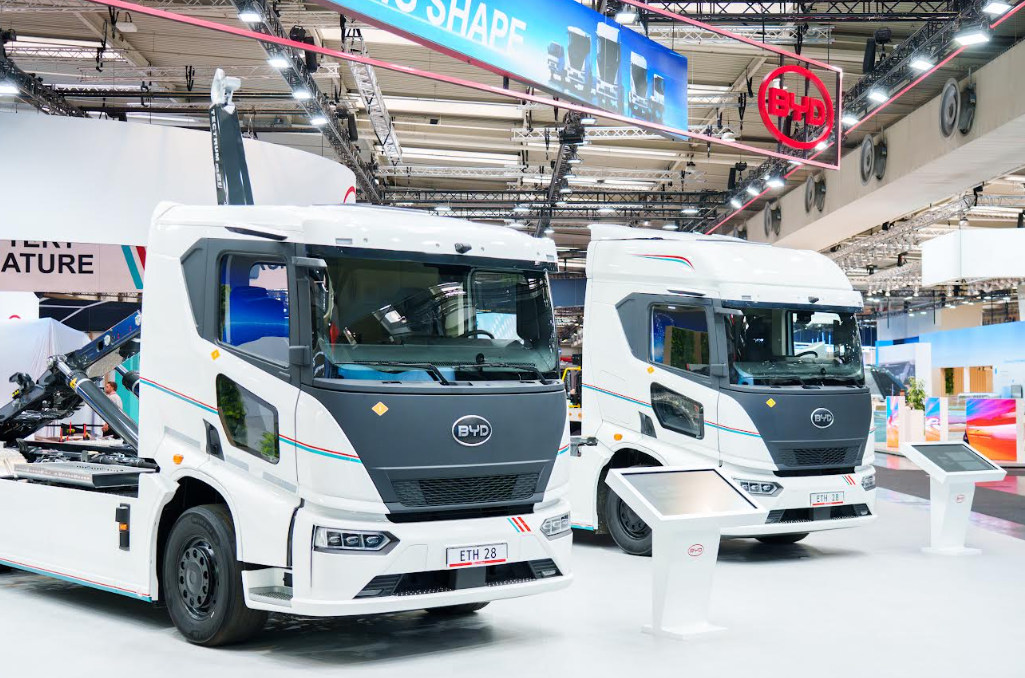
HANNOVER, Germany — BYD launched an aggressive push into Europe’s heavy-duty market at the IAA Transportation show, unveiling a flagship 44-metric-ton electric tractor along with ultra-fast megawatt commercial charging systems designed to challenge continental truck makers established on their home turf.
The Chinese automaker, which has built a significant global footprint in electric passenger vehicles and urban transit buses, used the biennial commercial vehicle show in northern Germany to demonstrate that its ambitions in Europe extend far beyond last-mile courier vans and municipal fleets.
At the center of the presentation was the BYD ETT 44, a 4×2 heavy-duty electric semi-truck that delivers up to 1,000 metric horsepower and an operating range of up to 372 miles with a 651 kilowatt-hour Blade lithium iron phosphate battery pack. BYD executives combined the truck with a commercial fast-charging architecture capable of consuming 1.5 megawatts of direct current power. The system can recharge the pack from 20 to 80 percent of its capacity in about 20 minutes, returning approximately 248 miles of highway range.
The truck comes at a critical time for the European road freight sector, which is facing increasingly strict carbon dioxide reduction mandates enacted by the European Union. Under continental regulations, manufacturers must reduce emissions from the entire heavy commercial vehicle fleet by 45 percent by 2030, rising to 90 percent by 2040. Those rules have forced legacy European brands, including Daimler Truck, Volvo Group, Scania and Traton’s MAN, to invest billions of euros in electric battery and hydrogen fuel cell architectures.
However, high purchase premiums and an underdeveloped public charging network along trans-European transport corridors have slowed the pace of mass adoption among fleet operators. BYD is attempting to address those operator concerns through vertical integration and aggressive warranty support.
The company offers the ETT 44 battery with a 10-year/1.2 million kilometer warranty as standard equipment. Across the European heavy-duty truck segment, basic warranties typically span two to three years, and battery coverage extends six to eight years, unless shippers purchase expensive secondary service plans.
Stella Li, executive vice president of BYD, said the commercial vehicle push is an extension of the company’s internal battery and electronics manufacturing capabilities.
“We have already implemented FLASH charging in passenger vehicles. Today we are bringing this technology to commercial vehicles, starting with our trucks,” Li said during the company’s presentation in Hannover. “With 1.5 megawatts of charging power, it can charge from 20 to 80 percent in about 20 minutes, offering up to 248 miles of range. Less time charging. More time on the road.”
Li emphasized that BYD plans to sell freight transport vehicles not simply as stand-alone tractors, but as components within a broader proprietary energy logistics network that encompasses on-site solar generation, stationary battery storage, energy price management and customized fleet financing.
“From batteries and solar power to energy storage, FLASH charging and commercial vehicles, we provide a comprehensive solution for sustainable commercial transportation,” Li said.
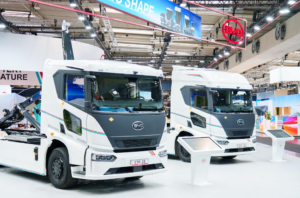
Beyond the flagship long-haul tractor, BYD expanded its European portfolio of medium and heavy vehicles with two new rigid models shown in 4×2 and 6×2 configurations. The vehicles on display included a 26-ton swap body vehicle and a professional hooklift unit. The additions mean the company now markets zero-emission commercial vehicles ranging from 3.5 metric tons in the urban distribution sector to 44 metric tons in regional and long-haul transportation.
The presentation attracted intense interest and scrutiny at the Hannover exhibition grounds, where European manufacturers have historically dominated trade discussions. While traditional commercial vehicle makers have introduced competitive long-range battery models, such as the Mercedes-Benz eActros 600 and Volvo FH Electric, BYD’s complete control over battery cell production gives it a price and scale advantage that has unsettled industry executives.
Trade tensions between Brussels and Beijing over electric vehicle subsidies have added another layer of complexity to BYD’s business expansion. While the European Commission has focused import duties primarily on passenger cars, Chinese commercial vehicle manufacturers have accelerated their plans to anchor assembly operations, distribution agreements and technical partnerships directly within Europe to protect their operations against future regulatory measures.