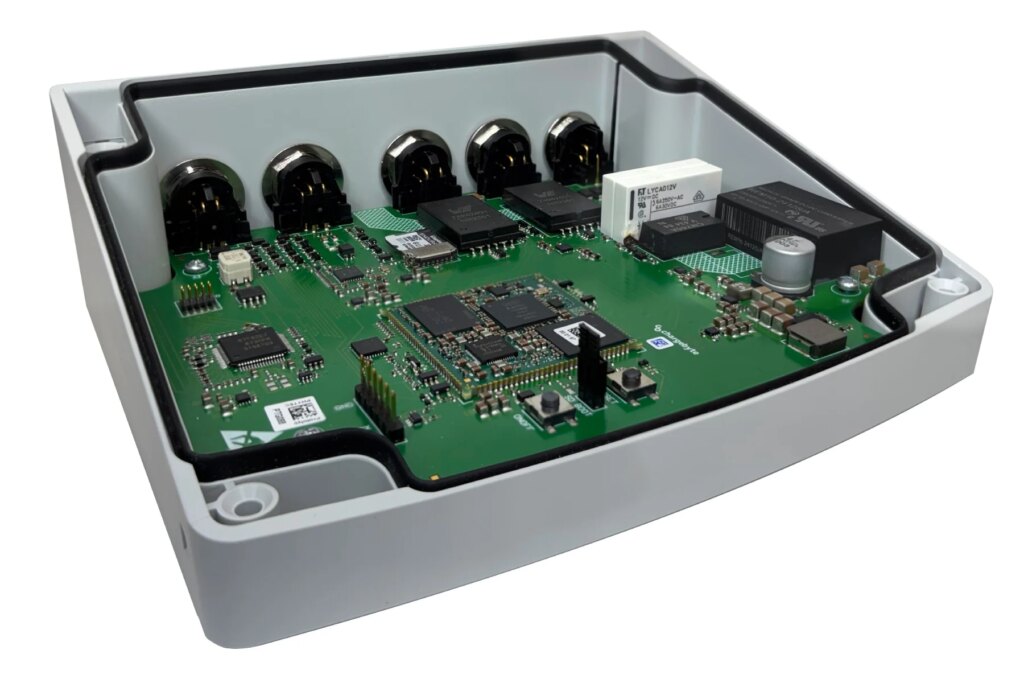
Leipzig-based company Chargebyte has launched Charge Control Y (CCY), a new control unit for megawatt charging stations. Designed for heavy electric transportation, the device is ideal for logistics centers, truck depots, ports and highway service areas. The charge controller is suitable for both equipping new charging stations and retrofitting existing systems.
During development, special attention was paid to resistance to interference and harsh environmental conditions. The vehicle interfaces feature reinforced galvanic isolation according to IEC 60664-1, withstanding surge voltages up to 1,500 volts DC and nominal impulse voltages up to 4 kV.
In the event of a high voltage failure in the charging cable, the downstream control units, backend and connected components remain isolated. The housing of the control unit is protected against dust and water jets according to the IP65 standard and is designed for ambient temperatures from -40 to +70 degrees Celsius, as well as humidity levels up to 95 percent. All cables are connected using waterproof M12 connectors.
Inside the device, two independent computing units work together. While a primary computer handles periodic loading and communication, a secondary processor acts exclusively as a security monitor. This continuously monitors emergency stops and up to four temperature sensors in the cooling system, charging connector and power electronics. If there is a risk of overheating, the system automatically reduces the charging power or turns off the station.
On the software side, the control unit supports the ISO 15118-20 protocol for modern charging communication, including Plug & Charge. Integrated security monitoring meets the industry standard SIL 1 (IEC 61508) and is protected against cyber attacks using a TPM hardware chip.
Chargebyte uses the open source EVerest system, which allows charging station manufacturers to adapt and develop the software independently without being tied to a single supplier. Security and operating software updates can also be installed remotely, reducing service efforts. The charge controller developed and manufactured in Germany is now available.
Source: Information provided via email.