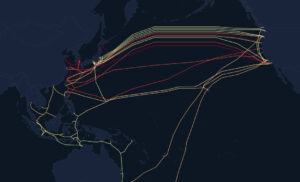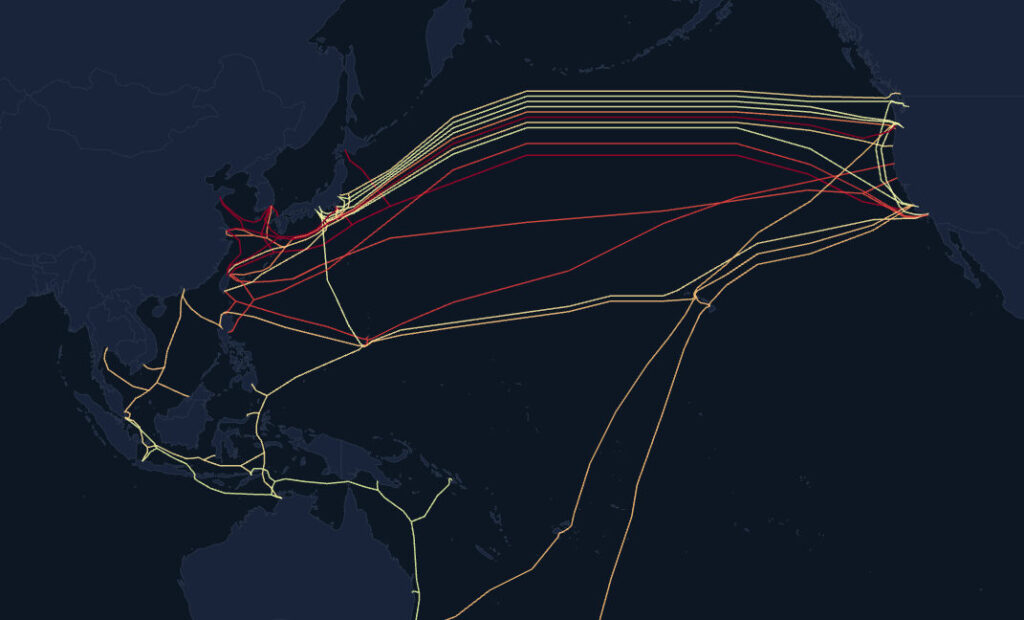
The index suggests the risk to cables is highest in Taiwan, Japan and the Philippines, partly because of China’s claim to sovereignty over Taiwan, but also because undersea cables linking the region to the United States must pass through shallow waters with busy shipping lanes.
Among the 10 transpacific cables identified as highest risk, several are still in development with significant ownership stakes by U.S. companies. These include the TPU project, owned by Google, the ORCA cable, owned by Meta, and the E2A cable, co-owned by Verizon along with companies from Japan, South Korea and Taiwan. All three projects had risk scores in the top five.
The report’s authors warn that any serious disruption of a single trans-Pacific cable could “risk overwhelming current available capacity on direct routes between the United States, Taiwan, Japan and the Philippines, forcing data to use slower, less direct routes.”
An even larger outage involving multiple cables, potentially during a geopolitical crisis involving Taiwan, could “significantly reduce room for maneuver and even overwhelm the trans-Pacific capability as a whole,” and communications between the United States and the Indo-Pacific region would have to be rerouted via other cables around the world. This could have significant economic consequences for Internet communications, cloud services and financial trade.
Dual-use technologies and survey tracks
This comes as the world’s major powers continue to grow their fleets of military submarines and underwater drones, as well as continue to develop and deploy dual-use technologies such as underwater cable cutters that could be used for repair or sabotage.
China has also deployed a fleet of research vessels equipped with seafloor mapping technologies near trans-Pacific undersea cables, according to a separate report published in October 2026 by the Center for Strategic and International Studies (CSIS), a think tank based in Washington, DC.
CSIS analysts found that China-flagged research vessels stood out as outliers in the amount of time they spent near underwater infrastructure. They analyzed the movements of more than 200 research ships from various nations between 2020 and 2025.