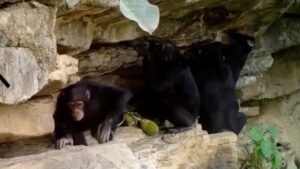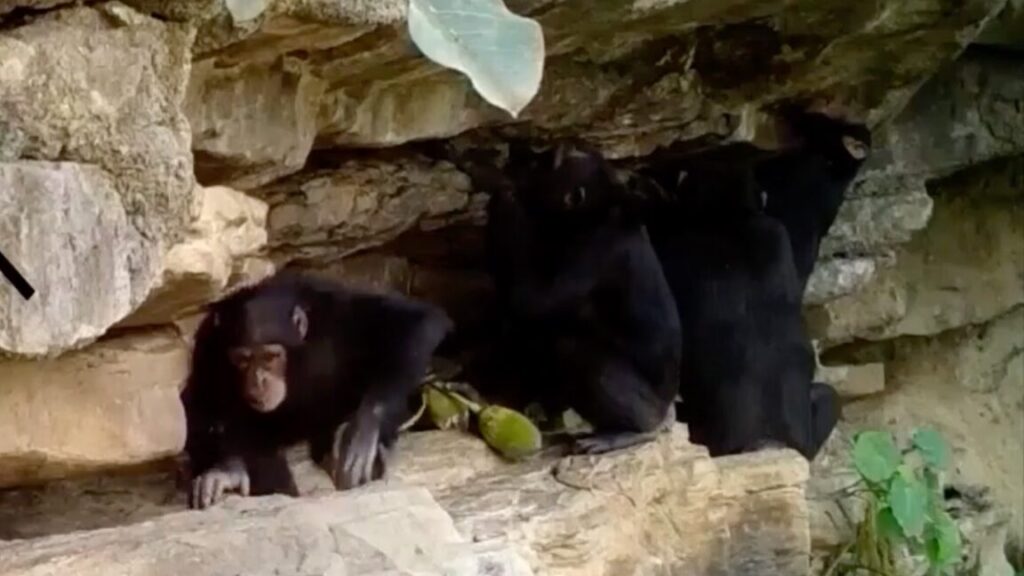
Chimpanzees are known to use rudimentary tools when searching for food. According to a new article in the journal Frontiers in Psychology, this learned behavior is passed from adult to offspring through social learning. Specifically, adult chimpanzees consciously model the behavior and then pass their tools on to juveniles so that they can imitate the same movements.
“Receiving food and tools from experienced individuals, what we call food or tool transfer, may help chimpanzees learn to use technology to extract difficult-to-access food,” said co-author Andreu Sánchez-Megías, a doctoral student at the University of Barcelona and the Jane Goodall Institute Spain in Senegal. “Tool transfer thus appears to be a form of teaching, along with observation and supervised practice. It appears that in this way mothers are the most important role models and teachers for young chimpanzees.”
As we have previously reported, the use of tools was once considered one of the defining characteristics of humans, although Charles Darwin observed chimpanzees using stones to crack nuts in 1871. In 1960, the late primatologist Jane Goodall observed a chimpanzee named David Greybeard bending a branch, stripping off the leaves, and using them to spoon termites from a nest into his mouth. Upon learning of the behavior, Goodall’s mentor Louis Leakey remarked, “Now we must redefine ‘tool,’ redefine ‘human,’ or accept chimpanzees as human.” Since then, chimpanzees have been observed making sponges from leaves to absorb liquids, forming sticks to collect algae, and sharpening rudimentary spears for hunting.
Other examples of tool use have been observed in various species, although the behavior appears to have evolved more commonly in monkeys and great apes. Dolphins can playfully throw objects, which some scientists consider to be a form of tool use, especially if it is another member of the same species. Possible purposes include communication, social bonding or aggression. (Octopuses have also been observed exhibiting similar throwing behavior.)