Support CleanTechnica’s work through a Substack subscription, on Patreon, or on Stripe. Help us produce all the original, high-quality content we publish week after week despite the challenges of AI deleting content, anti-social media, inflation and other obstacles.
The way water moves in the world’s oceans is affected by a number of factors. We know that tides are mainly influenced by the gravitational pull of the moon, but wind and temperature can also affect the behavior of ocean waters. At the surface, prevailing winds can push water in one direction or another, but below the surface, temperature variations can also influence the flow of ocean waters.
In the Atlantic Ocean, warm water at the equator flows north along the coast of the United States and Canada before turning east toward Iceland. From there, it flows south along the western coast of Europe on its way back to the equator. Oceanographers know that current as the Atlantic Meridional Overturning Current or AMOC, but it is commonly known as the Gulf Stream.
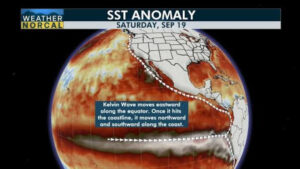
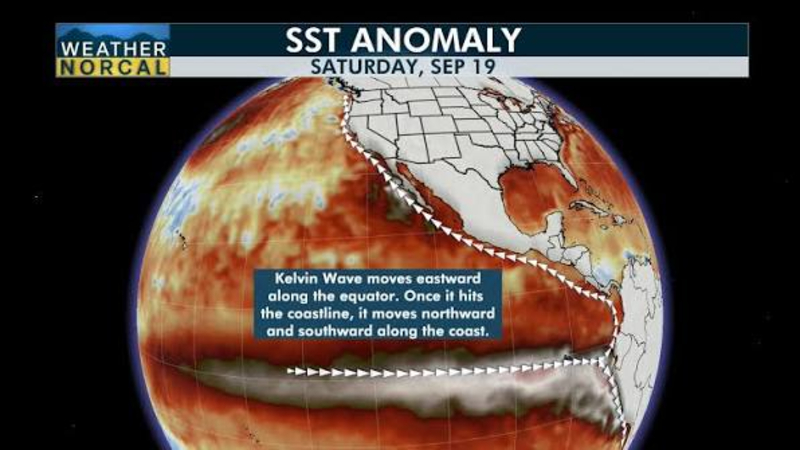
A Kelvin wave in the Pacific
In the Pacific Ocean, prevailing trade winds near the equator normally push warm water westward toward Australia and Southeast Asia, but something out of the ordinary is happening this year. Due to a strong El Niño event, those prevailing winds are now calm or flowing eastward, pushing those warm Pacific waters against the coast of South America. Blocked by that land mass, they turn north and south. A portion of that flow is now approaching Southern California and is expected to reach San Francisco in about three weeks.
This wall of warm water is known to scientists as the Kelvin wave, and yes, the name refers to the same Lord Kelvin who entered university at age 10 and gave us the Kelvin temperature scale. “You can continue [Kelvin waves] throughout. “We see higher sea levels along the equator, and when the wave reaches the coast of South America, it can’t continue going east,” Severine Fournier, a research scientist who studies ocean circulation at NASA’s Jet Propulsion Laboratory, told The Guardian. “So it goes north and south.”
Here is an interview with Dillon Amaya, a NOAA scientist, who does a good job of explaining this phenomenon in a way understandable to non-scientists. It is 9 minutes long and well worth your time. For those who want a more scientific explanation, here’s how Wikipedia explains things.
So what happens when the Kelvin wave reaches California? First, it will stick around for a while and could bring dramatic changes to the climate. “They say it never rains in Southern California.” According to one song, but that may not be true this year. Thanks to the Kelvin wave, increased precipitation and winter storms are likely. Additionally, sea levels along the West Coast could rise 6 to 12 inches due to all that warm water accumulating along the coast. The result should be obvious: more flooding in low-lying areas that are already feeling the effects of sea level rise.
A change in wind direction
Nate Mantua, a research scientist at the National Oceanic and Atmospheric Administration’s Southwest Fisheries Science Center, told The Guardian that in a typical year, there is a thick layer of warm water in the western Pacific around northeastern Australia and Southeast Asia. “When the wind stops blowing or weakens, the force holding that pile of water in place disappears, so the water rises or sloshes back toward California,” he said. He and his fellow researchers expect the Kelvin wave’s influence to persist through the winter and into early next year.
Mantua explained that Kelvin waves are a natural phenomenon that has occurred for thousands of years. NOAA has been tracking them since it began keeping ocean records. Sea levels have already risen about 8 inches over the last century, and Kelvin waves will add more water on top of that.
“We can predict many of the impacts, but not all,” he added. “In El Niño winters in the North Pacific, we tend to have… more storms and large storm waves in the ocean than we normally have. So if you add that to this elevated sea level… then you just expose places to more ocean energy and just plain flooding.”
The biggest Child in 1000 years
Climate scientists expect this year’s El Niño to be the largest in the last 1,000 years. They have already recorded the highest temperature ever recorded for the phenomenon and are still several months away from when it is expected to reach its peak. Strong El Niño events are associated with more severe storms, along with increased storm surges, flooding and coastal erosion.
“It’s a different wave than what you’re used to on the beach. They don’t crash. They don’t really feel like they’re coming,” said Mike Jacox, a research oceanographer at the Southwest Fisheries Science Center. “This winter, we’re supposed to have very high tides around Thanksgiving and Christmas. If there are also more storms, then there will be storm surge. It’s like you’re raising the bar on everything that’s going on.”
California Governor Gavin Newsom has already declared a state of emergency. Road closure and snow removal teams are being deployed along state highways, and the national guard is preparing for search and rescue missions to help people trapped by flooding.
“A key observation from past El Niño events is that the most damaging storms are often those that coincide with the highest tides,” Kate Huckelbridge, director of the California Coastal Commission, wrote in a recent memo. “Storms that peak during high tides are much more likely to cause damage than if the same storm peaked during low tide.”
It’s up to us
Attentive readers are aware that many climate-related changes are currently occurring around the world, and while some can be attributed to naturally occurring events, the main causal factor is the extraction of fossil fuels that took millions of years to create and burning them as quickly as possible in the space of a few centuries. Scientists can do a good job tracking changes, but only we can prevent man-made changes to Earth’s environment.
Sign up for CleanTechnica’s Weekly Substack to get in-depth analysis and high-level recaps from Zach and Scott, subscribe to our daily newsletter, and follow us on Google News.
Do you have any tips for CleanTechnica? Do you want to advertise? Want to suggest a guest for our CleanTech Talk podcast? Contact us here.
Subscribe to our daily newsletter to receive 10-15 new cleantech stories per day. Or sign up to receive our weekly newsletter on the week’s top stories if the daily grind gets too much.
CleanTechnica uses affiliate links. See our policy here.
CleanTechnica Comment Policy