Support CleanTechnica’s work through a Substack subscription, on Patreon, or on Stripe. Help us produce all the original, high-quality content we publish week after week despite the challenges of AI deleting content, anti-social media, inflation and other obstacles.
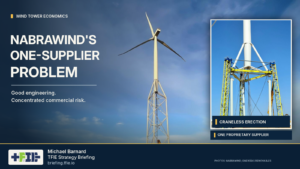
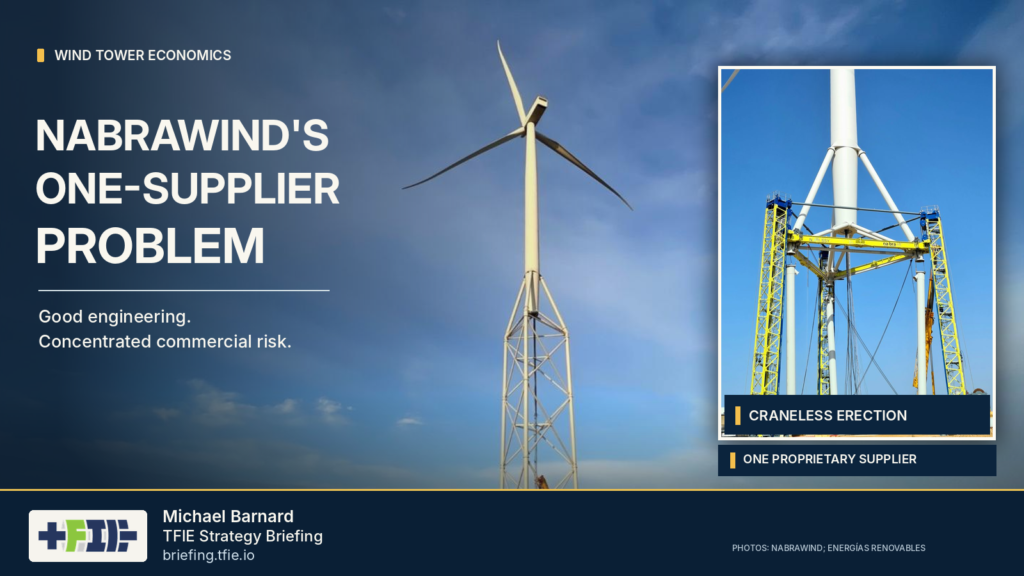
Spain’s Nabrawind has developed a way to install exceptionally tall wind turbine towers without needing to bring a huge crawler crane to the site. Their Nabralift system uses a tubular top tower supported by a three-legged steel frame. Hydraulic equipment lifts the assembled turbine while modular sections are inserted beneath it near ground level. The lifting frame can then be removed and used in another installation. This solves real logistics and construction problems, especially in remote sites where transportation by specialized cranes is expensive and where wind can disrupt conventional lifting operations.
The company has moved beyond demonstration-scale hardware. In September 2026, UL Solutions issued type certification for Envision’s 7.8 MW turbine on Nabrawind’s 188-meter tower. Fortescue is using 17 such tower configurations at the 133 MW Nullagine wind project in the Pilbara region of Western Australia, where construction is underway. Nabrawind had already built a 160-metre prototype in Spain in less than two weeks and has supplied smaller commercial towers in Morocco and France.
The engineering benefits are credible. Nabrawind reports using approximately 20% less tower steel than comparable conventional tubular designs and reduces foundation concrete by up to 80%, depending on design and site. These are supplier claims and not independently established savings across all wind farms. The ability to avoid large cranes, simplify transportation, and elevate turbines in windier conditions could also have a substantial bearing on overall installation cost and construction schedules. High center heights are only maintained when those costs are justified by the electricity generated over the life of the project.
The current deployment has an unusual business structure. Fortescue acquired Nabrawind in September 2025 and is building Nullagine to serve its own mining operations. Fortescue has the capital, domestic electricity demand and industrial incentive to support a proprietary technology. A successful installation in that context would be an important test of construction performance, but would not establish that an unrelated wind developer could finance and maintain the same system under ordinary commercial arrangements with third parties.
Nabralift’s proprietary construction approach creates a procurement problem. Conventional tubular towers can be obtained from several qualified manufacturers, and experienced contractors can compete for much of their construction work. A developer selecting Nabralift is currently dependent on one supplier for the central tower system, lifting expertise and associated support. Wind turbine OEMs also create supplier dependencies, but focusing another critical part of the project on a proprietary installation system requires its own contract and risk assessment.
A type certificate provides valuable technical assurance on the certified turbine and tower configuration. A lender or insurer still needs enforceable delivery schedules, long-term guarantees, repair and maintenance provisions, clarity on replacement parts, and a viable remedy if the supplier’s capacity or business priorities change. These questions become more important when a wind farm must operate for 25 years or more and there is no qualified alternative supplier for the same system.
Nabrawind’s next major test is a large, independently developed and financed wind farm that accepts those risks on commercial terms. Qualified installation partners, credible long-term service agreements and greater competitive capability could make their engineering advantages easier for developers to acquire. The 188 meter tower has deserved technical attention; its broader market depends on confidence in financing and procurement catching up with the machinery.
My full TFIE Strategy Briefing assessment looks at Nabrawind’s self-erecting design, Fortescue’s Nullagine rollout and the concentration of suppliers that independent wind developers would have to manage. It follows my previous assessment of 300 meter wind towers, where the economics of construction were the central challenge.
Sign up for CleanTechnica’s Weekly Substack to get in-depth analysis and high-level recaps from Zach and Scott, subscribe to our daily newsletter, and follow us on Google News.
Do you have any tips for CleanTechnica? Do you want to advertise? Want to suggest a guest for our CleanTech Talk podcast? Contact us here.
Subscribe to our daily newsletter to receive 10-15 new cleantech stories per day. Or sign up to receive our weekly newsletter on the week’s top stories if the daily grind is too much.
CleanTechnica uses affiliate links. See our policy here.
CleanTechnica Comment Policy