Cosmic signals
Photo credit: ©Johan Jarnestad/Royal Swedish Academy of Sciences
Photo credit: ©Johan Jarnestad/Royal Swedish Academy of Sciences
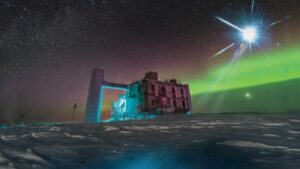
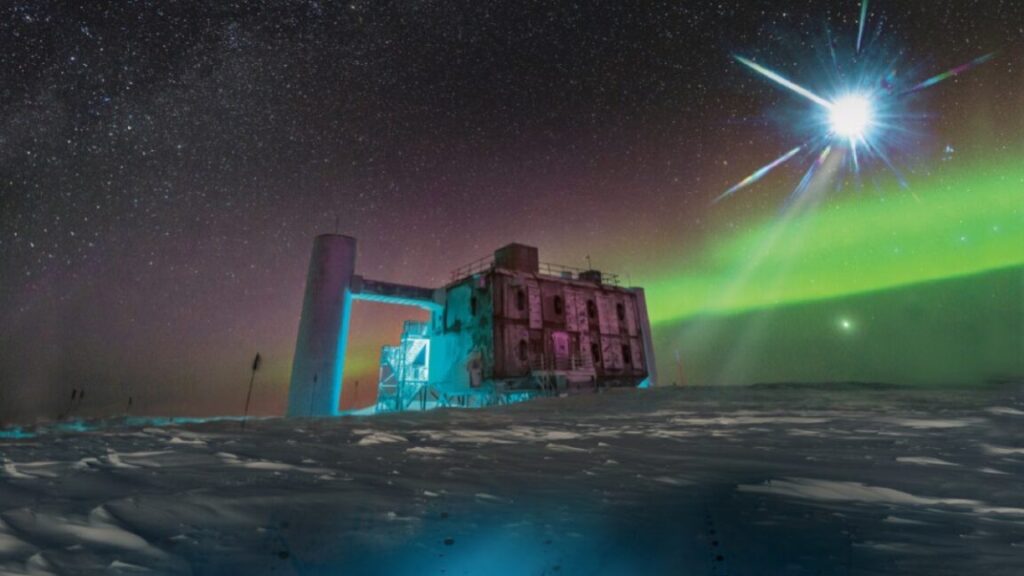
In 2014, IceCube discovered three neutrinos with unprecedentedly high energies, nicknamed Bert, Ernie and Big Bird. In 2017, physicists traced a high-energy neutrino to a specific source – a distant galaxy called TXS 0506+056, often referred to as the “Texas event.” That same year, IceCube scientists tested a prediction of the Standard Model: that neutrinos are more likely to interact with matter at higher energies. As predicted, the number of neutrinos passing through Earth decreased compared to those arriving tangentially, and their frequency continued to decrease as an energy product.
And in 2022, IceCube scientists retraced the paths taken by high-energy cosmic neutrinos on their way to Earth. After researching data for over a decade, they found evidence – in the form of a tantalizing excess of 79 neutrinos – that an active galaxy called Messier 77 (also known as the Squid Galaxy) is a strong candidate for a high-energy neutrino emitter. This result brought astrophysicists one step closer to solving the mystery of the origin of high-energy cosmic rays.
“Cosmic rays, wherever they originate, produce neutrinos, but at the time we had no idea where or how,” Halzen said. “Now when we see neutrinos, we are seeing the first cosmic accelerators for the first time, and that is really exciting.”
IceCube isn’t done making new discoveries yet. “We have these neutrinos with enormous energies, but all the physics we’re doing seems to be consistent with the Standard Model neutrino physics that we know and love, and we want to break through that,” Halzen said.
The project just completed a major upgrade in February, adding five more rows of light sensors to the bottom center of the existing arrays, along with an additional 600 new light sensors and calibration instruments. Last month, the National Science Foundation committed $53 million over the next five years to keep it operating.
On Halzen’s future research plans: “I’m working on a proposal and hope this award helps get it approved,” he joked during the press conference.