“We don’t know where the additional material comes from, but there are some hypotheses,” Santos-Sanz said.
The ghost moon
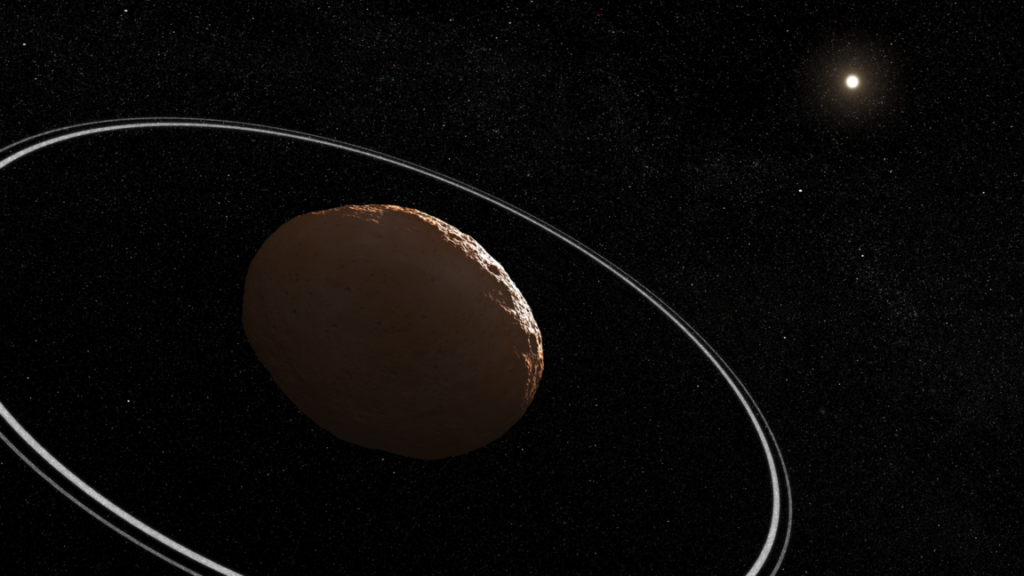
The main explanation, explains Santos-Sanz, is a small Shepherd satellite sharing the orbit of the outer ring. Such an object should explain the stability of the rings and their sharp edges, and could also shed debris that replenishes C1R. “This satellite, if it exists, has not been discovered yet,” Santos-Sanz said.
A computer model based on JWST data also provides clues as to what the two rings are made of. However, Santos-Sanz makes it clear that this part of the work is unfinished. “Our feeling from this model is that the inner ring should be made up of larger particles than the outer ring. The outer ring, in our opinion, is dustier,” he said. “But that’s still a work in progress. I can’t say for sure, well, that’s dusty, that’s not it.”
The best test, the team argues, would be to observe another Chariklo occultation, this time with visible light, which would distinguish true changes from a wavelength effect. “We are looking for new coverage,” Santos-Sanz said. He explains that it’s important to understand how rings around small bodies develop over time, since Chariklo isn’t the only one who has them.
Rings are now known around another body from the same category as Chariklo, called Chiron, the dwarf planet Haumea and the trans-Neptunian object Quaoar. Rings of giant planets are already known to shift over months and years; Saturn’s D ring has measurably shrunk and Neptune’s Adams arcs are rearranging. Now small bodies seem to be doing it too.
“I think this work is just one piece of the puzzle,” Santos-Sanz said, “but it could be an important clue for more comprehensive studies of the rings around smaller bodies and around giant planets.”
Santos-Sanz’s study is published in Science Advances: